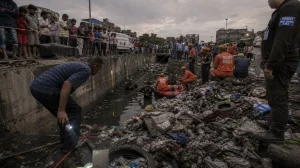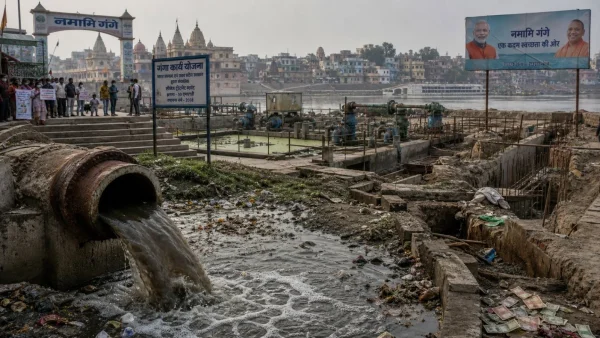
The sight of sewage flowing directly into the Ganga has once again raised uncomfortable questions about the effectiveness of India’s flagship river-cleaning programme, Namami Gange.
For years, successive governments have allocated thousands of crores of rupees toward sewage-treatment plants, sewer networks, riverfront development, industrial pollution control and other projects intended to restore the health of the Ganga.
Yet in several stretches of the river and its tributaries, untreated or inadequately treated sewage continues to enter the river system.
The issue therefore goes beyond the amount of money sanctioned.
The fundamental question is:
If substantial public money has been spent on cleaning the Ganga, why is untreated sewage still reaching the river?
Namami Gange: A Massive Public Investment
The Namami Gange Programme, launched in 2014, was designed to tackle the major sources of pollution affecting the Ganga.
Its objectives include:
Construction and rehabilitation of sewage-treatment plants;
Expansion of sewerage networks;
Interception and diversion of drains;
Treatment of industrial effluents;
River-surface cleaning;
Biodiversity conservation;
Maintaining ecological flow;
Improving monitoring and enforcement.
The programme has involved projects worth tens of thousands of crores of rupees across the Ganga basin.
Government agencies have repeatedly reported progress in creating sewage-treatment capacity and completing infrastructure projects.
But infrastructure on paper is not the same thing as a clean river.
The Sewage Problem Has Not Disappeared
The Ganga receives wastewater from numerous cities and towns along its course.
Urbanisation has increased the volume of sewage generated, while sewerage infrastructure has not always expanded at the same pace.
There are several possible reasons why untreated wastewater can continue reaching a river even after sewage-treatment projects have been completed.
1. Inadequate sewer connections
A treatment plant cannot treat sewage that never reaches it.
Homes, commercial establishments and entire neighbourhoods can remain outside the sewer network, allowing wastewater to flow through open drains directly toward rivers and tributaries.
2. Drains bypassing treatment facilities
A city may have a sewage-treatment plant while individual drains continue discharging into a water body.
Intercepting these drains and diverting their flow to treatment facilities is therefore just as important as constructing the treatment plant itself.
3. Treatment plants operating below capacity
Another problem is utilisation.
A treatment plant may have substantial installed capacity but receive less sewage than expected because of incomplete sewer networks, faulty pumping infrastructure or operational problems.
A facility that exists but does not operate properly cannot deliver the promised environmental benefit.
4. Poor operation and maintenance
Sewage-treatment infrastructure requires continuous electricity, staffing, maintenance and monitoring.
Treatment is not a one-time construction project.
Pumps fail.
Equipment requires maintenance.
Pipelines become blocked.
Plants can operate below design standards.
The river ultimately reflects the performance of the entire system—not merely the number of projects inaugurated.
The Real Question: Where Did the Money Go?
Asking where public money went does not automatically mean that corruption occurred.
That distinction matters.
Funds can legitimately be spent on land acquisition, sewer networks, treatment plants, pumping stations, electricity infrastructure, rehabilitation, operation and maintenance, monitoring and other components.
But taxpayers are entitled to demand outcome-based accountability.
For every major project, the public should be able to determine:
How much was sanctioned?
How much was actually spent?
What was constructed?
When did it become operational?
How much sewage was supposed to be treated?
How much is actually being treated today?
Who operates the facility?
Is the treated discharge meeting prescribed standards?
And most importantly:
Is untreated sewage still entering the river?
Spending Is Not the Same as Cleaning
This is perhaps the central issue.
A government can announce hundreds of projects and spend thousands of crores.
But the success of a river-cleaning programme cannot ultimately be measured by:
Number of projects sanctioned;
Number of treatment plants inaugurated;
Amount of money allocated; or
Number of kilometres of sewerage constructed.
The final measure has to be the condition of the river and the quantity and quality of wastewater entering it.
If untreated sewage continues flowing into the Ganga, then something in the chain is failing.
The failure could be infrastructure, implementation, operation, maintenance, monitoring or enforcement.
But simply pointing to the amount spent does not answer the environmental question.
Who Is Responsible?
Responsibility for sewage management is distributed among multiple institutions.
State governments, urban local bodies, pollution-control authorities and central agencies can all have roles depending on the project and location.
That makes accountability particularly important.
When sewage enters a river, responsibility should not disappear into a maze of departments.
A transparent system should identify:
Which drain is responsible?
Which agency controls it?
Which treatment plant is supposed to receive the wastewater?
Why did the sewage bypass treatment?
Who was responsible for preventing the discharge?
Without clear answers, responsibility can simply move from one department to another.
The Ganga Cannot Be Cleaned Through Announcements Alone
The Ganga is not a single pollution point.
It is a massive river system passing through densely populated regions and receiving wastewater from hundreds of urban and industrial sources.
That makes cleaning it extraordinarily difficult.
But difficulty cannot become an excuse for indefinite failure.
Every untreated drain represents a measurable pollution source.
Every non-functional treatment plant represents infrastructure that is not delivering its intended public benefit.
Every sewer connection left incomplete represents sewage that may continue finding its way into the environment.
What Should Be Publicly Disclosed?
A genuinely transparent Namami Gange monitoring system should allow citizens to track every major sewage project from sanction to actual performance.
For each treatment plant, authorities should publish:
InformationWhat citizens should knowProject costSanctioned and actual expenditureCapacityDesigned treatment capacityActual inflowSewage actually receivedUtilisationPercentage of capacity being usedTreatment qualityRegular laboratory resultsBypass incidentsFrequency and durationOperating agencyWho is responsibleMaintenanceCurrent operational statusConnected populationNumber actually connected to sewerageOutfallWhere treated water is dischargedSuch information would make it considerably easier to determine whether public spending is producing actual environmental results.
The Bottom Line
The question is not whether the government has spent money on the Ganga.
It clearly has.
The more important question is whether that spending has stopped the pollution at its source.
If untreated sewage is still flowing into the river, then citizens have every right to ask why.
A clean Ganga cannot be established through budget announcements, inaugurations or publicity campaigns.
It requires functioning sewage networks, operational treatment plants, effective monitoring and accountability when systems fail.
The ultimate audit of Namami Gange should not be the amount of money spent.
It should be the amount of untreated sewage that no longer reaches the river. And if raw sewage is still entering the Ganga after years of investment, the public deserves a transparent explanation of exactly where the system is failing—and who is responsible for fixing it.