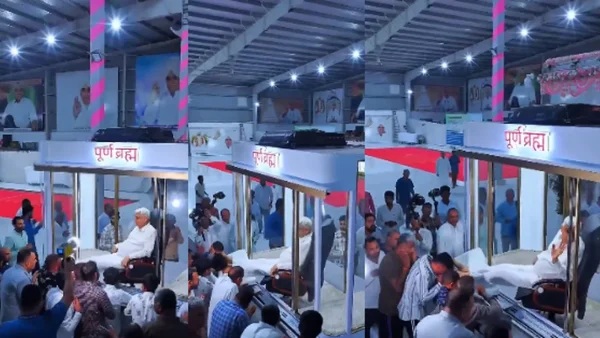
A video circulating on social media showing self-styled spiritual leader Sant Rampal Maharaj travelling in an air-conditioned vehicle has sparked widespread discussion over the increasingly elaborate arrangements surrounding his public appearances.
According to the video, devotees gather around the moving vehicle and seek blessings from Rampal as he travels past them. A collection or donation arrangement is also visible on or around the vehicle, prompting social-media users to describe it as a “moving donation box.”
The striking visual has led to a wave of commentary online, with people contrasting the current arrangement with earlier appearances in which Rampal would reportedly move through the ashram on foot while meeting devotees.
“Now Baba doesn’t even have to walk”
The video has been widely shared with sarcastic commentary suggesting that the religious leader has effectively found a way to distribute blessings without leaving the comfort of an air-conditioned vehicle.
Devotees can be seen approaching the vehicle, touching his feet or seeking his blessings as it moves through the premises.
Whether viewed as a matter of religious practice, personal comfort or organisational arrangement, the spectacle has prompted a broader debate about the growing scale and institutionalisation of religious organisations built around individual spiritual leaders.
The Hisar ashram and the 2014 violence
The discussion also brings renewed attention to the history of Rampal’s Satlok Ashram in Barwala, Hisar.
In November 2014, a major confrontation took place at the ashram after authorities attempted to arrest Rampal. The prolonged standoff involved thousands of his followers and a large police deployment.
The confrontation ended with deaths and injuries.
Six women and an infant were found dead inside the ashram during the standoff, while another woman later died in hospital, according to reports from the time. The incident became one of the most serious law-and-order episodes associated with the ashram.
Rampal was subsequently arrested and faced multiple criminal cases arising from the events.
Life sentence and subsequent legal proceedings
In 2018, a Hisar court sentenced Rampal to life imprisonment in connection with two murder cases relating to deaths during the 2014 violence. Several of his followers were also convicted in the cases.
However, the legal proceedings did not end there.
Rampal and others challenged their convictions before the Punjab and Haryana High Court. The High Court subsequently suspended the sentences in the murder cases subject to conditions, allowing the convicted persons relief while the appeals remain pending.
Therefore, describing the legal position simply as “Rampal was sentenced to life imprisonment and is out on bail” leaves out an important part of the judicial process.
His conviction and the subsequent suspension of his sentence are matters arising from ongoing appellate proceedings.
A religious organisation with a large following
Despite the criminal cases and years of controversy, Rampal continues to have a substantial following.
His organisation conducts religious programmes and attracts large numbers of devotees.
The contrast between the scale of the organisation and the controversies surrounding its leader has repeatedly attracted public attention.
The latest video adds another dimension to that discussion.
For supporters, elaborate arrangements surrounding a spiritual leader may simply be part of the functioning of a large religious organisation.
For critics, the image of a spiritual leader travelling in an air-conditioned vehicle surrounded by devotees—and accompanied by a collection mechanism—raises questions about religious commercialisation, hierarchy and the relationship between spiritual authority and money.
Where does faith end and spectacle begin?
India has a long tradition of spiritual leaders attracting large followings.
As religious organisations grow, however, the line between religious practice, institutional management and public spectacle can become increasingly difficult to define.
The key questions raised by the viral footage are therefore not merely about one vehicle.
They include:
Who funds such arrangements?
How are donations collected and accounted for?
How much institutional wealth is accumulated by large religious organisations?
And how should organisations with millions of followers maintain transparency and accountability?
These questions apply far beyond Rampal or his organisation.
The larger debate
The video itself does not establish wrongdoing.
Nor does an air-conditioned vehicle, by itself, establish financial misconduct.
But it has nevertheless become a powerful visual symbol in an ongoing debate about India’s increasingly elaborate religious institutions.
At a time when millions of ordinary Indians struggle with rising living costs, images of powerful spiritual figures travelling in luxury can naturally provoke strong reactions.
For devotees, the arrangement may simply represent convenience and security.
For critics, it raises an uncomfortable question about whether simplicity and spirituality are becoming increasingly separated as religious organisations grow into large institutions.
A viral image with a complicated backstory
What appears at first to be a simple viral video therefore carries a much longer history.
Behind the image of an air-conditioned vehicle moving through a crowd of devotees lies an organisation that has faced years of controversy, including the deadly 2014 confrontation at its Hisar ashram and subsequent criminal proceedings against its leader.
The courts will ultimately determine the outcome of the pending legal appeals.
But the public debate over the organisation’s growing scale, its financial transparency and the changing public image of its leader is likely to continue.
From walking among devotees to receiving them from an air-conditioned vehicle, the latest spectacle has certainly changed the way Rampal’s public appearances are being viewed.
And for many observers, the bigger question remains:When faith becomes a large institution, who watches the institution?