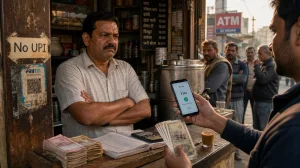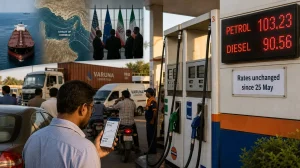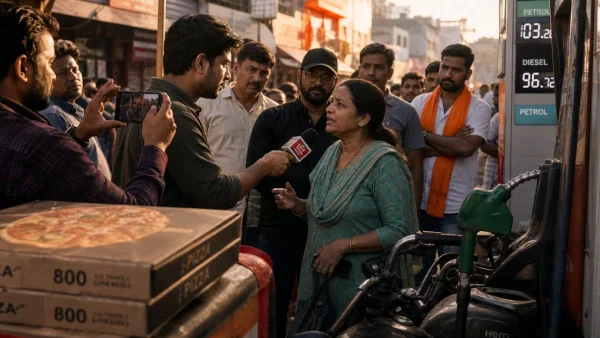
A street interview circulating on social media has triggered a heated debate about how ordinary Indians perceive inflation, petrol prices and the rising cost of everyday essentials.
In the video, a journalist asks a woman whether she is concerned about rising prices of petrol and milk. Her response has gone viral.
When asked about expensive petrol, she reportedly compares the price with an ₹800 pizza, questioning why consumers can pay hundreds of rupees for food but complain about fuel becoming more expensive.
When the journalist presses her about inflation, she reportedly argues that China is also facing economic difficulties and that people should follow Prime Minister Narendra Modi’s position.
The video has divided social media users.
Some see the woman’s comments as an example of political loyalty overriding economic concerns.
Others argue that a single street interview should not be used to judge millions of voters.
And that distinction matters.
Pizza Is Optional. Petrol Isn’t.
The most striking part of the exchange is the comparison between pizza and petrol.
The argument essentially goes:
“If you can spend ₹800 on pizza, why complain about expensive petrol?”
It sounds clever.
But economics doesn’t quite work that way.
Pizza is generally a discretionary purchase. A person can decide not to buy it.
Petrol, for millions of people, is connected to:
Going to work
Running businesses
Transporting goods
Travelling to hospitals
Taking children to school
Operating agricultural machinery
Delivering products
And even people who don’t personally buy petrol feel its effects.
Fuel prices can influence transportation costs, which can feed into the prices of other goods and services. So the comparison between an ₹800 pizza and petrol misses a basic distinction:
You can skip the pizza. You cannot necessarily skip the cost of transportation.
And Then Came China
The second response has generated even more discussion.
The woman reportedly argues that inflation shouldn’t be a major concern because China is also facing economic difficulties and people should follow Modi’s guidance.
This raises an interesting question:
Should another country’s economic problems determine how much an Indian family worries about its household budget? China’s economy can certainly affect India through global trade, commodities, manufacturing and geopolitics.
But when the price of milk rises in an Indian household, the immediate question for that family is much simpler:
“How much more are we paying?”
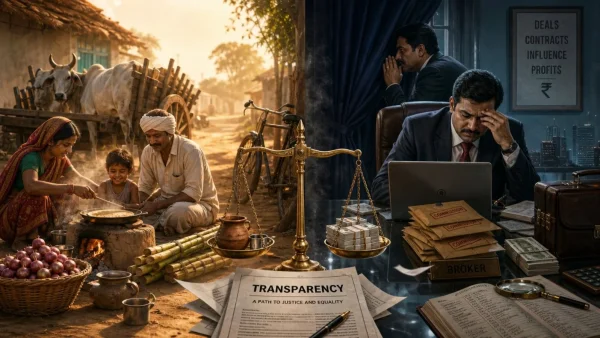
Political Loyalty vs Economic Reality
The video has become a larger debate about a phenomenon sometimes described online as political tribalism—where people defend their preferred political party even when discussing issues that directly affect their own finances.
But there is an important warning here.
Calling every Modi supporter an “andhbhakt” is no more useful than dismissing every government critic as “anti-national.”
People can support a government and still criticise its economic policies.
They can dislike an opposition party and still complain about inflation.
Democracy works precisely because citizens are allowed to separate political preference from policy evaluation.
The Viral Video May Be Entertaining—But It Doesn’t Prove a Political Trend
One claim circulating alongside videos like this is that such interviews prove that a particular political party is losing votes.
There is no reliable evidence that one viral street interview—or viral videos generally—can establish that BJP is losing votes.
Election outcomes are determined by millions of voters and numerous factors, including:
Employment
Inflation
Welfare schemes
Caste dynamics
Local candidates
National security
Infrastructure
Leadership
Regional issues
Opposition strategy
A viral video may influence online conversation.
It does not automatically predict an election.
Instagram isn’t an exit poll.
The Real Problem: When Every Question Becomes Political
Perhaps the most troubling part of the debate is not the woman’s political preference.
It is the possibility that ordinary economic questions are increasingly being interpreted through a political lens.
Ask:
“Is petrol expensive?”
Response:
“But Modi…”
Ask:
“Is milk expensive?”
Response:
“China is also suffering.”
Ask:
“Are household expenses rising?”
Response:
“What about the previous government?”
At some point, the conversation stops being about economics.
It becomes football.
My team versus your team.
The Sarcasm Writes Itself
Journalist: “Petrol is expensive. Isn’t that a problem?”
Citizen: “Have you seen the price of pizza?”
Economist: “But—”
Citizen: “China.”
Economist: “But your household—”
Citizen: “Modi Ji.”
Economy:
“Can we please have a serious conversation?”
A Better Question for Voters
Instead of asking people whether they support Modi, Rahul Gandhi, BJP, Congress or any other political party, journalists could ask something much more useful:
“Has your household budget become easier or harder over the past five years?” Then ask:
Has your income increased?
Have food expenses increased?
Has transportation become more expensive?
Are you saving more or less?
Has your family’s purchasing power improved?
Are you satisfied with government services?
Those answers would tell us far more about people’s economic experiences than a five-second slogan.
Should Supporters Criticise Their Own Government? Absolutely.
A strong democracy doesn’t require citizens to hate the government.
It requires citizens to question it.
A BJP supporter can say:
“I support Modi, but petrol prices are hurting me.”
A Congress supporter can say:
“I support Congress, but this policy is wrong.”
A fence-sitter can say:
“Show me the numbers before I decide.”
That isn’t disloyalty.
That’s citizenship.
Don’t Blame the Voter—Challenge the Argument
It is easy to mock the woman in the video.
But mocking an individual citizen doesn’t solve the underlying problem.
The better response is to challenge the argument with facts.
If petrol prices are high, discuss the components of the retail price.
If milk prices are rising, examine procurement costs, feed prices, logistics and supply.
If inflation is falling or rising, look at official inflation data.
If China is experiencing economic difficulties, examine what those difficulties actually mean for India.
Facts are much harder to defeat than insults.
Final Take: Loyalty Is Fine. Blindness Isn’t.
The viral interview has sparked an important conversation—not because one woman’s comments represent an entire political party’s supporters, but because it demonstrates how easily economic questions can become political arguments.
Supporting a leader is a democratic right.
Defending every government decision regardless of its consequences is a different matter.
And complaining about inflation is not anti-national.
A citizen can love the country, support the Prime Minister and still say:
“Petrol is expensive.”
“Milk is expensive.”
“My household budget is under pressure.”
That isn’t political betrayal.
That’s simply looking at the bill.