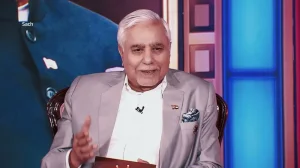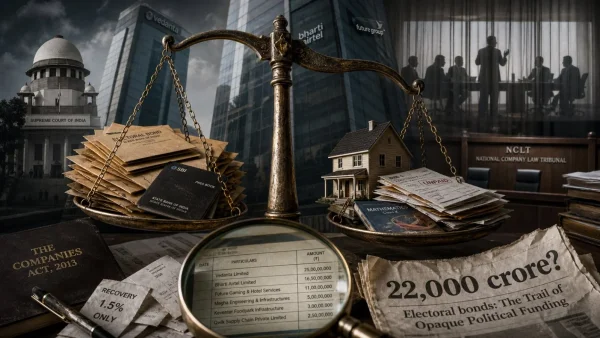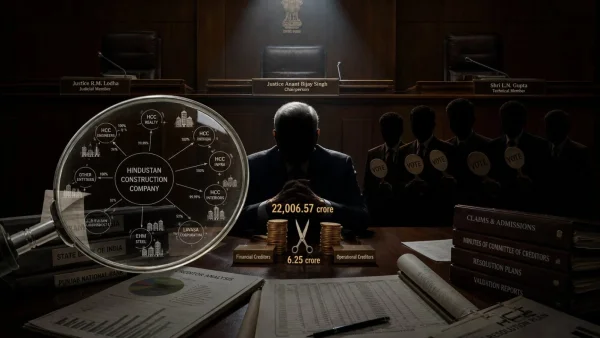
The insolvency case involving Subhash Chandra, founder of the Essel Group and chairman emeritus of Zee Entertainment, is attracting renewed scrutiny after the National Company Law Tribunal (NCLT) approved a repayment plan offering approximately ₹6.25 crore to creditors against admitted claims of about ₹22,006.57 crore.
The headline numbers have already generated debate over what has been described as a 99.97% haircut.
But the more complicated questions lie beneath that calculation.
Dissenting creditors have challenged the plan on several grounds, including the dramatic decline in Chandra’s reported net worth, the eligibility of five creditors to vote, and the absence of an independent forensic investigation into his assets. The original NCLT bench was divided on several issues, requiring a third member to resolve the differences.
The “Only a Guarantor” Argument
One defence circulating around the case is that Chandra was merely a personal guarantor, rather than the principal borrower.
Legally, that distinction matters—but it does not mean a personal guarantee is merely a ceremonial undertaking.
Under Section 128 of the Indian Contract Act, unless the contract provides otherwise, a surety’s liability is co-extensive with that of the principal debtor.
That is precisely why creditors could make claims against Chandra in his personal-guarantor insolvency proceedings.
The government has nevertheless stressed that the ₹22,006.57 crore figure should not be interpreted as ₹22,000 crore of loans personally borrowed by Chandra. The claims arose from guarantees associated with borrowings by several Essel/Zee-linked companies, and creditors retain recovery avenues against principal borrowers, securities and other available assets. Government sources have also said the approved arrangement envisages approximately ₹1,494 crore from principal borrowers, in addition to the ₹6.25 crore attributable to Chandra’s personal plan.
So the central issue is more precise:
How much could creditors legitimately recover from Chandra’s personal estate as guarantor—and was that estate properly identified and investigated?
The ₹40,000-Crore Question
This is where the case becomes particularly contentious.
Creditors pointed to historical net-worth certificates that reportedly put Chandra’s net worth at approximately:
₹45,888 crore in 2017
₹40,562 crore in 2018
Against that, his currently disclosed net worth has been reported at approximately ₹31.79 crore.
That represents an extraordinary difference.
The figures, however, require an important qualification.
Chandra has disputed the interpretation of the historical numbers, arguing that the very high figures did not represent his personal wealth in the ordinary sense and that some valuations reflected the market value of group-company holdings. Reports also note that he has described the high net-worth figures as misleading.
Nevertheless, the discrepancy was serious enough for dissenting creditors to argue that it required deeper investigation.
Their basic question was straightforward:
If historical financial documents showed wealth of tens of thousands of crores, how did the currently disclosed personal estate fall to roughly ₹31.79 crore?
Creditors Wanted Asset Tracing
The lenders opposing the repayment plan argued that the dramatic decline warranted an independent forensic audit and asset-tracing exercise.
The objective would not simply be to establish that Chandra is currently wealthy or poor.
It would be to determine what happened to assets previously attributed to him.
Such an investigation could potentially examine:
Property transactions
Share transfers
Transfers to related entities
Transactions involving relatives
Trusts and LLPs
Loans and advances
Disposals of valuable assets
Consideration received for asset sales
Whether transactions occurred at fair market value
Whether any assets were transferred before or during financial distress
The NCLT ultimately did not make a forensic investigation a mandatory precondition for approving the repayment plan.
That decision is now one of the major points of contention.
The 61.78% Voting Block
Perhaps the most politically and financially sensitive issue concerns five creditors whose voting rights were challenged by dissenting lenders.
The five entities were:
World Crest Advisors LLP
Lemonade Capital Advisors LLP
Corpcall Capital Advisors LLP
Veena Investments Pvt Ltd
Direct Media Distribution Ventures Pvt Ltd
Together, these entities represented approximately 61.78% of the voting share, according to the objections raised by dissenting creditors.
Opposing lenders argued that the entities had links to Chandra’s wider family and business ecosystem and therefore should not have been allowed to vote in favour of the repayment plan.
The allegations included relationships involving family members, directorships, shareholding and connections with companies associated with the Essel ecosystem.
But there is an important legal caveat.
The tribunal did not simply accept the allegation that these entities were related parties.
The Third Member took a narrower interpretation of the statutory test for determining whether an entity qualified as an “associate” of the debtor and concluded that the legal requirements for excluding their votes had not been sufficiently established.
Therefore, the correct description is that their voting eligibility was disputed by creditors and ultimately upheld under the tribunal’s interpretation of the applicable law—not that the tribunal found them to be secretly controlled by Chandra.
Why the Mathematics Matters
The voting figures nevertheless explain why the dispute is so important.
The repayment plan received approximately 80.81% support from creditors by voting share.
But dissenting lenders argued that the five disputed entities accounted for approximately 61.78% of that voting power.
If their votes were excluded, the balance of support would have been dramatically lower.
That does not prove that the plan was improperly approved.
But it does explain why the identity and independence of those five creditors became such a central issue.
In insolvency proceedings, voting power is not merely symbolic.
It can determine whether a repayment proposal crosses the statutory threshold required for approval.
The Economic Conflict-of-Interest Question
This leads to the deeper question raised by the dissenting lenders:
Were all creditors voting solely according to their independent economic interests, or did relationships within the wider business ecosystem affect the voting outcome? That question requires evidence.
If the five entities were genuinely independent creditors with independent economic interests, their votes are part of the legitimate commercial decision-making process.
If, on the other hand, they were economically controlled or substantially influenced by interests aligned with the debtor, then the voting structure would raise a fundamentally different question.
The tribunal’s statutory analysis ultimately allowed the votes to stand.
But the dispute demonstrates why beneficial ownership, economic control and related-party relationships can become critical in large insolvency proceedings.
The ₹185-Crore Claims Issue
Another issue emerged during the proceedings involving claims reportedly exceeding ₹185 crore on behalf of around 1,260 people.
Those claims were admitted without adequate supporting documentation and were subsequently excluded following further scrutiny, according to reports on the tribunal proceedings.
The episode adds another layer to the case.
It shows how important verification of creditor claims can be when the voting structure itself has major consequences.
If claims are improperly admitted, voting percentages can potentially be distorted.
If legitimate claims are excluded, creditors can lose their ability to participate fully.
That is why the integrity of the creditor list is fundamental to any insolvency process.
What the NCLT Ultimately Decided
The tribunal approved the repayment plan despite objections from several major financial creditors, including HDFC Bank, Axis Bank, Canara Bank, RBL Bank, LIC Housing Finance and Union Bank of India.
The tribunal held that once the statutory requirements were satisfied and the creditor-approved plan complied with the applicable framework, it could not simply substitute its own commercial judgment for that of the creditors.
The approved plan is therefore binding on creditors covered by it, including those who voted against it, subject to the applicable legal remedies.
Several lenders are reportedly preparing to challenge the decision before the National Company Law Appellate Tribunal (NCLAT).
That means the controversy may not end with the NCLT order.
Is This Really a ₹22,000-Crore “Write-Off”?
This is another area where headlines can become misleading.
The ₹22,006.57 crore figure represents admitted claims against Chandra in the personal-guarantor proceedings.
The ₹6.25 crore represents the amount going to creditors from his personal repayment plan, with another ₹25 lakh earmarked for the insolvency process.
That does not mean that ₹22,000 crore of underlying bank loans have suddenly disappeared.
Creditors may continue to pursue principal borrowers, collateral and other available recovery avenues.
Government sources have therefore argued that describing the case as a ₹22,000-crore bank write-off is incorrect.
But this clarification does not eliminate the controversy over Chandra’s personal guarantee.
The practical question remains:
How much could creditors have recovered from the guarantor if the assets and transactions underlying the dramatic fall in his reported wealth had been independently traced?
Where Did the Wealth Go?
This may ultimately become the most important unanswered question.
There is no established finding in the NCLT proceedings that Chandra illegally transferred or concealed assets.
That distinction is crucial.
A dramatic decline in net worth does not, by itself, prove asset diversion.
Assets can lose value.
Share prices can collapse.
Debt obligations can increase.
Businesses can fail.
Assets can legitimately be sold.
Money can be used to repay other creditors.
All of those possibilities must be examined before drawing conclusions.
But precisely because there are several possible explanations, the demand for forensic examination becomes understandable.
The question is not “prove that wealth was hidden.”
It is:
“Show the financial trail and establish what happened.”
A Test for the Insolvency System
The case therefore goes beyond one businessman.
It raises broader questions about India’s insolvency framework and its ability to deal with very large promoters and complex corporate networks.
An effective system must be capable of answering four basic questions:
What did the debtor own?
What did the debtor owe?
What happened to the assets?
Who had the right to decide the recovery plan?
If those questions are answered transparently, even a very large haircut can potentially be justified.
If they are not, public confidence in the process can suffer.
The Bottom Line
The Subhash Chandra case should not be reduced to the simplistic claim that “₹22,000 crore was forgiven for ₹6.5 crore.”
The legal and financial structure is more complicated.
The ₹22,006.57 crore figure concerns admitted claims against Chandra as a personal guarantor; principal borrowers and other recovery avenues remain relevant.
At the same time, the case contains genuinely difficult questions.
Historical net-worth certificates reportedly placed Chandra’s wealth at ₹45,888 crore in 2017 and ₹40,562 crore in 2018, while his currently disclosed net worth is around ₹31.79 crore.
Five disputed creditors reportedly controlled 61.78% of the voting share.
Dissenting lenders questioned their connections to the Chandra/Essel ecosystem.
The NCLT ultimately allowed their votes under its interpretation of the statutory test.
Creditors also sought deeper forensic examination of Chandra’s assets, but the tribunal did not make such an investigation a mandatory condition for approving the plan.
None of these facts, by themselves, establishes fraud.
But together they explain why the case deserves scrutiny beyond the headline “99.97% haircut.”
The most important questions are therefore not merely:
“Why did creditors recover only ₹6.25 crore?”
They are:
“What happened to the wealth previously attributed to the guarantor?” “Were all the creditors who voted truly independent?” “Did the voting structure accurately represent independent creditor interests?” And ultimately:
“Was the approved plan genuinely the best recovery available, after every relevant asset and relationship had been properly examined?” Those questions are now likely to move beyond the NCLT and into appellate proceedings.
Until they are conclusively answered, the Subhash Chandra insolvency case will remain one of the most closely watched tests of how India’s insolvency system handles large promoters, complex corporate relationships and billions of rupees in disputed financial claims.