A political claim about Uttar Pradesh has triggered a heated debate over government spending, welfare promises and the use of public money ahead of elections.
A viral post claims that the Yogi Adityanath government plans to provide ₹50,000 to every woman in Uttar Pradesh, and argues that such a move would place an enormous burden on the state exchequer.
However, there is an important factual caveat: I could not find an official Uttar Pradesh government announcement confirming a universal ₹50,000 cash transfer to every woman. The state’s current official welfare and budget documents show several women-focused programmes, but not the universal payment described in the viral claim. (Information Uttar Pradesh)
That distinction matters.
Still, the underlying debate is legitimate: if a government proposes a large cash-transfer programme, how should citizens judge whether it is financially sustainable and whether it delivers lasting empowerment?
First, Let’s Check the Mathematics
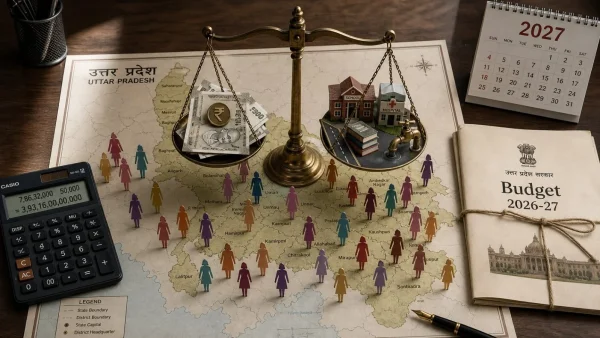
The viral claim cites 7,86,32,000 women and proposes ₹50,000 for each.
The calculation would be:
7,86,32,000 × ₹50,000 = ₹3,93,16,00,00,00,000
That equals approximately:
₹3.93 lakh crore —not ₹3,931.6 crore as sometimes stated in social-media posts.
That’s a crucial correction.
For perspective, Uttar Pradesh’s 2026–27 budget estimates total expenditure excluding debt repayment at about ₹8.51 lakh crore. (PRS Legislative Research)
So a hypothetical universal ₹50,000 payment to 7.86 crore women would represent roughly 46% of that year’s expenditure excluding debt repayment.
That would be an extraordinary fiscal commitment.
But Is the ₹50,000 Scheme Actually Real?
This is where viral political messaging needs to be separated from verified policy.
The Uttar Pradesh government’s 2026–27 budget documents do contain substantial allocations for women and child development—approximately ₹18,620 crore across related schemes. They also include specific programmes such as women’s pensions, working-women hostels, nutrition programmes and support for girls’ education. (Information Uttar Pradesh)
For example, the Mukhyamantri Kanya Sumangala Yojana provides financial assistance to eligible girl children in stages, with the current maximum benefit listed at ₹25,000—not ₹50,000 for every adult woman. Eligibility is also restricted by conditions including family income and number of children. (Saharanpur District)
The government has also approved the Rani Lakshmibai Scooty Scheme, under which around 50,000 meritorious women students are expected to benefit. (Hindustan Times)
So the broader claim that the government is spending on women is certainly supported by official documents.
The claim of ₹50,000 for every woman, however, requires an official notification before it can be treated as established fact.
The Question Behind the Viral Claim Is Still Important
Suppose a government actually proposed such a payment.
Would handing out ₹50,000 necessarily be a bad policy?
Not automatically.
Cash transfers can help families manage immediate expenses, improve consumption, support education and provide women with greater financial autonomy.
The real questions would be:
Who qualifies?
Is the payment one-time or recurring?
Where will the money come from?
What is the total fiscal cost?
Will it increase borrowing?
What happens to existing welfare programmes?
Is the programme targeted at vulnerable women or universal?
What measurable outcome is expected?
A welfare scheme shouldn’t be judged merely by the size of the cheque.
Could ₹3.93 Lakh Crore Transform Uttar Pradesh’s Schools?
This is the central argument being raised by critics.
They ask whether a massive hypothetical expenditure could instead be invested in government schools, classrooms, drinking water, toilets, teachers, books, laboratories, digital infrastructure and nutrition programmes.
That is a reasonable policy debate.
Uttar Pradesh’s own budget already allocates substantial resources to education and social sectors. The state’s 2026–27 budget also provides funding for nutrition, residential schools and women’s welfare programmes. (Information Uttar Pradesh)
The question is therefore not simply:
“Should women receive money?”
It should be:
“What combination of cash support and long-term public investment produces the greatest improvement in women’s lives?”
Cash Today or Opportunity Tomorrow?
There is an important philosophical difference between the two approaches.
A cash transfer provides immediate purchasing power.
A functioning school provides years of opportunity.
A clean water system provides continuous public health benefits.
A functioning hospital provides protection when families face medical emergencies.
A safe road creates economic opportunity every day.
A skill-training programme can potentially increase income for years.
None of these necessarily has the immediate political visibility of a ₹50,000 transfer.
And that’s where the political controversy begins.
Is This “Vote Buying”? Be Careful With That Label
Critics may describe pre-election welfare promises as “vote buying.”
But legally and politically, that conclusion cannot simply be assumed.
Governments routinely announce welfare schemes before elections. The fact that a programme benefits voters does not automatically make it an illegal inducement.
The more meaningful scrutiny concerns:
Timing
Was the scheme announced immediately before an election?
Targeting
Is it designed primarily around a particular voting constituency?
Funding
Can the state afford it?
Transparency
Was the financial burden clearly disclosed?
Long-term viability
Will the programme survive after the election?
These questions allow citizens to distinguish between legitimate welfare and fiscally irresponsible populism.
The Election Clock Matters
Uttar Pradesh is heading toward its next Assembly election cycle, making large welfare announcements particularly politically consequential.
The government has already been rolling out or expanding women-focused initiatives. The Rani Lakshmibai Scooty Scheme, for instance, is being implemented ahead of the expected 2027 Assembly election and is projected to benefit about 50,000 meritorious women students. (Hindustan Times)
That doesn’t prove electoral manipulation.
But it does make timing, funding and outcomes legitimate subjects of public scrutiny.
The Bigger Question: What Does “Women’s Empowerment” Mean?
Women’s empowerment cannot be reduced to a transfer of money.
It also means:
Education.
Employment.
Safety.
Healthcare.
Property rights.
Financial independence.
Access to credit.
Skill development.
Political participation.
Reliable public infrastructure.
A woman who receives ₹50,000 but has no safe transport to work, no nearby healthcare facility and no quality school for her children may still remain economically vulnerable.
Don’t Let the Arithmetic Become the Story
The viral ₹50,000 claim makes for a dramatic headline because the number is enormous.
But the more important question is whether the underlying policy actually exists in the form being circulated.
At present, the official material I found does not substantiate a universal ₹50,000 payment to every woman in Uttar Pradesh. What it does show is a substantial portfolio of women- and girl-focused schemes and a sizeable budgetary commitment to the sector. (Information Uttar Pradesh)
That distinction should remain at the heart of responsible reporting.
What the Government Should Publish If Such a Scheme Is Proposed
If the ₹50,000 proposal is formally announced, citizens should demand a complete financial statement.
The government should disclose:
Number of eligible beneficiaries
Total estimated expenditure
Source of funding
Whether the payment is one-time or recurring
Eligibility criteria
Administrative costs
Impact assessment
Effect on existing welfare programmes
Impact on state borrowing
Expected economic and social outcomes
There should be no ambiguity about who gets the money and who ultimately pays for it.
The Real Debate Is Not Women vs Development
This debate should not be framed as though spending money on women means spending less on development.
Women are development.
Investing in girls’ education is investing in development.
Providing women with financial security is development.
Building safe schools, hospitals, transport and sanitation for women is development.
The real choice is between short-term visibility and long-term outcomes, not between women and infrastructure.
Final Word
The viral claim that the Uttar Pradesh government will give ₹50,000 to every woman needs to be treated cautiously until an official government order confirms it.
But the calculation attached to the claim illustrates just how enormous such a universal transfer would be: ₹3.93 lakh crore, if the stated 7.8632 crore beneficiary figure were used.
That’s not pocket change.
That’s a policy decision with consequences for the state’s entire budget.
So instead of asking only:
“Will I get ₹50,000?” Citizens should ask the more important questions:
Where will the money come from?
Who qualifies?
What happens to schools and hospitals?
Is this a sustainable welfare programme?
What measurable improvement will it create?
And, above all:
Is the government investing in citizens for the next five years—or simply trying to impress them for the next five minutes?