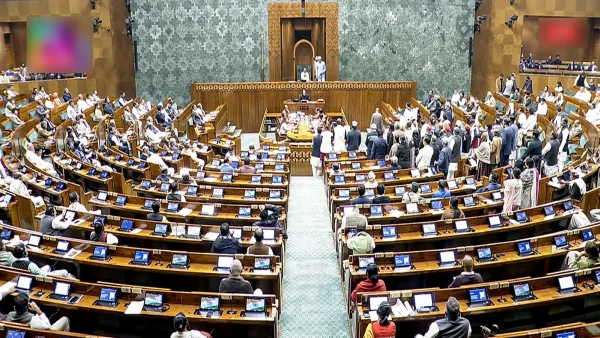
India’s Parliament is supposed to be where the country’s biggest questions are debated, governments are scrutinised and laws affecting more than a billion people are examined.
But the numbers from the 2026 Monsoon Session tell a rather uncomfortable story.
The Lok Sabha functioned for only 15 hours and 36 minutes, recording productivity of around 19%, according to data cited from PRS Legislative Research. The session was among the lowest-productivity Lok Sabha sessions in more than two decades; since 2004, only two other sessions have recorded lower levels of functioning.
That isn’t merely a parliamentary statistic.
It is a question about what taxpayers are getting from Parliament.
15 Hours and 36 Minutes: What Happened to the Rest of the Time?
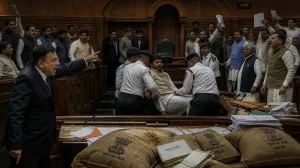
Parliamentary proceedings were repeatedly disrupted by protests, sloganeering and adjournments.
The result was a familiar cycle:
Protest → disruption → adjournment → negotiations → another protest → another adjournment.
Eventually, the House did conduct legislative business, but the overall productive time remained exceptionally low. Reports said several Bills were passed despite the limited functioning, while Question Hour was repeatedly disrupted.
And that last point is particularly important.
Because Question Hour isn’t parliamentary decoration.
It is one of the mechanisms through which MPs can ask ministers direct questions about government decisions, spending and administration.
When Question Hour disappears, one of Parliament’s most visible accountability mechanisms disappears with it.
The Strange Paradox: Bills Can Pass While Debate Suffers
Perhaps the most uncomfortable feature of the session is the contradiction.
Parliament can still pass legislation despite spending very little time functioning.
Reports indicate that 12 Bills were passed during the session, even as overall productivity remained extremely low.
That raises an obvious question:
Is passing a Bill the same thing as properly scrutinising a Bill? Not necessarily.
Good legislation isn’t simply about how many Bills make it through the parliamentary pipeline.
It is also about:
how thoroughly they are debated;
whether MPs can propose amendments;
whether experts’ concerns are considered;
whether unintended consequences are examined;
whether opposition objections receive answers;
whether committees have adequate time to scrutinise provisions.
Speed is not automatically efficiency. Sometimes the most important work Parliament does is the work that prevents a bad law from being passed in haste.
Who Is Responsible? Government or Opposition?
This is where political parties will inevitably point fingers.
The government can argue:
“The Opposition is deliberately disrupting Parliament.”
The Opposition can respond:
“We are disrupting proceedings because the government refuses to allow discussion on issues that matter to citizens.”
Both sides have a constitutional role.
But neither side can escape the final outcome.
The government has a responsibility to facilitate debate. The Opposition has a responsibility to participate constructively in debate. And the Speaker has the responsibility to maintain order while protecting the rights of both sides.
When Parliament repeatedly becomes dysfunctional, the public loses regardless of which side started the disruption.
The Taxpayer Is Paying for the Dysfunction
There is an unavoidable public-interest dimension to this.
Parliament isn’t a private meeting between politicians.
It is funded by taxpayers.
MPs, parliamentary staff, security personnel, infrastructure, technology and administrative systems all cost public money.
Citizens therefore have a reasonable expectation:
If Parliament is sitting, Parliament should work. That doesn’t mean MPs should never protest.
Protest is part of democracy.
But there is a difference between forcefully opposing a government and making the institution itself unable to function.
And Here’s the Irony
Imagine an office where employees arrive every day.
The meeting starts.
Someone shouts.
Another person raises a placard.
The meeting is suspended.
Everyone returns.
Another argument begins.
Meeting suspended again.
At the end of the month:
“We completed some files.”
The boss:
“Excellent productivity!”
😂
Except Parliament isn’t an ordinary office.
Its unfinished work affects the entire country.
Question Hour Should Be Sacred
Among all the consequences of disruption, the loss of Question Hour deserves particular attention.
A government can issue press releases.
It can hold conferences.
It can publish advertisements.
But in Parliament, ministers face direct questions from elected representatives.
Questions can concern:
unemployment.
inflation.
healthcare.
national security.
infrastructure.
welfare schemes.
administrative failures.
When Question Hour is repeatedly lost, citizens lose an important opportunity to hear ministers answer these questions on the parliamentary record.
PRS has previously highlighted that disruption of Question Hour reduces MPs’ opportunity to hold the government accountable. (PRS Legislative Research)
This Isn’t a New Problem
Parliamentary disruptions aren’t unique to 2026.
PRS data has repeatedly documented sessions affected by interruptions.
For example, the Monsoon Session of 2015 was described by PRS as one of the least productive sessions of the preceding 15 years, with repeated disruptions in both Houses. (PRS Legislative Research)
More broadly, parliamentary data shows that the number of sittings has declined over the decades. PRS has noted that Parliament now sits substantially fewer days than it did in the 1950s and 1960s. (PRS Legislative Research)
So the 2026 session isn’t an isolated accident.
It is part of a much larger problem with the functioning of India’s legislatures.
The Bigger Question: Has Disruption Become the Political Strategy?
There was a time when parliamentary disruption was an extraordinary weapon.
Increasingly, it can appear to have become part of the political playbook.
Opposition parties know that creating disruption guarantees television coverage.
Government parties know that blaming the Opposition for the disruption is politically useful.
And television cameras capture the confrontation.
Meanwhile, detailed committee discussions don’t necessarily generate the same headlines.
Drama gets attention. Parliamentary scrutiny gets buried. That creates a dangerous incentive structure.
But the Government Can’t Simply Say “Opposition Did It”
Even if the Opposition is responsible for major disruptions, the government still has a duty to ensure parliamentary business functions as effectively as possible.
That means:
negotiating with opposition parties;
allowing legitimate discussions;
scheduling debates strategically;
using parliamentary committees effectively;
ensuring adequate time for legislation;
avoiding unnecessary confrontation.
The government possesses considerable influence over the legislative agenda.
So blaming only one side doesn’t solve the institutional problem.
And the Opposition Can’t Hide Behind “We Were Protesting”
Either There is a legitimate democratic right to protest.
But MPs aren’t elected solely to protest.
They are also elected to:
debate,
question,
legislate,
scrutinise spending,
represent constituents,
and hold governments accountable.
A protest that prevents the very questioning MPs were elected to perform can become self-defeating.
What Should Change?
India needs more than another round of political blame.
1. Protect Question Hour
Repeated disruption of Question Hour should have institutional consequences.
2. Strengthen parliamentary committees
Major legislation should receive meaningful committee scrutiny.
3. Create predictable debate windows
Important national issues should receive guaranteed discussion time.
4. Improve cross-party negotiations
The government and Opposition should have structured mechanisms for resolving disputes before proceedings begin.
5. Publish disruption statistics
Citizens should be able to see exactly how much time was lost and why.
6. Hold MPs accountable
Persistent disruption should carry transparent consequences while protecting legitimate dissent.
The Most Important Question Isn’t “Who Won?”
Political parties may spend the next few days arguing about who caused the disruptions.
But that’s not the question citizens should be asking.
The question is:
What did Parliament actually accomplish with the time it was given? Because Parliament isn’t supposed to be a theatre where political parties demonstrate who can shout the loudest.
It is supposed to be the place where the country thinks out loud.
Final Word
A Parliament functioning for just 15 hours and 36 minutes, with productivity around 19%, should concern supporters and critics of every political party.
If the Opposition disrupted proceedings unnecessarily, it should be held accountable.
If the government avoided legitimate debate, it should be held accountable.
If the Speaker failed to maintain a workable balance, that too deserves scrutiny.
Because democracy isn’t measured only by how many laws are passed.
It is also measured by how seriously those laws are debated, how effectively governments are questioned and how much opportunity elected representatives have to speak for the people who sent them there.
And perhaps the most uncomfortable statistic from this Monsoon Session isn’t 19% productivity.
It’s this: 15 hours and 36 minutes. For a country of 1.4 billion people, that is an extraordinarily expensive amount of silence.