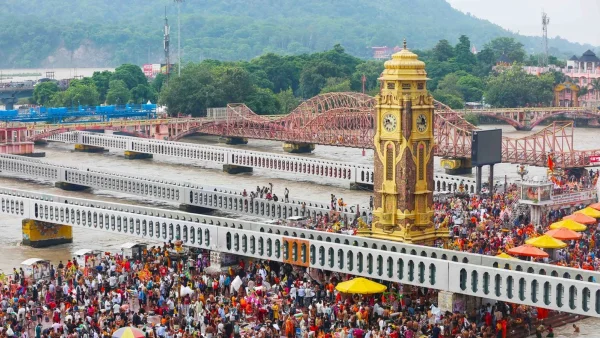
The 2026 Kanwar Yatra may have ended with the chanting of Har Har Mahadev, but in Haridwar, another story has only just begun: the massive cleanup.
The pilgrimage drew an estimated 4.8 crore Kanwariyas, according to police figures, setting a new record over the previous year’s estimated 4.5 crore. The yatra concluded on August 11.
Now sanitation workers are confronting the enormous physical aftermath of that footfall.
Reports from the Haridwar Municipal Corporation put the waste collected during the pilgrimage at around 8,000 metric tonnes, while other reports have cited approximately 7,000 tonnes. The difference appears to reflect different stages or estimates of the cleanup, so the precise final figure should be treated with caution.
Either way, the scale is staggering.
From Sacred Ghats to Mountains of Plastic
The waste reportedly includes:
Plastic bottles
Food packaging
Plastic sheets
Discarded clothes
Slippers
Food waste
Disposable items
Other pilgrimage-related material
Large quantities have accumulated around Ganga ghats, parking areas, markets and other high-footfall locations. Municipal teams are now working to restore the city’s public spaces after the departure of the pilgrims.
Haridwar Municipal Commissioner Nandan Kumar told ThePrint that the city had seen heavy waste accumulation around ghats, markets and parking areas and that cleaning had become the administration’s immediate priority.
The Most Disturbing Discovery: Urine-Filled Bottles
Among the more unusual findings reported by sanitation workers were bottles allegedly containing urine in changing rooms and public facilities around Har Ki Pauri.
The reports have generated considerable public reaction because they point beyond a simple shortage of dustbins.
They raise questions about basic public hygiene, toilet availability and individual responsibility during mass gatherings.
However, these reports should not be used to characterise millions of pilgrims collectively. A few disturbing instances cannot fairly be attributed to every devotee who participated in the yatra.
The Bigger Problem Isn’t Religion. It’s Scale.
There is an uncomfortable reality here.
When nearly five crore people converge on one pilgrimage destination, even a relatively small amount of waste generated per person becomes an enormous municipal burden.
If one person leaves behind only a small plastic bottle, wrapper or piece of disposable material, multiply that by millions.
Suddenly, the “small” problem becomes thousands of tonnes.
Mass pilgrimage requires mass waste management. And that means planning for the crowd before the crowd arrives—not simply sending sanitation workers in after everyone leaves.
But Should Pilgrims Get a Free Pass? Absolutely Not.
Waste management is partly the government’s responsibility.
But not littering is the citizen’s responsibility.
No municipal corporation can realistically place a sanitation worker behind every pilgrim.
People travelling to a sacred river should arguably have an even greater reason to avoid leaving plastic, food waste and clothing behind.
The contradiction is difficult to ignore:
A pilgrimage centred around the Ganga should not leave the Ganga surrounded by plastic. Faith and civic responsibility should not be treated as competing ideas.
And What About the Administration?
The government cannot simply say:
“People littered, therefore people are responsible.”
Authorities knew that millions of devotees were coming.
The 2026 turnout was anticipated to approach five crore, and large-scale arrangements were made for traffic, security and crowd management. (Times Now Navbharat)
The same level of preparation must apply to sanitation.
That means:
More toilets
Public facilities need to be sufficient for the scale of the gathering.
More bins
Bins must be placed where people actually congregate—not merely where they look good on an official map.
Frequent collection
A bin that overflows for six hours is effectively a pile of garbage with a lid.
Waste segregation
Plastic, organic waste and other materials should be separated at source wherever practical.
Plastic reduction
The less single-use plastic entering the pilgrimage zone, the less plastic has to be collected afterwards.
Real-time monitoring
Authorities can use CCTV, drones and sanitation teams to identify waste hotspots quickly.
The Strange Irony of “Clean India”
India has spent years promoting cleanliness and the Swachh Bharat message.
The government has also promoted models for managing large religious gatherings as cleaner, more sustainable events. A government publication highlighted the 2025 Kanwar Yatra among events presented as examples of zero-waste management, including measures such as plastic restrictions, waste segregation and drone monitoring.
So the obvious question for 2026 is:
What happened when the world’s largest sanitation challenge arrived at the gates of Haridwar? If thousands of tonnes of waste are ultimately collected, the next step should not simply be another cleanup drive.
The authorities should examine where the system failed and where behaviour failed.
The Sanitation Workers Are Doing the Work Nobody Wants to See
There is also a human story beneath the numbers.
While the pilgrims have gone home, sanitation workers remain behind.
They are dealing with:
rotting food;
discarded clothing;
plastic waste;
contaminated public spaces;
overflowing garbage;
foul-smelling waste;
heavily used toilets and changing areas.
The city’s cleanup operation is effectively the final leg of the pilgrimage—but without chants, crowds or cameras.
The people doing this work deserve proper protective equipment, sanitation facilities, safe working conditions and adequate staffing.
Can Haridwar Handle Five Crore People Without Producing Thousands of Tonnes of Waste?
That should be the question before the 2027 Kanwar Yatra.
Because the answer cannot simply be:
“We’ll clean it afterwards.”
That is not sustainable waste management.
The better model is:
Prevent → Reduce → Segregate → Collect → Process → Restore.
Cleanup should be the last step, not the entire strategy.
A Religious Gathering Should Leave Behind More Than Garbage
The Kanwar Yatra is an important religious pilgrimage for millions of devotees.
There is no contradiction between respecting the faith of those pilgrims and questioning the environmental consequences of a gathering of this scale.
In fact, the two concerns belong together.
If the Ganga is sacred, keeping its surroundings clean should be part of that reverence.
If the pilgrimage is about devotion, civic responsibility should travel alongside devotion.
And if Haridwar is expected to welcome five crore visitors, the city deserves a waste-management system designed for five crore visitors—not a cleanup operation that begins after they leave.
The Final Question
The 2026 Kanwar Yatra demonstrated the extraordinary scale of India’s religious gatherings.
But it also demonstrated the extraordinary scale of the civic challenge they create.
Nearly 4.8 crore devotees came to Haridwar.
Thousands of tonnes of waste were subsequently collected, with official/media estimates ranging from roughly 7,000 to 8,000 tonnes. (ThePrint)
Now the city is cleaning up.
The real test isn’t whether Haridwar can clean the garbage after the Kanwar Yatra.
The real test is whether, next year, it can prevent so much of it from being created in the first place. Because faith can bring millions to the Ganga—but faith alone cannot clean the plastic left behind.
That requires something far less spiritual and much more practical:
civic sense, responsible pilgrims, serious planning and an administration prepared for the crowd it invited.