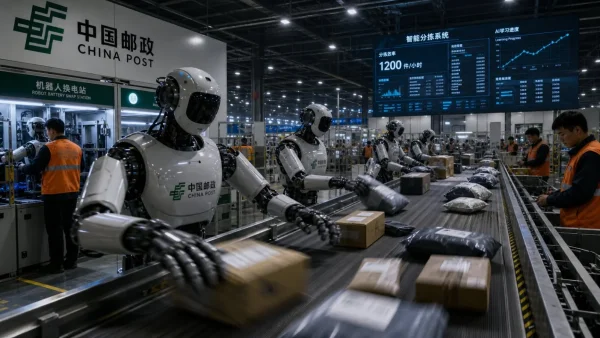
The future of logistics is beginning to look remarkably different.
Humanoid and embodied-intelligence robots are now being deployed in real-world postal and logistics operations in China, where machines are being trained to perform one of the industry’s most repetitive jobs: picking up parcels and feeding them onto automated sorting lines.
Recent footage and official industry reports show humanoid robots independently handling packages, including grasping, repositioning and placing parcels onto moving conveyor systems. In one reported deployment, the machines have reached up to 1,200 parcels per hour under peak operating conditions. (gd.spb.gov.cn)
But there is an important correction to the viral description: the strongest official evidence for the 1,200-per-hour figure comes from China Post’s Guangzhou postal operations and from a Shenzhen logistics deployment, rather than clearly establishing that a Longhua postal sorting centre itself is running robots at exactly that rate. Shenzhen’s postal authorities separately reported humanoid robots operating at a Longhua-area logistics centre, with performance reaching about 900 parcels per hour in July, while further upgrades were underway. (gd.spb.gov.cn)
These Aren’t Just Robots Moving Boxes
What makes the technology interesting is not simply speed.
Traditional industrial automation works best when the environment is predictable: fixed objects, fixed positions and predefined movements.
Logistics is much messier.
Packages arrive in:
Different sizes
Different shapes
Different materials
Different orientations
Soft bags
Hard boxes
Irregular parcels
The newer embodied-intelligence systems are designed to deal with precisely this variability.
China’s postal authorities say the robots being tested can identify parcels, grasp them, deal with irregular items and orient packages appropriately before placing them into the sorting process. (gd.spb.gov.cn)
That ability to adapt rather than simply repeat one programmed movement is what makes the development significant.
1,200 Parcels an Hour: What Does That Actually Mean?
A peak rate of 1,200 parcels per hour works out to roughly:
*20 parcels every minute
or approximately:
one parcel every three seconds.
That is an extraordinary pace for a machine that must identify, grip, manipulate and release objects of varying shapes.
However, “peak throughput” should not be confused with guaranteed continuous production performance.
Real-world productivity depends on factors including:
Parcel size
Package weight
Conveyor speed
Battery life
Robot downtime
Exception handling
Maintenance
Accuracy
Human intervention
That distinction matters when evaluating spectacular robot-performance claims.
Shenzhen Is Becoming a Testing Ground
The development fits into Shenzhen’s broader push to integrate artificial intelligence and robotics into physical industries.
In 2026, Shenzhen postal authorities reported that three humanoid robots had been introduced at a mail-processing centre for repetitive parcel-feeding work. After months of testing, the robots reached approximately 900 parcels per hour, around 85% of the efficiency of human workers, with reported accuracy of 95% when flipping parcels. (gd.spb.gov.cn)
The same report said the machines were being used to reduce the physical burden on workers, allowing human employees to focus on unusual parcels and exceptions.
That is an important point.
The immediate future may not be “robots replace everyone.” It may be:
robots handle repetitive work while humans handle the difficult work.
Why Humanoid Robots?
A natural question is: why build a humanoid robot instead of a conventional robotic arm?
The answer lies partly in existing infrastructure.
Warehouses and sorting centres have largely been designed around human workers.
A humanoid machine can potentially operate in spaces already designed for people without requiring an entirely new factory layout.
That could make deployment easier in certain environments.
China’s broader robotics industry is already investing heavily in this direction. Shenzhen’s Longhua district, for example, opened a pilot humanoid-robot production line in April 2026 aimed at moving robots from prototypes toward scalable manufacturing. (Shenzhen Longhua District Government)
The China Post Experiment Is Bigger Than One Robot
The Guangzhou deployment provides an even broader picture.
Chinese reports say the Star Motion M7 humanoid robot has been deployed by China Post for parcel-feeding operations. The machine uses a dexterous five-finger hand and an embodied-intelligence system designed to learn from real-world operating data.
According to the company and Chinese official reporting, the system can handle parcels made from different materials and of different sizes, flip them so labels face upward and identify abnormal items. Its reported maximum feeding rate is 1,200 parcels per hour, with efficiency above 85% of human performance.
That represents a shift from:
“Look what our robot can do.”
to:
“Let’s make the robot work inside an actual logistics operation.”
What Happens to Human Workers?
This is where the robotics revolution becomes more complicated.
Sorting parcels is physically demanding.
Workers repeatedly bend, lift, turn and move packages for hours. Shenzhen’s postal authority specifically said robotic deployment could reduce repetitive physical labour and the risk of occupational strain. (gd.spb.gov.cn)
That’s the positive side.
But there is another question:
If robots become cheaper and more capable, how many workers will eventually be needed? For companies, automation can mean:
Lower labour costs
Greater consistency
Longer operating hours
Easier scaling during peak seasons
Reduced workplace injuries
For workers, however, it could mean fewer traditional logistics jobs.
The transition therefore creates a policy challenge: automation may eliminate some repetitive jobs while creating demand for technicians, engineers, robot supervisors and AI specialists.
China’s Bigger Bet on Embodied AI
This development is part of a much larger Chinese technology push.
The country is attempting to move artificial intelligence beyond screens and software and into the physical economy.
That means AI systems that can:
See.
Understand.
Move.
Grip.
Adapt.
Learn from physical environments.
The ambition is enormous: factories, warehouses, hospitals, retail environments and eventually homes could all become potential markets for embodied AI.
But Don’t Confuse a Viral Video With Full Automation
There is also a reality check worth mentioning.
A robot successfully handling parcels in a controlled logistics environment does not mean humanoid robots are ready to replace human workers everywhere.
The technology still faces major challenges:
Battery endurance
Mechanical reliability
Cost
Safety
Handling extremely irregular objects
Software failures
Maintenance
Network connectivity
Scaling across different facilities
Even Shenzhen’s own postal authority describes these deployments as ongoing testing and iteration, rather than declaring the problem completely solved. (gd.spb.gov.cn)
The Real Breakthrough May Be the Learning
Perhaps the most important part isn’t the 1,200 figure.
It is the data.
Every time a robot grabs a different package, encounters an unusual shape or makes a mistake, the system can potentially learn from that physical interaction.
That creates a feedback loop:
Robot works → encounters new situation → collects data → model improves → robot becomes more capable.
If this process continues successfully, robots could become increasingly useful in environments that previously required human adaptability.
The Logistics Industry Is Watching Closely
For years, automation in logistics relied heavily on conveyor belts, robotic arms, scanners and automated guided vehicles.
Humanoid robots introduce something different: general-purpose physical manipulation.
The ultimate question isn’t whether a robot can move one box.
It’s whether one machine can reliably perform thousands of different physical tasks without requiring an expensive custom system for every task.
If that becomes economically viable, the impact could extend far beyond parcel sorting.
Final Word
China’s latest logistics-robot experiments offer a glimpse of a future in which humanoid machines aren’t merely demonstrations at technology exhibitions—they are becoming co-workers inside real industrial operations.
The reported 1,200-parcel-per-hour peak is impressive, but the bigger story is the transition from laboratory demonstrations to actual postal work. China Post is already testing embodied-intelligence robots in operational environments, while Shenzhen is continuing to improve their speed, accuracy and adaptability. (gd.spb.gov.cn)
The question is no longer simply:
“Can humanoid robots sort parcels?”
They clearly can.
The more consequential question is:
“How quickly can they become cheap, reliable and capable enough to transform the way the world’s warehouses operate?”
If the answer arrives sooner than expected, the next revolution in logistics may not be driven by faster conveyor belts.