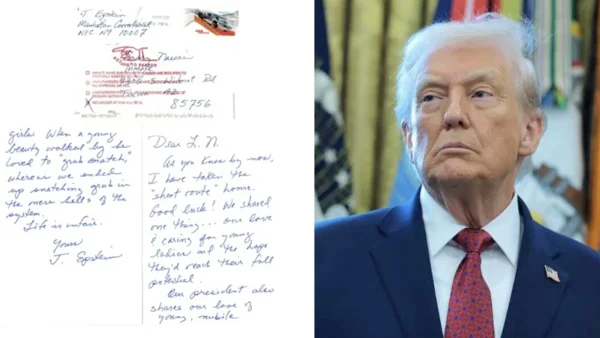
The new lot of data from the Department of Justice has sparked the dispute surrounding the final period of Jeffrey Epstein’s life all over again. This dispute is circling around an unrefined, presumably fictious letter meant for Larry Nassar. The latter is called upon in the message to the aid of Donald Trump and ‘young, very attractive girls’”. However, now federal authorities say that it was an elaborate imitative attempt at creating public noise around the high-profile criminal cases.
The letter that set off alarms
In the package of 30,000 pages freshly put out connected to Epstein, was among them a postcard which the interpretation of is questionable that was putatively mailed in August 2019 from the Metropolitan Correctional Center in Manhattan. It talked about the shared ‘love’ for young women and maintained that ‘our president also shares our love of young, nubile girls’. Nassar never received the card.
The note was detected to be inside with Epstein’s mail that was returned to sender from the jail where he was confined awaiting trial on sex traffic charges. Publication of it along with other testimonies caused the online rumor scientists to go mad with political intrigue and speculation concerning the powerful people among Epstein’s connections.
Authenticity questioned, then debunked
The FBI swiftly started to investigate the case when they received the card. Their conclusions were based on the fact that the writing was not that of Epstein’s. The postage stamp on the card was dated three days after Epstein died, and its source was Northern Virginia, not New York. The crucial missing piece was Epstein’s prisoner ID number, which was a must for him to send mail as a prisoner.
The letter was said to be fake by the Department of Justice. One of the key points is that just because a document appears in a transparency release does not mean that its content is valid. Their stance has been the same since the beginning, and that is that their actions in publishing these documents were compulsory, and at the same time the victims’ identities had to be protected.
Trump’s name appears, but not in evidence of a crime
The latest release was made with a special reminder; the documents contain some weird and wild claims concerning Donald Trump. Many of these were lodged with the FBI just before the 2020 election. The Department even went to the extent of saying that the mentioned allegations were totally baseless and that they did not exist. The revelation also took place with Trump being implicitly identified as a crook, at least up to that point.
In the past, records have pointed out shared trips and relationships in the circle around Epstein. Nevertheless, federal agencies continuously stress transparency, not implication, as their main goal. Claims have to be substantiated by proof, and in most of the people who are in the files are not charged with any wrongdoing.
Epstein and Nassar – a shocking pair
The recipient of the document’s guidelines furthered the surprising effect. Larry Nassar, an ex-doctor of USA Gymnastics and Michigan State University, currently serving a de facto life sentence for child pornography possession and multiple sexual assaults of athletes he was supposed to take care of. The very hint of tacit communication among the two felons mentioned above has led to a public uproar.
No matter if the card was real or fake the world had been forced to disconnect it from the main Epstein case. Thus, it was also a powerful example of how things can be easily counterfeited or wrongly assigned and in that way, which aspects of the past are corrupted in general, were also one of those rare or unique occurrences that shows that the filing system and archives of libraries and bookstores can be very just dishonest and negligent in a sense.
The content of the new Epstein files
Following previous leaks, the latest release contains emails, notes, messages, and other paperwork. Some of the documents go back to August 2019, the same month Epstein reportedly committed suicide while being in custody. Agencies have been very careful in removing any information that could be used to identify the victims and witnesses, but at the same time, they have to follow the directives of Congress for the release of public information.
These data dumps are gigantic and oftentimes quite complex. They have everything- timelines, legal custody chains, and leads for further investigation. They are also the source of rumors and misinterpretation, most of the time only a snippet of the material gets shared and people are not even aware of the context.
Disinformation risk and the need for caution
The phony letter confirms the complexity of the task to distinguish the truth from the lies in the case of the Epstein’s documents. The time differences, the postal service records, and handwriting analysis may sound like dry technical tasks, but they are must-do in verifying the origin of the documents. If not, the plot might attract people by sensational claims that will not pass the test of credibility.
The bottom line for both investigators and the general public is that primary evidence is of utmost importance. Also relevant are institutional checks, like prison mail regulations and an independent forensic examination.
What will follow
It has been hinted that there will be more releases because of the legal process. In the course of this process, the Justice Department has announced it will keep on releasing and protecting the necessary materials. Thus, the Epstein story will be moving forward, piece by piece, and there will be occasional surprises and corrections.
At the moment, the most sensational part in the new set is also the most untrustworthy. The supposed Epstein-to-Nassar letter mentioning Trump and ‘young, nubile girls’ has been rejected by U. S. authorities but it lives on as a warning sign of a case that is still a blend of facts, hearsay, and the public's curiosity.