One could say the numbers from 2025 are the strongest indication in years that nuclear fuel is a defence priority for the US. Even so, the overwhelming majority of reactor fuel still comes from overseas. The stakes are as much economic as they are strategic.
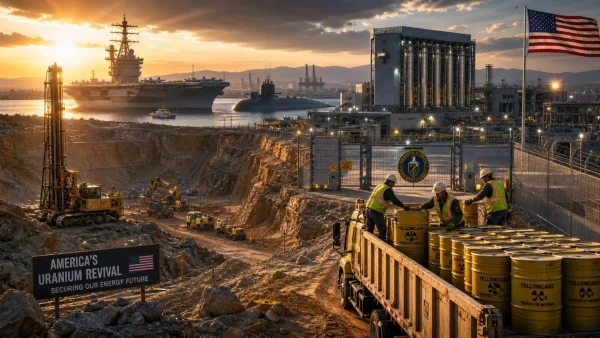
For the military, that is a concern, not just for the grid. You have enriched uranium running the nation’s nuclear submarines and aircraft carriers. A report from the Government Accountability Office puts it plainly: since 2013 the US has not had the means to produce enriched uranium to national-security standards, leaving defence planners in the lurch.
Washington intends to put an end to that. In January 2026 the Department of Energy put forward $2.7 billion to expand what can be done at home, with the objective of a fuel chain that can absorb market and geopolitical shocks.
Security stakes rise as fuel supply becomes a defence issue
The US Energy Information Administration reports that 2.1 million pounds of uranium concentrate came out of the country’s mines in 2025, a marked increase on the 657,000 pounds of 2024. It is a surge born of policy designed to curtail dependence on those overseas and shore up what is viewed as essential to national security.
Then again, yellowcake or uranium concentrate is only the beginning. Before it is any use as reactor fuel it has to be converted and enriched. Without greater domestic capability in those areas, you cannot have energy or defence autonomy no matter how much is mined.
Output jumps, but demand dwarfs US supply
The disparity is hard to miss. EIA figures show US civilian operators put in orders for 46.9 million pounds of U3O8 equivalent in 2025, though down from 55.9 million the year before. Of what was delivered to reactors, a mere 7 per cent was of US origin.
Foreign interests call the shots. Canada is responsible for 32 per cent, Kazakhstan 28 per cent and Australia 15 per cent. That kind of concentration is an invitation to trade and logistical trouble, even as the domestic mines pick up the pace.
Prices and sourcing patterns shift
There is a certain urgency to the strategy and the costs to match. The average price of uranium has climbed 11 per cent to $58.46 a pound in 2025 from $52.71 in 2024. Between the higher bills and the import reliance, it makes for complicated planning for utilities and their policymakers.
A defensible fuel base is a must for the defence establishment to avoid being open to outside pressures. Restoring enrichment capacity is non-negotiable when one is talking about fleet readiness and nuclear deterrence.
Mining revival gathers pace underground
Investment in the field is keeping step with the production rebound. Exploration drilling hit 1,824 holes for over a million feet in 2025, compared with 1,324 and some 0.6 million feet in 2024, which speaks to a broadening pipeline of resources.
On the development side, companies were busier too. They finished 3,708 holes this year versus 2,462 last, with total footage ticking up to 1.30 million feet from 1.26 million. One sees the promise of near-term supply in those figures.
It is a sign miners are making themselves ready for a tighter market and a policy climate that puts a premium on being self-reliant rather than chasing spot prices.
What needs to happen next
You see both progress and pressure in the data. With mines turning out 2.1 million pounds and operators buying 46.9 million, there is a gulf to be crossed that will take more than a single budget cycle to bridge.
The federal findings and the EIA would have decision-makers do the following:
– See to it that conversion and enrichment are expanded in tandem with mining
– Put in place long-term procurement to give investment some stability
– Make sure fuel is available for defence-critical applications
– Work with allied suppliers to contain risk
The $2.7 billion push for enrichment is only the opening move. Timely delivery of that capacity is key to assuring fuel for carriers and submarines and to giving utilities some cover from volatility.
The consumer will feel it in a roundabout way; a more robust fuel chain is good for decarbonisation and reliability. But the industry gets a clear message: if the US wants genuine fuel security from its mining comeback, then midstream capacity and development are as important as the ore.
Australia, Kazakhstan and Canada will be indispensable as we rebuild our own capabilities. Still, the centre of gravity is moving. Given the drilling activity, the national-security imperatives and the price environment, 2025 is shaping up to be the beginning of something new for US uranium, not a passing phase.
Execution is the test. Enrichment schedules, corporate plans and policy have to come together. Should they, the next tranche of EIA data may well show a nuclear fuel cycle that is not only larger in volume but more sovereign and secure.