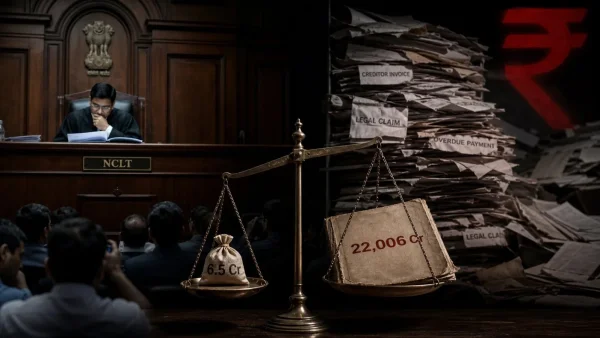
A National Company Law Tribunal (NCLT) decision involving Zee Group founder Subhash Chandra has triggered a fierce debate over India’s insolvency framework after the tribunal approved a repayment plan under which creditors could receive just ₹6.5 crore against admitted claims of approximately ₹22,006.57 crore.
The numbers are striking: the approved recovery works out to roughly 0.03% of the admitted claims, leaving creditors with a 99.97% haircut.
The case has quickly become a flashpoint over whether India’s insolvency process adequately protects lenders and whether extremely large debt claims can ultimately result in exceptionally small recoveries.
₹22,006 crore versus ₹6.5 crore
Under the repayment plan approved by the NCLT, Chandra would pay approximately ₹6.5 crore, including an amount towards insolvency-process costs, against admitted creditor claims of ₹22,006.57 crore.
Put simply, creditors would recover only about three paise for every ₹100 claimed.
That is why the decision has attracted such intense attention.
Critics have questioned how a person facing claims running into tens of thousands of crores can have a resolution plan involving payment of only a few crores.
However, legally, the issue is more complicated than simply saying that ₹22,006 crore of “debt was waived for ₹6.5 crore.”
This was a personal insolvency resolution process
The case concerns Subhash Chandra’s personal insolvency proceedings, rather than a blanket write-off of all Zee Group debt.
According to reports, the proceedings originated from a personal guarantee Chandra had provided for a ₹170-crore loan taken by Vivek Infracon. Indiabulls Housing Finance initiated insolvency proceedings against him, with the personal insolvency case eventually being admitted by the NCLT.
The ₹22,006.57 crore figure represents admitted claims against Chandra in the personal insolvency process.
Why did the NCLT approve such a small recovery?
This is the central question.
The tribunal’s reasoning was not that creditors should simply forgive ₹22,000 crore.
The NCLT considered the value of Chandra’s personal assets and the prospects of recovery if the proposed resolution failed.
According to the tribunal’s reasoning, the valuation of Chandra’s personal estate indicated that his assets were worth substantially less than the amount being claimed. The tribunal concluded that rejecting the plan could potentially leave creditors facing bankruptcy proceedings and an even lower recovery.
In other words, the tribunal’s argument was essentially:
₹6.5 crore now may be better for creditors than an uncertain or potentially negligible recovery through bankruptcy.
Creditors objected
Not every creditor accepted the proposal.
A group of lenders led by LIC Housing Finance strongly objected, describing the proposed payout as “unviable and unlawful.”
The NCLT order records that LIC Housing Finance had an admitted claim of approximately ₹1,322.39 crore, while the proposed repayment to it was only about ₹38 lakh—roughly 0.028% of its admitted claim.
The dissenting creditors therefore argued that such a negligible recovery should not receive approval.
The tribunal ultimately rejected those objections.
How did the plan get approved?
The case itself involved a divided tribunal.
The original two-member NCLT bench delivered a split verdict on the repayment plan. A third judicial member, Nilesh Sharma, was subsequently appointed to resolve the disagreement.
Sharma approved the repayment plan under Section 114 of the Insolvency and Bankruptcy Code (IBC).
The plan had received support from creditors representing 80.81% of the voting share, while the objecting creditors represented less than 20%.
The approved plan is binding on creditors under the applicable provisions of the IBC.
Is this really “paying 0.03% and becoming debt-free”?
That popular social-media description is too simplistic.
The NCLT has approved a repayment plan under the personal insolvency framework. It does not mean that every liability connected with Chandra or every Zee Group obligation has simply disappeared because ₹6.5 crore was paid.
Nor does it mean that an ordinary borrower can approach a bank and demand the same treatment.
The insolvency system operates according to specific statutory procedures, creditor voting, asset valuations and judicial oversight.
But the extraordinary size of the haircut is still a legitimate subject of public debate.
Why the case has triggered public anger
The controversy has an obvious emotional dimension.
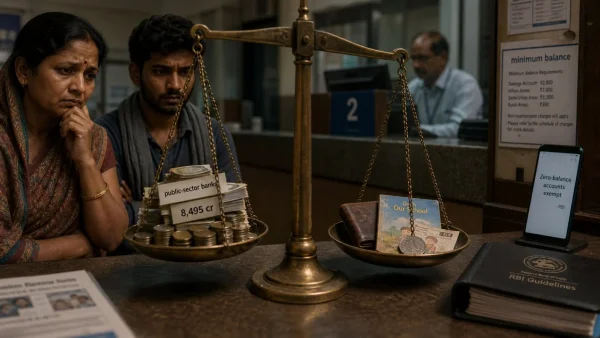
Ordinary borrowers struggling with relatively small loans can face persistent recovery efforts, penalties, legal notices and proceedings when they default.
Against that backdrop, news that creditors facing a ₹22,006-crore claim may recover only ₹6.5 crore naturally raises questions about whether the system treats large and small debtors differently.
The comparison is politically powerful—but it should also be made carefully.
A personal insolvency resolution approved under the IBC is not the same thing as a bank voluntarily waiving an individual’s loan.
Still, the perception of unequal treatment is likely to remain a major issue.
Political reaction
The decision has already triggered political criticism.
Congress leader Jairam Ramesh described the outcome as effectively a “mundan” rather than merely a haircut, arguing that it undermines the credibility of the insolvency framework.
Former businessman Vijay Mallya also reacted publicly to the decision, using it to question the functioning of India’s debt-resolution system.
These are political and personal reactions, however, rather than findings of the NCLT itself.
The bigger question: What is the purpose of the IBC?
The Insolvency and Bankruptcy Code was designed to provide a structured mechanism for dealing with financial distress, improve recoveries and resolve insolvency within a predictable legal framework.
But the Subhash Chandra case highlights a difficult question:
When the debtor’s available assets are dramatically smaller than the creditors’ claims, should the system prioritise maximum possible recovery or a legally structured exit from insolvency?
If the debtor genuinely has insufficient assets, demanding the entire amount may produce nothing.
But if creditors receive only a tiny fraction of their claims, the system must also demonstrate that all assets, transactions, guarantees and potential sources of recovery have been properly examined.
What this case does—and does not—prove
The NCLT’s decision does not by itself establish corruption, favouritism or wrongdoing.
There is no basis to claim, merely from the size of the haircut, that somebody “told the NCLT to do this.”
The tribunal gave a legal rationale for its decision, and the plan received the required creditor support.
But the decision undeniably raises serious policy questions:
Is a 99.97% haircut consistent with the objectives of the IBC?
Were all potentially recoverable assets properly valued?
Did creditors have sufficient information before voting?
Should there be stronger safeguards where recoveries are extraordinarily low?
Does the framework create a perception that large borrowers can obtain disproportionately generous settlements?
How should the law balance a debtor’s fresh financial start against creditors’ right to recover?
A ₹22,000-crore question for India’s insolvency system
The most important issue is therefore bigger than Subhash Chandra.
The case has placed the credibility of India’s personal insolvency framework under the microscope.
For creditors, ₹6.5 crore against ₹22,006.57 crore is an extraordinary outcome.
For the tribunal, the question was whether that recovery was better than the realistic alternative available from Chandra’s financial position.
And for the public, the question is simpler:
If an ordinary person can face serious consequences over a relatively small unpaid loan, why should a resolution involving tens of thousands of crores result in creditors recovering only a few crores?
The answer lies in the insolvency law and the facts of each case—but the sheer scale of this haircut means the debate over fairness, accountability and equality in India’s debt-resolution system is unlikely to end with this order.