A fresh controversy has erupted in Madhya Pradesh over alleged financial irregularities involving government funds worth around ₹600 crore, with investigators reportedly finding suspicious transactions in which public money was allegedly transferred to private bank accounts linked to government employees, their wives and relatives.
The allegations have triggered demands for a comprehensive investigation and raised questions about safeguards within the state’s treasury-payment system. Importantly, the matter is an allegation under investigation and should not be treated as a proven ₹600-crore “scam” until the investigations and judicial processes establish individual culpability.
What has the investigation reportedly found?
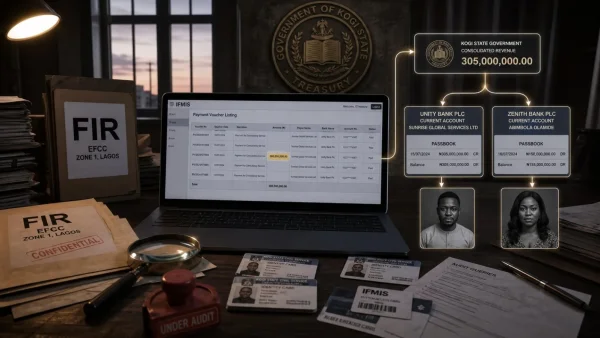
According to reports citing the State Financial Intelligence Cell (SFIC) of the Directorate of Treasury and Accounts, investigators identified approximately 199 suspicious transactions involving around ₹305 crore. Some of the money was allegedly transferred from government accounts to private accounts associated with employees and their family members.
The alleged irregularities reportedly occurred through the state’s Integrated Financial Management Information System (IFMIS), the electronic system used for government payments.
Investigators have reportedly identified several possible mechanisms, including:
Payments allegedly made against fake bills
Instances of the same work being paid for twice
Government funds allegedly transferred to private bank accounts
Use of employee credentials or system access inappropriately
Creation of duplicate employee codes, potentially enabling multiple payments
Employees allegedly sharing login credentials with others
These findings, if established in individual cases, could point to serious weaknesses in financial controls.
Were wives and relatives’ accounts involved?
This is among the most serious allegations.
Reports say investigators found transactions in which government funds were allegedly routed into accounts belonging to employees’ wives and other relatives.
However, an important distinction must be made: the presence of money in a relative’s account does not by itself establish that the relative participated in corruption.
Investigators would need to establish:
Where the money originated.
Who authorised the payment.
Why the payment was made.
Who ultimately controlled the recipient account.
Whether the recipient knew the source of the money.
Whether the transaction represented a legitimate government payment or diversion of public funds.
Those questions will determine individual criminal liability.
₹305 crore versus ₹600 crore: Why the numbers differ
The ₹600-crore figure being circulated refers to the broader financial irregularity under investigation, while reports have separately identified approximately ₹305 crore in suspicious transfers.
That distinction matters.
It would be misleading to say that investigators have already proved that ₹600 crore was stolen and that the entire amount went into relatives’ accounts.
The investigation appears to cover multiple forms of suspected irregularity, including questionable transfers, duplicate payments and other violations of treasury procedures.
Questions over the treasury system
The controversy also raises questions about how such transactions could occur within a government financial system.
If the allegations are ultimately substantiated, investigators will need to determine whether the problem was caused by:
individual fraud, inadequate verification, deliberate collusion, weaknesses in IFMIS controls—or a combination of all four.
The reported use of duplicate employee codes and shared login credentials is particularly significant because government payment systems depend heavily on authentication and segregation of duties.
FIRs and investigations
Reports indicate that dozens of FIRs have been registered, with more than 400 people reportedly coming under scrutiny in connection with the broader irregularity. Some cases are also reportedly being examined by agencies including the Economic Offences Wing (EOW) and the Enforcement Directorate (ED). (The Credible News)
Being named in an investigation, however, does not mean that a person has been found guilty.
The final responsibility of determining criminal liability rests with the investigative and judicial processes.
Political Controversy
The issue has quickly become political.
The opposition has demanded a detailed probe into the alleged irregularities and questioned how such a large amount could potentially move through government financial systems without being detected earlier. Congress leaders have also demanded accountability from the state government.
The BJP-led Madhya Pradesh government, meanwhile, faces pressure to explain:
How the irregularities were detected.
When the government first became aware of them.
How much money has actually been lost.
How much has been recovered.
How many officials have been suspended.
How many cases have resulted in FIRs.
Whether the treasury system has been secured against similar manipulation.
The Bigger Issue: Public Money and Accountability
The most important question is not simply “₹600 crore scam?”
It is:
How could government money allegedly reach private accounts without adequate safeguards detecting the transactions earlier?
Government expenditure ultimately comes from public revenue.
If even a fraction of the allegations is proved, the consequences go beyond accounting irregularities. Money intended for government programmes, salaries, infrastructure and public services could have been diverted from its intended purpose.
That makes transparency and independent investigation essential.
What should happen next?
A credible investigation should establish the complete money trail and publicly clarify:
How much money was actually diverted?
Who authorised each suspicious payment?
Who received the money?
How much has been recovered?
Were senior officials negligent or complicit?
Were system vulnerabilities deliberately exploited?
What safeguards have now been introduced?
Until those questions are answered, political claims of a proven ₹600-crore scam should be treated cautiously.
But the reported findings are serious enough to demand a transparent, independent and time-bound investigation.
Public money is not government money in the personal sense—it is taxpayers’ money. Any proven diversion therefore requires not only recovery of funds, but accountability for everyone involved, regardless of rank or political affiliation.