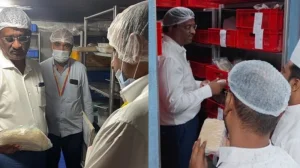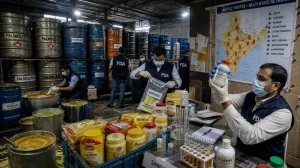
Concerns over food adulteration have resurfaced in Noida and Greater Noida after food-safety teams destroyed large quantities of paneer found to be unfit or suspected to be adulterated during intensified inspections ahead of the festive season.
Recent reports show that authorities in Gautam Buddha Nagar have taken action against multiple consignments of paneer within days. On August 22, around 400 kg of paneer reportedly being transported from Aligarh for supply to the Delhi-NCR market was intercepted and destroyed. On August 23–24, another 300 kg supplied from Mewat, Haryana, was seized at a dairy in Garhi Chaukhandi, Noida, and destroyed after officials found it prima facie unfit for human consumption.
A separate report on the wider crackdown put the quantity destroyed in Noida and Jaipur at 600 kg combined, while several samples of paneer, curd, khoya and other dairy products were sent for laboratory testing.
The alarming question: how much adulterated food escapes detection?
The seizures raise an uncomfortable question for consumers.
If food-safety teams can uncover hundreds of kilograms of questionable paneer during a concentrated inspection campaign, how much potentially unsafe food is entering the market between inspection drives?
There is, however, no reliable evidence to conclude that the entire city is receiving a particular quantity of fake paneer every day. Seized quantities cannot simply be extrapolated into an estimate of citywide consumption or adulteration.
What the seizures do demonstrate is that food-safety surveillance needs to be continuous, risk-based and adequately staffed, rather than relying only on festival-season drives.
What officials actually found
In the latest Noida action, officials collected samples from the suspected paneer before destroying the stock. Eight samples from different establishments were reportedly sent to laboratories, including samples of paneer, curd, khoya and sweets. Laboratory findings will determine what further action is warranted. (India Today)
This distinction is important.
A product being described as “unfit for consumption” or “suspected adulterated” during an inspection is not the same as a laboratory-confirmed finding of a particular adulterant.
The final scientific reports matter because they can establish whether the food violated prescribed safety or quality standards and what enforcement action should follow.
Why Paneer Adulteration Is a Serious Public-Health Concern
Paneer is consumed widely across India—in homes, restaurants, hotels, sweet shops, hostels and catering establishments.
The problem becomes particularly serious when consumers cannot determine whether the product they are buying is genuine.
Adulteration can involve the substitution of milk fat and protein with cheaper materials or the use of ingredients that do not meet food-safety standards. The health consequences depend on what has actually been added and in what quantity.
Children, elderly people and people with existing health vulnerabilities can be particularly sensitive to unsafe food.
That is why food safety cannot be treated simply as a festival-season issue.
Should Food-Safety Checks Continue 365 Days a Year?
This is perhaps the strongest question raised by the Noida seizures.
Festival campaigns are necessary because demand for milk, paneer, khoya, ghee and sweets rises sharply, creating greater incentives for adulteration.
But food is consumed every day.
A consumer does not eat adulterated paneer only during Diwali, Holi or Raksha Bandhan.
Therefore, enforcement should ideally operate throughout the year, with more intensive surveillance during periods of unusually high demand.
A strong model would combine:
Regular inspections
Random sampling
Risk-based targeting of repeat offenders
Laboratory testing
Supply-chain monitoring
Action against manufacturers and distributors
Follow-up inspections
Public disclosure of enforcement outcomes
The Supply Chain Matters Too
Another important aspect is the movement of dairy products across state borders.
In recent Noida cases, officials reported paneer arriving from Mewat in Haryana and Aligarh in Uttar Pradesh. (Navbharat Times)
That means enforcement cannot stop at the retail shop.
Authorities need to examine the entire chain:
Manufacturer → transporter → wholesaler → retailer → restaurant → consumer
If a supplier repeatedly sends unsafe products into NCR markets, action only against the final retailer may not solve the underlying problem.
FSSAI and State Authorities Have a Larger Role
Food safety in India operates through the national framework established under the Food Safety and Standards Act, 2006, with the Food Safety and Standards Authority of India (FSSAI) and state food-safety administrations playing different regulatory and enforcement roles.
The recent Noida operations illustrate why coordination between central and state authorities is important.
A successful enforcement system should not merely seize products.
It should answer:
Who manufactured it?
Where did the raw materials come from?
Who transported it?
How many batches entered the market?
Which businesses received the product?
Was the supplier previously flagged?
What happened after the laboratory report?
Those questions turn a raid into meaningful enforcement.
From Seizure to Accountability
Destroying unsafe food prevents that particular batch from reaching consumers—but it doesn’t necessarily stop the business responsible from repeating the offence.
That’s why consumers should watch what happens after the headlines disappear.
If laboratory tests confirm violations, authorities should pursue the appropriate legal action under food-safety law and conduct follow-up inspections.
The public also deserves transparency about enforcement outcomes—not just photographs of seized food.
The Bigger Question for Noida
The recent seizures should not be used to claim that all paneer sold in Noida is fake. There is no evidence for such a sweeping conclusion.
But they do expose a genuine regulatory challenge.
Hundreds of kilograms of questionable paneer being intercepted within a short period is enough to justify sustained scrutiny of the dairy supply chain.
The real test will be whether enforcement continues after the festive season, whether repeat offenders are identified, whether laboratory reports lead to action, and whether consumers can trust the food placed on their plates.
Food safety cannot be seasonal.
Festivals may bring special enforcement drives, but the responsibility to keep adulterated food away from consumers exists 365 days a year.
For a city as densely populated and commercially connected as Noida-Greater Noida, regular surveillance of paneer, milk, khoya, ghee and other high-risk food products isn’t an extraordinary demand.
It is basic public-health governance.