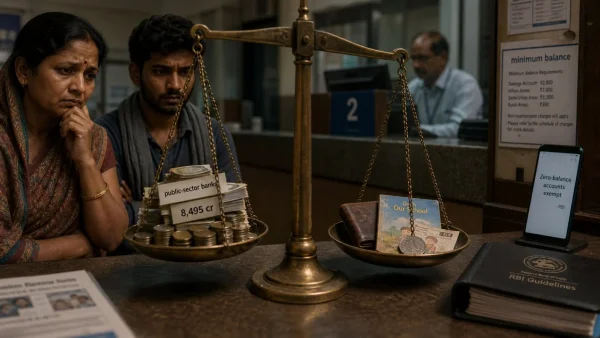
A striking figure has resurfaced in India’s banking debate: public-sector banks collected ₹8,495 crore in penalties from customers for failing to maintain minimum balances over a five-year period, according to data provided by the government in Parliament in 2024.
The figure has prompted renewed criticism over whether minimum-balance charges disproportionately affect ordinary account holders who may have limited or irregular incomes.
However, the viral claim in the accompanying image needs an important clarification: ₹8,495 crore refers to public-sector banks, not all banks in India. The charge also isn’t automatically imposed on every low-balance account.
What exactly is the ₹8,495-crore figure?
According to the government response, public-sector banks collected ₹8,495 crore over five years from customers who failed to maintain the required minimum balance in their accounts. That worked out to an average of around ₹1,699 crore per year.
The government has also clarified that banks are permitted to levy such charges on eligible accounts under RBI rules, subject to conditions.
So the headline “banks collected ₹8,500 crore” is broadly based on real government data, but saying that all Indian banks collected ₹8,500 crore would be misleading.
Why do banks charge a minimum-balance penalty?
Banks may specify a minimum average balance for certain savings accounts. If the customer falls below that threshold, the bank can levy a charge according to its board-approved policy.
But RBI rules place important restrictions on these charges.
Under RBI guidelines, customers must be informed about the minimum-balance requirement and applicable charges. If the balance falls below the required level, the bank must notify the customer and provide at least one month to restore the balance before the penal charge can be recovered.
The charge is also supposed to be proportionate to the shortfall, rather than being an arbitrary flat penalty. RBI says charges should be reasonable and should not cause the savings account to become negative solely because of the penalty.
But not every account can be penalised
This is one of the most important facts missing from many social-media posts.
Basic Savings Bank Deposit Accounts (BSBDAs), including Jan Dhan accounts, do not have a minimum-balance requirement.
Therefore, customers holding these accounts are not supposed to face minimum-balance penalties. The government reiterated this position in Parliament.
That means the ₹8,495-crore figure should not be interpreted as money extracted from every poor or middle-class bank customer.
Why is the issue controversial?
Critics argue that minimum-balance penalties can have a disproportionately large impact on people with modest or irregular incomes.
Consider a worker whose salary arrives at the beginning of the month but who has to withdraw most of it to pay rent, food, school expenses and other bills. Falling below a bank’s minimum-balance requirement can trigger charges even though the customer may have very little financial flexibility.
For a wealthy customer, a few hundred rupees may be insignificant.
For a low-income household, repeated deductions can matter considerably.
This has led to a broader question:
Should banks earn revenue by penalising customers who are least able to maintain surplus balances?
The banking industry’s counterargument
Banks, however, argue that maintaining accounts involves costs—branches, technology, ATM infrastructure, personnel, payment systems and customer-service operations.
Minimum-balance requirements and service charges are therefore part of the pricing structure for certain account types.
The RBI itself does not prohibit such charges for all ordinary savings accounts. Instead, it requires banks to make them transparent, reasonable and proportionate.
The distinction matters: a charge permitted under RBI rules isn’t necessarily evidence of wrongdoing by a bank.
RBI has tightened the rules
The regulatory framework has evolved over time.
RBI’s rules require banks to:
Clearly disclose minimum-balance requirements.
Inform customers about applicable charges.
Give customers notice when the balance falls below the required level.
Allow at least one month to restore the balance.
Link the penalty to the extent of the shortfall.
Avoid allowing the account to become negative solely because of the penalty.
RBI has also taken enforcement action where banks failed to follow these requirements. In February 2025, for example, the central bank fined Nainital Bank ₹61.40 lakh, including for charging flat-rate minimum-balance penalties rather than charges proportionate to the shortfall.
The debate is getting bigger
The issue has continued to attract parliamentary attention.
In March 2025, the Finance Ministry told the Rajya Sabha that RBI rules permitted banks to levy minimum-balance penalties under board-approved policies, subject to the regulatory safeguards.
More recent government data also show that the issue hasn’t disappeared. In FY2025-26, private-sector banks collected approximately ₹4,948.71 crore in minimum-balance charges, while public-sector banks collected around ₹2,100 crore, according to data reported from a government response in July 2026.
That makes the debate particularly relevant today.
So, is the viral image correct?
Partly.
✅ Correct: Public-sector banks collected approximately ₹8,495 crore over five years in minimum-balance penalties.
❌ Misleading: The ₹8,495 crore figure does not represent all banks in India.
❌ Misleading: It cannot automatically be described as money taken exclusively from “poor and middle-class people.”
✅ Important: Basic Savings Bank Deposit and Jan Dhan accounts are exempt from minimum-balance requirements.
✅ Important: Banks must follow RBI rules governing notice, proportionality and reasonableness of such charges.
The real question
The debate shouldn’t simply be “banks are looting customers” versus “banks are following the rules.”
The more meaningful question is whether India’s banking system should continue relying on minimum-balance charges when digital banking, financial inclusion and zero-balance accounts are increasingly central to the country’s financial architecture.
Bank charges may be legally permitted—but that doesn’t end the policy debate over whether they are fair, proportionate and appropriate for India’s lowest-income account holders.
₹8,495 crore is a large number. The important question is not just how much banks collected, but who paid it, how often, and whether the people paying those charges had meaningful alternatives.