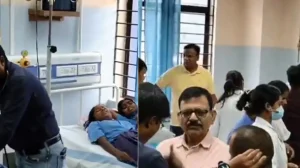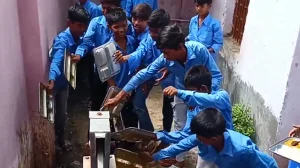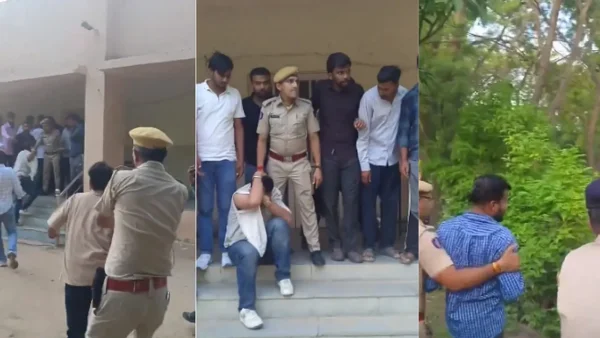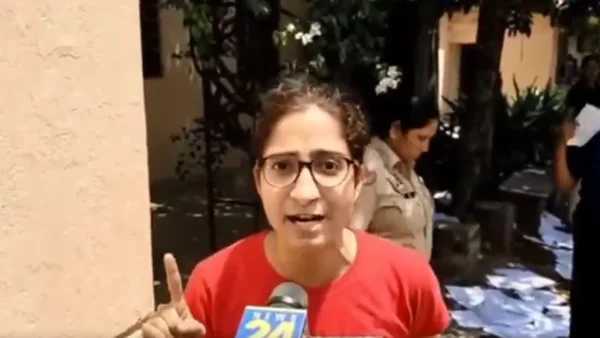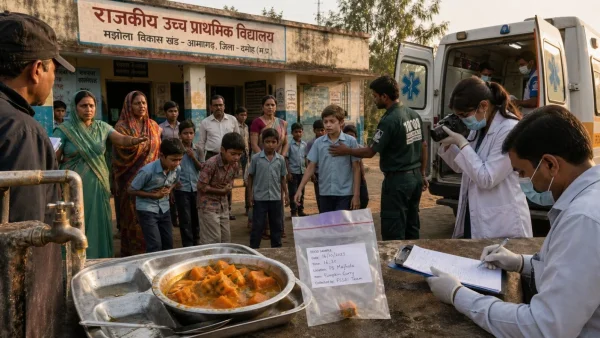
A mid-day meal served at a government school in Kota’s Poonia Devli village has triggered a serious food-safety concern after 27 students reportedly fell ill, with 21 requiring treatment in hospitals.
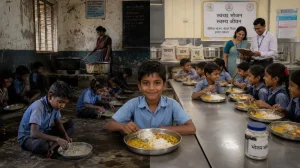
The incident occurred on August 24 at the Government Upper Primary School in the Ranpur area. Around 110 of the school’s 130 enrolled students were present when the meal was served. The menu included a pumpkin preparation. Roughly two hours later, students began complaining of nausea, vomiting, stomach pain and dizziness.
21 Children Taken to Hospital
As some students developed more severe symptoms, 21 were taken to hospitals in Kota.
According to officials, 17 were taken to the government-run New Medical College Hospital, while four were taken to a private hospital. The children were reported to be stable, with doctors providing symptomatic treatment, particularly for vomiting and discomfort.
One parent alleged that her Class 4 son became dizzy and collapsed after eating the pumpkin curry. She also alleged that no teacher or school staff member initially accompanied him to the medical facility. That allegation requires independent verification.
Was the Mid-Day Meal Actually Responsible?
This is where the story requires caution.
The timing has naturally put the school meal under suspicion, but officials have not yet established that contaminated food caused the illness.
District Education Officer (Elementary) Rup Singh Meena said it was too early to identify the meal as the sole cause. Authorities are also examining other possibilities, including heat, humidity and possible local water contamination. Food and medical testing is expected to provide more definitive answers.
The meal was reportedly prepared and supplied by Annapurna Sahakari Samiti to several other schools. Officials said children at those schools also consumed the food, but no similar complaints had been reported there at the time of the initial investigation.
That fact does not automatically clear the food, but it is one of the circumstances investigators must examine.
The Bigger Question: Will the Cook Take the Blame and the System Walk Away?
The incident has revived a familiar concern surrounding school meals: when children fall sick, will accountability stop with the lowest-level worker?
A cook can be suspended or removed quickly. But food safety in a government school involves an entire chain:
Procurement → Storage → Preparation → Quality checks → Distribution → Supervision → Medical response
If contaminated food is ultimately confirmed, investigators should determine where the failure occurred, rather than automatically placing responsibility on the cook alone.
Questions worth asking include:
Who supplied the ingredients?
Who inspected their quality?
How were the ingredients stored?
Who supervised preparation?
Was the cooked food checked before serving?
Were food samples preserved for testing?
Were prescribed hygiene procedures followed?
Who was responsible for monitoring the meal programme?
Did the school have adequate drinking-water facilities?
When did officials first receive information about the children’s illness?
“Strict Action” Must Mean More Than a Press Statement
The familiar administrative response to such incidents is to announce an inquiry and promise strict action.
But the real measure of accountability comes after the inquiry.
If laboratory testing confirms food contamination, authorities must identify the precise failure, fix it and ensure that the same supplier or process does not create another incident.
If food is ruled out and water contamination or another factor is responsible, that too needs to be publicly established.
Children’s health should not become an exercise in finding the easiest person to punish. A Larger Problem for the Mid-Day Meal System The Kota incident comes amid a series of recent reports of children falling ill after school meals in different parts of India. Such incidents highlight the importance of regular inspection, safe storage, hygiene and effective monitoring of school-meal programmes.
The mid-day meal is not simply another school activity. For many children, particularly those from economically vulnerable households, it is an important part of their daily nutrition.
That makes food safety a non-negotiable responsibility.
The Bottom Line
At present, the facts establish that 27 Kota students reported illness and 21 were taken to hospital after consuming a school meal. Their condition was reported as stable, and an investigation is underway. But it has not yet been scientifically established that the meal caused the illness.
So the appropriate demand is not a predetermined verdict against the cook—or anyone else.
It is a transparent investigation, laboratory testing, clear identification of the cause and accountability at every level of the food-supply chain.
Because if the answer is simply “remove the cook, announce strict action and move on,” the underlying problem remains.
And the next school lunch could become the next health emergency.