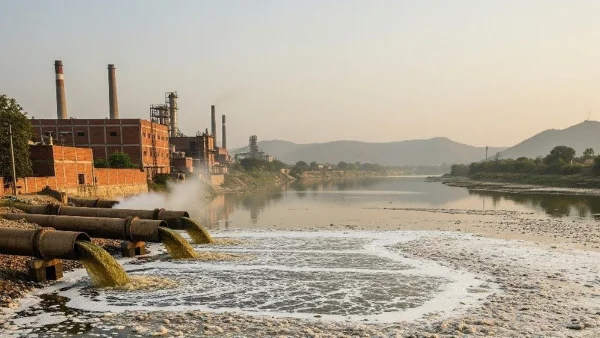
The Supreme Court has imposed an interim restriction on construction and development activities within 100 metres of the edge of Rajasthan’s Jojari River, citing the serious ecological degradation of the river and the need to prevent further damage while a scientific assessment of the river’s protection zone is carried out.
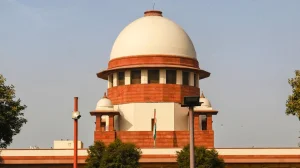
The order was passed on August 24, 2026, by a Bench comprising Justices Vikram Nath and Sandeep Mehta in a suo motu case concerning contamination of the Jojari River.
Why has the Supreme Court intervened?
The Court noted the serious extent of ecological degradation and widespread destruction of the riverine ecosystem. Earlier proceedings had also highlighted concerns over contamination of Rajasthan’s Jojari, Bandi and Luni rivers.
The Court’s intervention follows reports and committee findings pointing to concerns including contaminated water bodies, untreated industrial effluents, degradation of groundwater and agricultural land, possible encroachment on riverbeds and floodplains, and weaknesses in regulatory enforcement. (AdvocateKhoj)
100-metre no-construction zone
The Court has directed that no construction or development activity of any nature can take place within 100 metres from the edge of the Jojari River.
Importantly, this is an interim safeguard, not necessarily the final permanent buffer zone.
The Court said the restriction is necessary because the High Flood Line has not yet been scientifically determined and demarcated, along with the appropriate ecological buffer zones. The 100-metre restriction will remain until that scientific exercise is completed.
Even stricter restriction on polluting activities
The Court has gone further when it comes to activities capable of causing pollution.
As an additional interim safeguard, hazardous industries and activities capable of causing pollution, contamination or other damage to the river ecosystem are prohibited within 500 metres on either side of:
the existing flood line, where it has already been identified; or
the river’s present flow path, where the flood line has not yet been identified.
(Bar and Bench – Indian Legal news)
This means the order is not simply about stopping buildings near the river. It also seeks to prevent potentially polluting activities from worsening the environmental damage.
A scientific buffer zone is still to be determined
One of the key points in the Court’s order is that the 100-metre distance is an interim, measurable protection zone.
The ultimate buffer could be different once experts scientifically determine:
High Flood Line → River Corridor → Ecological Buffer Zone → Permitted Activities
The purpose of the interim restriction is to ensure that development does not continue while authorities are still trying to determine exactly how much protection the river requires.
Government coordination also under scrutiny
Earlier this month, the Supreme Court directed the Rajasthan government to establish an Integrated Coordination Group headed by the Chief Secretary to address contamination affecting the Jojari, Bandi and Luni rivers. (India Today)
The Court has also been monitoring the work of a separate committee examining the ecological condition of Rajasthan’s river systems.
The latest proceedings noted an overlap between the membership of the committee and the newly constituted coordination group. The Court clarified that the coordination group is an internal government mechanism for inter-departmental coordination and does not diminish the authority of the existing committee. (LawBeat)
Why this order matters
Rivers are not simply channels carrying water. Their floodplains, groundwater connections, vegetation and surrounding ecosystems form an interconnected environmental system.
Construction too close to a river can potentially:
obstruct natural drainage;
reduce floodplain capacity;
increase pollution risks;
damage riverine habitats;
interfere with groundwater systems; and
make future restoration more difficult.
The Supreme Court’s approach therefore reflects a precautionary principle: where the environmental risk is serious and the scientific boundaries are still being determined, development should not be allowed to proceed unchecked.
The real test begins now
A court order alone cannot restore a polluted river.
The Rajasthan administration will now have to ensure that the restrictions are actually enforced on the ground, identify illegal construction and polluting activities, complete the scientific mapping exercise and take meaningful steps towards ecological restoration.
The matter has been listed for further hearing on September 22, 2026. (India Today)
A river cannot be protected on paper alone
The Jojari case highlights a larger question for India’s rapidly urbanising regions:
Should governments first permit development and only later determine whether the river has enough space to survive—or should ecological limits be established before construction begins?
For now, the Supreme Court has chosen caution.
The message is clear: until science determines the river’s safe ecological boundaries, development cannot be allowed to come at the cost of the river itself.