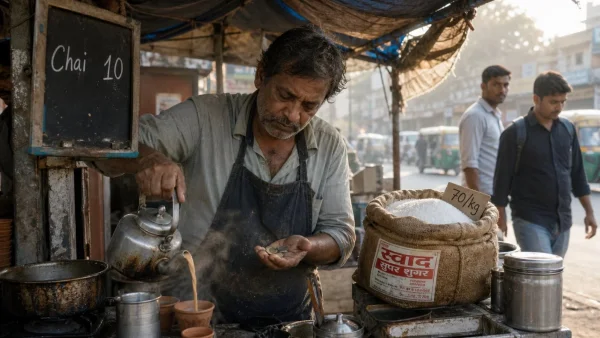
For millions of Indians, a roadside cup of tea is one of life’s simplest pleasures. But as sugar prices climb sharply across several markets, even this everyday cup is beginning to feel the pressure.
A video showing a small tea seller saying that customers are avoiding tea because of rising sugar prices has struck a chord online. Behind the viral moment is a much bigger story about food inflation, shrinking margins and the vulnerability of India’s small informal businesses.
Sugar Prices Have Risen Sharply
Government data shows that the average retail price of sugar increased from ₹48.18 per kg on July 20 to ₹55.70 per kg on August 20, 2026. The government says the increase reflects several factors, including lower-than-expected domestic production, festival-season demand, weather-related crop damage, tighter global supplies and speculation/hoarding. (Press Information Bureau)
Prices have been even higher in some cities. Reports from Jamshedpur put retail sugar at around ₹63–68 per kg, compared with ₹52–55 a month earlier. Tea stalls there have reportedly started increasing the price of a cup by ₹1–2. (The Times of India)
In Ahmedabad, sugar was reported to have crossed ₹70 per kg, prompting tea and coffee vendors to reconsider their prices. (ChiniMandi)
For a Tea Seller, Every Rupee Matters
A large restaurant can potentially absorb a temporary increase in an ingredient’s cost.
A roadside tea seller often cannot.
The business may operate on extremely small margins. Sugar is used in every cup, while the seller must also pay for:
Milk
Tea leaves
Cups and glasses
Water
Rent or vending charges
Transportation
Daily household expenses
If the seller increases the price, customers may simply walk to another stall.
And that creates a painful dilemma:
Raise the price and risk losing customers—or keep the price unchanged and lose the margin.
“People Are Avoiding Tea” — The Human Cost
The tea seller featured in the viral video reportedly says customers are now avoiding tea because of the increase in sugar prices.
Whether every consumer is actually reducing tea consumption cannot be established from one video. But the complaint reflects a genuine pressure being reported by small food businesses.
The Times of India has reported that tea stalls in Jamshedpur were already feeling the impact of higher sugar prices, with some vendors raising prices.
For a customer, ₹1 or ₹2 may appear insignificant.
For a person selling hundreds of cups every day, however, the calculation is different.
And for a low-income customer who buys tea regularly, even repeated small increases can add up.
But Is Ethanol Really Responsible for the Sugar Crisis?
This is where the debate becomes politically contentious.
Critics have argued that the diversion of sugarcane towards ethanol production has reduced sugar availability and contributed to higher prices.
The government strongly disputes that explanation.
According to the Ministry of Consumer Affairs, the proportion of sugar diverted towards ethanol actually fell from around 12% in 2022–23 to about 9% in 2025–26. The government also says nearly three-fourths of current ethanol production comes from grains, particularly maize. (Press Information Bureau)
The Indian Sugar & Bio-energy Manufacturers Association has similarly argued that the current price rally is not the result of an actual shortage, attributing it partly to speculative buying. Reuters reported that India still expects sufficient stocks to meet festival-season demand. (Reuters)
So blaming the entire price increase on ethanol would be too simplistic.
Government Forced to Intervene
The price surge has nevertheless become serious enough to prompt government intervention.
India recently announced permission for duty-free imports of 1 million tonnes of raw sugar, the country’s first major sugar import move in nearly a decade.
The government has also introduced stockholding restrictions for bulk consumers in an attempt to prevent excessive accumulation and further price pressure during the festival season.
These measures show that the price rise is no longer merely a concern for traders—it has become a broader consumer issue.
The Cup of Tea Is a Symbol
The emotional impact of the tea seller’s video comes from something very simple.
Nobody is talking about an expensive luxury product.
They are talking about chai.
For many Indians, tea is part of the morning routine, a break during work, a conversation with friends or a ₹10–₹20 purchase made almost automatically.
When the price of sugar rises enough to affect that tiny transaction, it becomes a visible reminder of how inflation reaches ordinary people.
A cup of tea may be small. The economic pressure behind it is not.
The Bigger Question
India’s sugar-price surge is being driven by a combination of factors, and the government says there is adequate supply rather than a fundamental shortage. (Press Information Bureau)
But for the tea seller in the viral video, the macroeconomic explanation offers little comfort.
His problem is much simpler:
Sugar costs more. Customers are buying less. His margins are shrinking.
And that is why this story is about more than sugar.
It is about how a sharp increase in the price of an ordinary kitchen staple can travel through the economy—from sugar mills to wholesalers, from wholesalers to shops, from shops to tea stalls, and finally into the pockets of ordinary consumers.
When even a humble cup of chai starts becoming unaffordable, inflation stops being a statistic and becomes a daily experience.