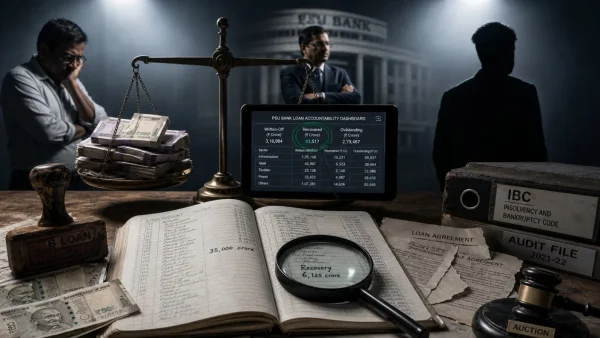
The phrase “₹35,000 crore written off by PSU banks” is guaranteed to provoke anger.
For an ordinary taxpayer, the reaction is understandable: if a public-sector bank writes off thousands of crores, it can appear as though the government has simply cancelled somebody else’s debt while ordinary citizens continue paying taxes and EMIs.
But there is an important distinction that often disappears in political arguments:
A bank write-off does not automatically mean the borrower has been forgiven. A write-off is generally an accounting treatment used when a loan is considered difficult to recover. The bank can continue pursuing recovery even after the loan has been written off.
In fact, public-sector banks reportedly recovered more than ₹35,000 crore from previously written-off accounts during FY2025-26, demonstrating why “written off” and “lost forever” are not interchangeable.
Write-Off vs Waiver: The Difference Is Real
A loan waiver means the borrower is relieved of the repayment obligation under the terms of the waiver.
A technical/accounting write-off, by contrast, does not necessarily extinguish the bank’s right to recover the money.
This distinction is important because a headline such as:
“Banks gave away ₹35,000 crore”
can create an impression that may not accurately describe what happened.
But correcting the terminology should not end the public debate.
It should actually lead to better questions.
Where Did the Money Go?
Public-sector banks manage deposits and capital within a regulated financial system.
When a large loan becomes unrecoverable, the consequences ultimately affect the banking system’s profitability and capital position.
Therefore, citizens have a legitimate interest in knowing:
How large were the original loans?
Which sectors were involved?
How much was written off?
How much has subsequently been recovered?
How much remains outstanding?
How many accounts involved alleged fraud?
How many borrowers were classified as wilful defaulters?
What action was taken against them?
The public deserves the numbers—not just the political slogan.
And Then Comes the Most Uncomfortable Question: Who Were the Defaulters?
This is where transparency becomes complicated.
The RBI has a specific regulatory framework governing wilful defaulters. Under RBI rules, wilful default can include situations where a borrower has the ability to repay but deliberately does not, diverts borrowed funds, siphons them off, or disposes of secured assets without the lender’s knowledge. (Reserve Bank of India)
But simply having a loan written off does not make someone a wilful defaulter.
A business can fail because of economic conditions, a collapsed market, poor management, unforeseen circumstances or other reasons.
So the public conversation must distinguish between:
ordinary business failure
financial distress
fraud
and
wilful default.
Why “They Don’t Even Tell You Who” Is More Complicated
It is tempting to say that citizens have absolutely no access to information about defaulters.
That’s too broad.
RBI regulations require banks to report information concerning wilful defaulters and provide a framework for dissemination of such information to lenders and credit-information companies. (Reserve Bank of India)
At the same time, the public does not necessarily receive a complete, real-time database containing every borrower whose loan has been written off.
And that creates a legitimate transparency debate.
Should taxpayers have greater visibility into large public-bank write-offs? If disclosure is restricted, the government and banks should explain precisely why.
The Bigger Problem Is Not the Accounting Entry
Suppose a bank writes off ₹1,000 crore.
The important questions aren’t simply:
“Why was it written off?”
They are:
Why did the bank lend ₹1,000 crore in the first place?
Was the borrower financially capable of repayment?
Were adequate safeguards followed?
Was collateral available?
Was money diverted?
Did auditors raise warnings?
Was there fraud?
What did the bank recover?
Were responsible individuals investigated?
That is where the accountability story lies.
The Recovery Numbers Tell a Different Story
The latest data also complicates the popular narrative.
Public-sector banks recovered over ₹35,000 crore from written-off accounts in FY2025-26, using mechanisms including the Insolvency and Bankruptcy Code, property auctions, settlements and Lok Adalats.
At SBI alone, recoveries from written-off accounts were reported at ₹10,054 crore in FY26, while its stock of written-off loans stood at about ₹1.61 lakh crore at the end of March 2026.
So the statement:
“Write-off = the bank has given up”
is not necessarily correct.
Recovery efforts can continue for years.
But Recovery Isn’t the Same as Success
Here’s where the criticism remains valid.
If a bank writes off ₹100 crore and eventually recovers only ₹20 crore, the accounting treatment doesn’t magically make the remaining ₹80 crore irrelevant.
There is an economic cost.
Banks have to make provisions against bad loans.
Capital gets tied up.
Profitability suffers.
And ultimately, public-sector banks are backed by the broader financial system and, indirectly, the public exchequer.
Therefore:
Recovery after write-off is good—but preventing reckless lending in the first place is better.
The Taxpayer’s Frustration Is Understandable
An ordinary citizen faces consequences for missing an EMI.
Interest accumulates.
Credit scores suffer.
Recovery proceedings can begin.
Assets can be seized.
Yet when enormous corporate loans become bad assets, the numbers can appear almost abstract.
That creates a perception of two different standards:
Strict consequences for the small borrower. Complex restructuring and recovery mechanisms for the large borrower. The banking system needs to demonstrate that this perception does not reflect reality.
The “Taxpayer Will Pay” Argument Also Needs Precision
It would be inaccurate to claim that every rupee written off by a PSU bank is directly taken from taxpayers.
Banks make provisions and absorb losses through their own financial statements, and recovery can continue.
But public-sector banks are ultimately state-owned or state-controlled institutions, and the government can inject capital into them when necessary.
That means the public has a legitimate interest in how large bad-loan losses are created and managed.
Public ownership should mean public accountability.
The Real Controversy
The most important question isn’t:
“Why did the bank write off the loan?” It is:
“Why did the banking system allow such a large loan to become unrecoverable—and what happened to the people responsible?” If the borrower genuinely failed because of circumstances beyond their control, the public should know.
If the borrower committed fraud, the investigation should be visible.
If money was deliberately diverted, criminal proceedings should follow where warranted.
If bank officials negligently approved the loan, accountability should not stop with the borrower.
And if recovery is still possible, write-off should never be mistaken for surrender.
The Bottom Line
Yes, ₹35,000 crore is an enormous number.
But the headline alone doesn’t tell the complete story.
A write-off isn’t automatically a waiver.
A default isn’t automatically fraud.
And a written-off loan isn’t necessarily a permanently lost loan—public-sector banks’ reported recovery of more than ₹35,000 crore from previously written-off accounts in FY26 is evidence of that.
But none of this removes the taxpayer’s right to demand transparency.
Citizens should not have to choose between understanding banking terminology and demanding accountability. They deserve both. The strongest question is therefore not:
“Why was the loan written off?”
It is:
“Who borrowed the money, why did it become unrecoverable, how much has been recovered, and who was held responsible?” Because public money deserves a public audit trail.