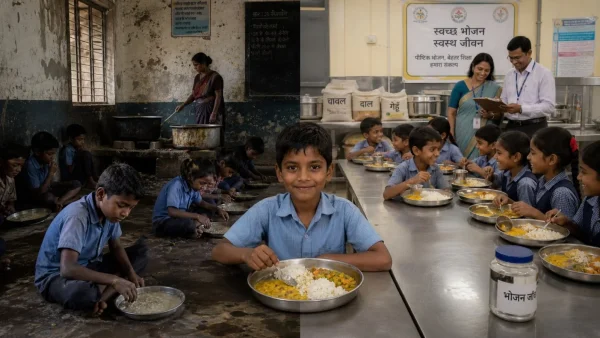
A school meal is supposed to be one of the simplest promises a government can make to a child: come to school, learn, and you will not have to study on an empty stomach.
India’s school-meal programme is among the country’s most important welfare interventions. It is designed not only to improve nutrition but also to encourage school attendance and reduce classroom hunger.
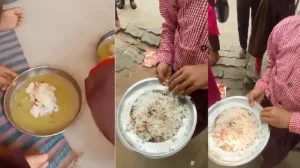
Yet images and videos showing poorly prepared, inadequate or unhygienic meals periodically trigger public outrage.
That has led to a provocative comparison increasingly seen online:
“Mid-day meal in a dictatorship.” followed by:
“Meanwhile, mid-day meal in the world’s largest democracy.” The comparison is politically loaded, but the underlying question is serious:
What does the quality of food served to children tell us about the quality of governance?
The School Meal Is Not Charity
India’s school-meal programme—now known as PM POSHAN—is a centrally sponsored scheme covering children in eligible government and government-aided schools.
Its objectives extend beyond simply feeding children.
The programme is intended to:
Improve children’s nutritional status
Encourage regular attendance
Improve concentration in classrooms
Reduce classroom hunger
Support disadvantaged children
Encourage children from different social and economic backgrounds to eat together
In other words, the meal is part of the education system itself.
A child who is hungry cannot be expected to concentrate on mathematics, science or language in the same way as a child who has eaten properly.
Then Why Do Shocking Images Keep Appearing?
Across different states, there have periodically been reports and viral videos involving allegations of:
Poor-quality food
Insufficient portions
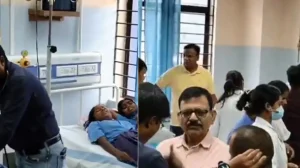
Contaminated meals
Inadequate kitchens
Poor hygiene
Children being served substandard ingredients
Food being prepared or stored in unsafe conditions
Every viral incident should be independently verified before the entire school-meal system is judged by it.
But repeated incidents raise a legitimate governance question:
Why aren’t monitoring mechanisms detecting these problems before children are served the food?
The Real Issue Isn’t the Menu—It’s Dignity
For many children, particularly those from economically disadvantaged families, the school meal may be an important part of their daily nutrition.
That makes the quality of the meal particularly important.
There is a profound difference between:
“We are giving children something to eat.”
and
“We are providing children with a nutritious, safe and dignified meal.”
The second should be the standard.
A child should not have to accept unsafe or humiliating food simply because it is provided free of cost.
Free food does not mean inferior food.
Where Does the Money Go?
This is where accountability becomes critical.
Public money is allocated for school nutrition.
Therefore, citizens should be able to ask:
How much money is allocated per child?
Who purchases the ingredients?
Who selects suppliers?
How frequently are kitchens inspected?
Are food samples tested?
Who checks portion sizes?
What happens when food is found to be unsafe?
Are contractors or officials held accountable for repeated violations?
These aren’t anti-government questions.
They are basic questions about public expenditure and children’s welfare.
The “World’s Largest Democracy” Claim Comes With a Higher Responsibility
India’s democratic identity makes this debate even more important.
Democracy isn’t merely about elections.
It also means public institutions being accountable to citizens.
A government school child may have little political power.
They may not be able to write a complaint to a department.
They may not understand government procurement rules.
They may not know whom to approach when a meal is inadequate.
That makes institutional safeguards even more important.
Children shouldn’t need political influence to receive a safe lunch.
Don’t Compare Governments—Compare Standards
The phrase “mid-day meal in a dictatorship” may be used online to contrast images from different countries or systems.
But such comparisons can become misleading if they rely on isolated photographs or unverified claims.
The more meaningful comparison is not:
Democracy vs dictatorship.
It is:
Poor governance vs accountable governance.
A dictatorship can theoretically provide excellent public services.
A democracy can provide terrible ones.
The political system alone does not determine the quality of a school lunch.
Institutions, funding, monitoring and accountability do.
What a Strong School-Meal System Should Look Like
A properly functioning programme should have multiple layers of safeguards.
1. Quality ingredients
Food grains and other ingredients should meet prescribed standards.
2. Hygienic kitchens
Cooking areas must have safe water, sanitation and proper storage.
3. Nutritional standards
Meals should meet prescribed calorie and protein requirements.
4. Regular inspection
Officials should conduct meaningful inspections rather than merely completing paperwork.
5. Community monitoring
Parents and local communities can play an important role in monitoring meals.
6. Food testing
Where contamination is suspected, samples should be tested quickly.
7. Immediate action
Unsafe food should never be served simply because it has already been prepared.
8. Accountability
Repeated violations should have consequences for those responsible.
The Most Important Stakeholder Is Sitting at the Desk
Government schemes are often discussed through budgets running into thousands of crores.
But the ultimate beneficiary isn’t a spreadsheet.
It’s a child.
A child sitting in a government-school classroom doesn’t care how impressive the scheme’s official name sounds.
They experience the scheme through a plate placed in front of them.
If that plate contains nutritious food, the policy is working.
If it contains unsafe or inadequate food, the policy has failed that child—regardless of how impressive the budget announcement was. The
Strongest Measure of Governance
Governments often point to highways, airports, digital infrastructure and large projects as evidence of development.
Those things matter.
But development should also be visible in places that don’t make headlines.
A clean school toilet.
A functioning classroom.
A qualified teacher.
A safe drinking-water supply.
A nutritious school meal.
These are not glamorous achievements.
But for millions of children, they are what government actually looks like.
The Bottom Line
The viral comparison between a “dictatorship’s” school meal and India’s mid-day meal may be designed as political satire.
But behind the sarcasm lies a serious issue.
A country cannot claim to be building a strong future while treating the basic nutrition of its children as an afterthought. The answer to a disturbing school-meal photograph should not be:
“Don’t show this.”
It should be:
“Find out why this happened—and make sure it never happens again.”
Because the real measure of a democracy isn’t simply whether citizens can vote.
It is whether the most powerless citizen—including a hungry child sitting in a government school—can expect the State to deliver what it promised. A school meal isn’t a favour. It’s a public commitment. And every child deserves that commitment to be safe, nutritious and dignified.