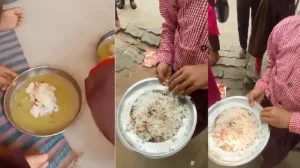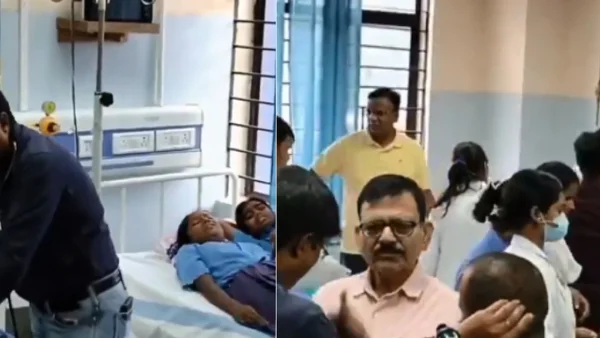
What was supposed to be an ordinary school lunch reportedly turned into a medical emergency at Middle School Parasi in Nalanda, after around 35 children fell ill following a mid-day meal.
According to the allegations circulating about the incident, the children complained that the food had too little salt. What happened next is at the centre of the controversy.
The students allegedly told officials that the cook mixed Surf detergent into the food instead of salt.
If confirmed, the incident would represent an extraordinarily serious failure of food safety and school supervision.
From “Salt Kam Hai” to Hospital?
According to accounts attributed to the children, they complained about the food being insufficiently salty.
Instead of correcting the seasoning normally, the cook allegedly added a substance that the students later identified as Surf/detergent.
Soon afterwards, around 35 children reportedly fell ill, with symptoms that allegedly included vomiting and other signs of illness.
The children were subsequently taken for medical attention.
At this stage, however, the allegation that detergent was actually mixed into the food should be treated as an allegation requiring official confirmation through food sampling and investigation.
That distinction matters.
Because when children fall ill after eating food served at a government school, the first priority should be establishing exactly what they consumed and why they became sick.
The Most Important Question: Was the Food Tested?
Don’t Let This Become Another “Nothing Happened” Story
In cases involving suspected food poisoning, authorities should preserve samples of the meal and conduct appropriate laboratory testing.
The investigation should establish:
What ingredients were used?
Was any detergent or other contaminant present?
Who prepared the meal?
Who supplied the ingredients?
Were food samples retained?
When were the samples tested?
What did the laboratory report show?
What did doctors record about the children’s symptoms?
Were any children hospitalised?
Was the kitchen inspected?
These are not complicated questions.
They are basic questions of food safety and accountability.
The Children Are the Most Vulnerable People in the Room
Mid-day meals are not simply another government programme.
For many children, the school meal is an important source of nutrition.
That makes food quality particularly important.
A child eating a government-provided meal should not have to wonder whether the food contains the ingredients listed on the menu—or something that absolutely does not belong anywhere near a plate.
And if the allegations are true, the issue isn’t merely about negligence.
It becomes a question of how such a dangerous mistake was allowed to happen in the first place.*
And Here Comes the Familiar Cycle
There is an uncomfortable pattern in many alleged school-food incidents:
Children fall ill → parents complain → officials arrive → school denies wrongdoing → inquiry is announced → attention moves elsewhere.
The danger is that the children themselves can become the easiest people to blame.
The sarcastic line circulating around this particular episode captures that fear:
“As usual, the school will deny it—and the children will apologise for falling sick.”
Of course, no child should ever be made to feel responsible for becoming ill after consuming food provided at school.
If It Was an Accident, Explain It. If It Was Negligence, Punish It.
Either Way, There Must Be Accountability
There are several possible explanations for what happened.
The allegation could be completely or partially inaccurate.
There could have been contamination from another source.
There could have been an accidental mix-up.
Or there could have been deliberate negligence.
Only a proper investigation can establish the truth.
But silence, denial or shifting blame cannot substitute for evidence.
If detergent was actually found in the food, the authorities must determine how it got there and whether anyone was responsible.
If it wasn’t, the administration should release the test findings and explain what caused the children to fall ill.
The Government’s Responsibility Doesn’t End at Serving the Meal
A government school meal involves several layers of responsibility:
Procurement → Storage → Cooking → Supervision → Distribution → Health response
A failure at any one of these stages can put children at risk.
That is why accountability should extend beyond the cook.
Who supervised the kitchen?
Who checked the ingredients?
Who was responsible for food safety?
Were prescribed hygiene standards being followed?
Was the school inspected regularly?
The Bigger Issue: Children Shouldn’t Be Guinea Pigs
Government schemes often get measured through numbers:
How many schools covered?
How many meals served?
How many beneficiaries?
But the most important number is sometimes ignored:
How many children ate the meal safely?
Because a successful mid-day meal programme isn’t one that simply puts food on a plate.
It is one that puts safe, nutritious food on that plate.
The children asked for salt. If the allegation is true, they got something that should never have come anywhere near their food.
Now the administration has a simple choice.
Test the food.
Find out what happened.
Tell the parents the truth.
Fix the system.
And if someone was responsible, hold them accountable.
Because these aren’t laboratory samples or statistics in a government report.
They are children.
A school lunch should never become a lesson in how little accountability can cost when the people at risk are too young to demand it themselves.