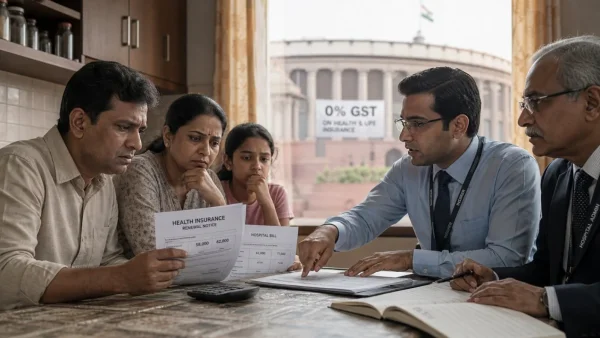
The government’s decision to eliminate GST on individual health insurance was presented as a major relief for policyholders. From September 22, 2025, GST on individual health insurance policies, including family-floater plans, was reduced from 18% to zero. (Financial Services)
But a claim made by journalist Rajiv Ranjan has raised an uncomfortable question:
If the tax has disappeared, why can a customer’s insurance premium still go up?
Ranjan reportedly compared his own premium before and after the GST change, saying that it had risen from around ₹58,000 to more than ₹62,000, despite the removal of the 18% GST.
His account has sparked debate about whether the tax benefit is actually translating into lower costs for ordinary policyholders.
How Can Premiums Rise After GST Becomes Zero?
The Missing Piece: Input Tax Credit
The explanation is more complicated than simply saying that insurers “kept the GST benefit.”
Under the earlier GST regime, insurers could claim input tax credit (ITC) on eligible taxable inputs. Once individual health insurance became GST-exempt, insurers generally lost the ability to claim ITC on taxable inputs such as commissions and brokerage, meaning those costs could become part of the insurer’s overall cost structure. (Press Information Bureau)
This creates an important distinction:
GST on the customer’s premium = 0%
does not necessarily mean
every component of the insurer’s underlying costs = 0%.
Insurers can revise premiums for legitimate reasons, subject to regulatory requirements. IRDAI says health-insurance pricing can take factors including age, risk, claims experience, administrative and distribution expenses, and medical and general inflation into account. (IRDAI)
So a higher renewal premium does not automatically prove that an insurer has pocketed the GST benefit.
But Here Comes the Controversy
The Government Said the Benefit Would Be Passed On
This is where the issue becomes politically and economically interesting.
After the GST exemption was announced, the Department of Financial Services said insurers had agreed to hold premium rates and pass the GST benefit fully to policyholders.
IRDAI subsequently monitored premiums and sought explanations from insurers about increases after the GST announcement. According to a government response in Parliament, all general and health insurers confirmed that they had not increased premiums and that the GST benefit had been fully passed on to policyholders as of January 2026. (Digital Sansad)
That creates an obvious tension with individual experiences like the one described by Ranjan.
If a policyholder’s bill went from ₹58,000 to ₹62,000, what exactly caused the increase? The answer could involve factors unrelated to GST—such as age-related pricing, claims experience, changes in coverage, medical inflation or a revised product structure.
But without examining the actual policy documents and renewal notices, it would be incorrect to conclude that the insurer simply absorbed the tax saving.
Then Comes the Hospital-Bill Allegation
₹42,000 Without Insurance Card, ₹77,000 After Showing It?
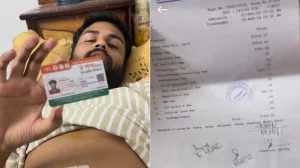
Ranjan also reportedly described an incident involving a relative’s treatment.
According to his account, the treatment reportedly cost around ₹42,000 when the patient did not use an insurance card, but the quoted bill allegedly rose to approximately ₹77,000 after the insurance card was presented.
If independently established, such a difference would raise serious questions about hospital pricing and insurer-hospital arrangements.
But this particular claim should be treated as an allegation requiring documentary verification, rather than as proof that hospitals routinely inflate bills for insured patients.
There can be legitimate differences between cash packages and insurance billing—for example, different negotiated rates, procedures, consumables, package structures and documentation requirements.
Still, a dramatic difference deserves an explanation.
Why Hospital Pricing Is Becoming a Bigger Issue
The Patient Often Finds Himself Between Two Powerful Industries
Health insurance operates through a complicated ecosystem involving:
Patient → Hospital → Insurer → TPA → Network agreements → Claims approval
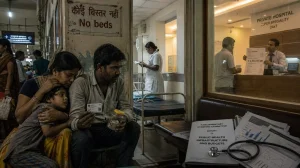
When something goes wrong, the patient can end up caught between competing interests.
Hospitals may argue that insurers negotiate aggressively and delay or restrict payments.
Insurers may argue that some hospitals overcharge or generate unnecessary claims.
And the patient?
The patient just wants treatment at a price they can understand and afford.
Recent reporting indicates that the government is considering broader reforms to address India’s rising healthcare costs, including standardising treatment rates and improving price transparency.
Is There Enough Transparency?
A ₹62,000 Premium Should Come With a Clear Explanation
When an insurance renewal rises substantially, consumers should be able to understand why.
IRDAI already requires insurers to follow principles for health-insurance pricing and provides rules around disclosures and underwriting loadings. (IRDAI)
But the larger consumer question remains:
Can an ordinary policyholder easily understand what caused their premium to increase?
If the answer is no, then even a legitimate price increase can appear arbitrary.
The GST Relief Debate Has a Bigger Lesson
Tax Reduction Alone Cannot Fix Healthcare Affordability
Removing 18% GST from individual health insurance was intended to make insurance more affordable. The government officially describes the measure as a way to reduce the cost burden and encourage wider insurance coverage.
But insurance affordability ultimately depends on much more than GST.
If premiums continue rising because of medical inflation, hospital charges, claims costs and other expenses, then the tax reduction alone cannot guarantee cheaper healthcare.
That’s why the debate is moving from:
“How much GST does the customer pay?”
to:
“How much does healthcare actually cost—and who decides that price?”
What Consumers Should Check
Before concluding that a GST benefit has disappeared, policyholders should compare the old and new policy schedules, not just the final amount.
Look for:
Base premium before GST
GST charged previously
New base premium
Sum insured
Age-related changes
Add-ons or riders
Deductibles and co-payments
Changes in policy terms
Claims history
Any revised product structure
IRDAI also advises consumers to examine exclusions, room-rent limits, waiting periods, co-payments and network hospitals before buying or renewing health insurance. (IRDAI)
The Bigger Question
Where Does the Consumer Stand in the Middle of the Insurance-Hospital Battle?**The controversy sparked by Ranjan’s account points toward a larger problem.
A government can remove a tax.
An insurer can change a premium.
A hospital can set or negotiate treatment charges.
But the person paying the bill has limited bargaining power.
That is why transparent pricing and effective regulation matter just as much as tax relief.
GST may have gone from the health-insurance bill, but affordability isn’t automatically guaranteed.
If consumers still see premiums rising and encounter dramatically different hospital bills depending on whether they use insurance, the question cannot simply be dismissed as a matter of taxation.
The real test of health-sector reform is not how impressive the tax announcement sounds—it is how much an ordinary family actually pays when it renews a policy or walks into a hospital.
Because for a middle-class family, "0% GST” means very little if the final bill keeps moving in the opposite direction.