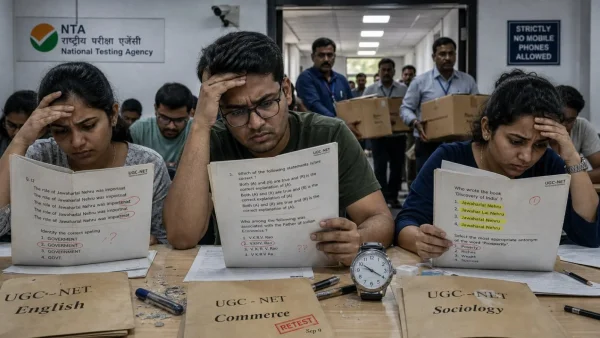
The National Testing Agency (NTA) has ordered fresh examinations for UGC-NET June 2026 in English, Commerce and Sociology after an internal review found serious deficiencies in the question papers.
The decision comes after candidates raised complaints about repeated questions, spelling and typographical errors, factual inaccuracies and translation problems. The controversy has once again put the spotlight on the quality-control mechanisms used in one of India’s major eligibility examinations. (The Times of India)
The UGC-NET is conducted by the NTA on behalf of the University Grants Commission (UGC) to determine eligibility for Junior Research Fellowship (JRF), Assistant Professor appointments and certain PhD admissions. (UGC NET)
What Went Wrong With the Papers?
67 Questions Reportedly Repeated in the English Paper
One of the biggest concerns involved the English paper, where candidates and subject experts alleged that a large number of questions had appeared in an earlier UGC-NET examination.
Reports said 67 out of 150 questions were identical or substantially similar to questions from the December 2024 examination. The allegations became serious enough to prompt demands for an independent inquiry.
A later report from The Economic Times said sources put the alleged repetition in English and Commerce at around 60%, although the precise extent of repetition has been reported differently across accounts.
Sociology Paper Under Scrutiny
When Even Names of Famous Sociologists Went Wrong
The Sociology paper generated a different set of complaints.
Candidates reported multiple spelling and language errors, including incorrect versions of the names of well-known sociologists. Reports cited examples such as “Putzer” instead of Ritzer and “Parsow” instead of Parsons, along with other problematic translations and wording.
Candidates also complained about poorly worded questions and translation issues, arguing that such errors could affect their ability to understand what was actually being asked.
A candidate writing for The Quint described spending significant examination time dealing with errors rather than concentrating solely on answering questions.
Why Didn’t NTA Simply Remove the Wrong Questions?
The Problems Were Considered Too Extensive
Initially, candidates were directed toward the normal question-challenge process.
However, after reviewing the complaints, the agency determined that the problems were substantial enough that simply deleting individual flawed questions would not adequately address the concerns.
An expert committee identified 67 repeated questions along with factual inaccuracies, typographical mistakes and translation errors, according to reports. NTA subsequently decided that fresh examinations were necessary for the three affected subjects.
When Will the Re-Examination Take Place?
No Additional Examination Fee for Affected Candidates
The fresh examinations for English, Commerce and Sociology are scheduled for September 9 and 10, 2026, according to reports.
Candidates who already appeared for the affected papers will not be required to pay another examination fee. The remaining 84 UGC-NET subjects are not affected by the re-test.
NTA sources have also indicated that the number of qualifying candidates and subject-wise allocations will not be reduced because of the re-examination.
NTA Faces Questions Over Quality Control
How Did So Many Errors Reach a National-Level Examination?
The controversy goes beyond individual spelling mistakes.
For candidates who spend months preparing for UGC-NET, the examination is a high-stakes assessment that can influence academic careers, research opportunities and eligibility for teaching positions.
That is why questions are now being raised about the checks that take place before a paper reaches the examination screen.
If repeated questions, factual errors, translation problems and typographical mistakes can survive multiple stages of question-paper preparation, review and approval, candidates naturally want to know where the quality-control process failed.
NTA Responded to the Initial Complaints
Agency Had Earlier Asked Candidates to Follow the Objection Process
When the controversy first emerged, a senior NTA official told NDTV that candidates should formally challenge problematic questions through the prescribed grievance mechanism and that genuine objections would be examined.
The subsequent decision to conduct fresh examinations indicates that the agency ultimately considered the issues serious enough to warrant a broader corrective measure.
NTA Announces Wider Overhaul
More Than 50 Staff Members Removed, Reports Say
The controversy has now triggered wider changes within the examination agency.
Reports say NTA has removed more than 50 staff members and begun restructuring parts of its examination system. It is also bringing in specialists in areas including test security, cybersecurity, psychometrics and technology.
The aim is to strengthen the question-paper creation, confidential operations and examination-security processes.
The Bigger Issue: Students Shouldn’t Have to Proofread the Exam
UGC-NET candidates are expected to demonstrate subject knowledge—not spend valuable examination time wondering whether a question contains a typo, whether a name has been incorrectly printed, or whether an option has been translated correctly.
For a national-level examination, accuracy isn’t a luxury.
It is the minimum requirement.
Students can prepare for difficult questions. They can prepare for tricky questions. They can even prepare for unexpected questions.
What they cannot reasonably prepare for is an examination paper that itself needs proofreading.
The NTA’s decision to conduct fresh examinations is a necessary corrective step for the affected candidates. But the bigger test now is whether the agency can ensure that the next question paper is checked so thoroughly that students are once again competing against the difficulty of the exam—not the mistakes in it.
For thousands of aspirants, the message is simple:
Their careers cannot be a beta test for an examination system that is still learning how to check its own question papers.