The reported findings of the Special Investigation Team (SIT) in the Ram Temple donation-related case have triggered a fresh political and public debate after reports said that Champat Rai and Anil Mishra were given a clean chit.
The development has been welcomed by supporters of the two officials, but critics are questioning whether the investigation examined every relevant allegation and witness thoroughly.
At the centre of the controversy is a larger question:
Was the investigation comprehensive enough to answer all the allegations surrounding the case?
Clean Chit, But Questions Remain
Why Are Critics Questioning the Investigation?
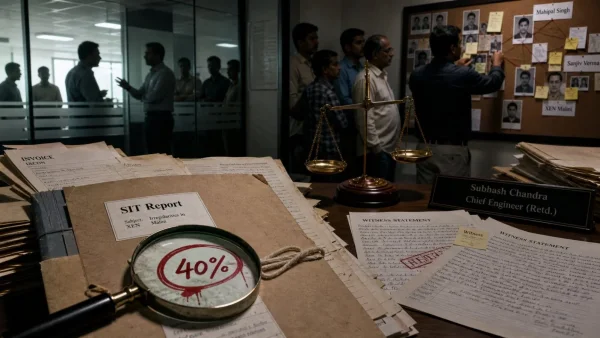
According to the criticism circulating around the SIT report, questions have been raised about whether certain witnesses were examined during the investigation.
One of the names being highlighted is Mahipal Singh, described by critics as a key witness in the matter. Questions have been raised over whether he was summoned or questioned by the SIT.
Another issue concerns engineer Dinanath Verma, who has reportedly made allegations relating to a purported 40% commission in connection with Ram Temple-related work.
These claims should be distinguished from established findings: an allegation or testimony is not proof of wrongdoing unless independently substantiated.
That makes the investigative process particularly important.
The 40% Commission Allegation
A Serious Claim That Demands a Clear Answer
Any allegation involving a commission of this magnitude in a major public-religious infrastructure project naturally deserves scrutiny.
If such a claim was formally made, the obvious questions are:
Was the allegation investigated?
Was the person making the allegation formally questioned?
Were relevant documents examined?
Were financial records independently verified?
Was there evidence supporting or contradicting the claim?
And if investigators found no evidence of wrongdoing, the public deserves to know how that conclusion was reached.
A clean chit carries far greater credibility when the investigative process behind it is transparent and comprehensive.
The Political Battle Is Now Moving Beyond the Investigation
Supporters See Vindication, Critics See Unanswered Questions
For supporters of the Ram Temple Trust leadership, the reported SIT conclusion can be presented as confirmation that allegations against the officials lacked sufficient evidence.
Critics, however, are taking a different view.
Their argument is essentially:
A clean chit can settle an allegation only if the investigation itself leaves no obvious investigative gaps.
That is why the alleged treatment of witnesses has become such an important part of the public debate.
Sarcasm Takes Centre Stage
The political reaction has been anything but restrained.
Critics have sarcastically suggested that the Ram Temple Trust should now “fetch water from the Saryu and wash the feet” of Champat Rai and Anil Mishra before restoring them to their positions.
The remark is clearly political satire, intended to mock what critics perceive as an overly favourable investigative conclusion.
Another sarcastic line circulating around the controversy invokes Lord Ram and Lanka, suggesting that even Lanka would be embarrassed by how the allegations were allegedly handled.
Such rhetoric may be politically charged, but it reflects the intensity of the debate surrounding the case.
The Real Issue: Trust in the Investigation
A Clean Chit Is Only as Strong as the Investigation Behind It
The controversy ultimately isn’t only about two individuals.
It is about public confidence.
The Ram Temple project carries enormous religious, cultural and political significance. Consequently, allegations involving its finances, contracts or administration naturally attract intense public attention.
In such circumstances, the strongest response to allegations is not merely:
“There is no evidence.”
It is:
“Here is what we investigated, here is whom we questioned, here are the documents we examined, and here is why the evidence does—or does not—support the allegation.”
That level of transparency can prevent speculation from filling the information gap.
What Happens Next?
Transparency Could Put the Controversy to Rest
If the SIT report has indeed cleared the individuals named in the allegations, the next logical step would be greater public clarity about its findings and methodology, subject to legal and investigative restrictions.
That could include explaining:
Which allegations were investigated.
Which witnesses were examined.
What documentary and financial evidence was reviewed.
Why specific allegations were rejected.
Whether any irregularities were found elsewhere.
Whether further action was recommended.
Such clarity would help distinguish political accusations from evidence-based findings.
The Question Isn’t Whether a Clean Chit Was Given—It’s Whether Every Question Was Asked
A clean chit should end an allegation when an impartial and comprehensive investigation establishes that there is no evidence of wrongdoing.
But when questions remain about witnesses, alleged commissions or the scope of the investigation, the public debate naturally continues.
The answer to suspicion isn’t louder political rhetoric. It is stronger transparency.
And in a matter as sensitive as the Ram Temple, accountability should be beyond politics.
Because if the allegations are baseless, a transparent investigation can bury them permanently. If they aren’t, transparency can uncover the truth. Either way, the public deserves the full story—not just the final line: “Clean Chit.”