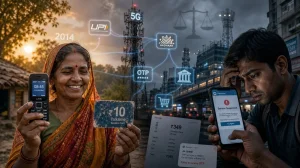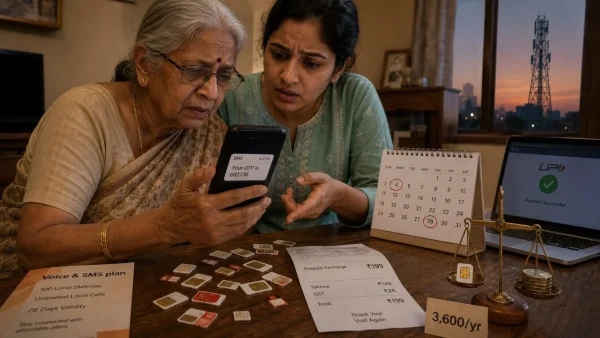
For millions of Indians, a mobile number is no longer merely a tool for making calls.
It is increasingly tied to banking, UPI, KYC, insurance, credit cards, government services and two-factor authentication. Lose access to the number, and a seemingly simple problem can quickly become a digital-access problem.
That has sparked a new consumer question:
If someone already has Wi-Fi and doesn’t need mobile data, why should they have to pay for a data-heavy mobile bundle simply to keep their SIM active and receive calls and SMS? Some consumers are describing the cost as an “OTP tax.”
The phrase is catchy. But the underlying affordability question is very real.
First, One Important Correction: ₹3,600 Is Not a Universal Mandatory Charge
The ₹3,600 figure generally represents a hypothetical ₹300-per-month recharge × 12 months.
It should therefore not be presented as a government-imposed annual OTP charge.
TRAI does not fix mobile tariffs. Telecom operators have commercial freedom to design their plans, subject to regulatory requirements around transparency and non-discriminatory tariffs. (Telecom Regulatory Authority of India)
More importantly, India already has voice-and-SMS-only prepaid plans.
TRAI specifically says such plans are designed for customers who do not require internet services and want mobile connectivity primarily for voice calls and messages. These plans can have validity of up to 365 days. (Telecom Regulatory Authority of India)
So the real question isn’t:
“Why does India force everyone to pay ₹3,600 for OTPs?”
It is:
“Are the cheapest voice/SMS-only options sufficiently affordable and accessible for people who need little or no mobile data?”
That’s a much stronger consumer-policy question.
The Mobile Number Has Become a Digital Key
The importance of a mobile number has changed dramatically.
Today, it can be connected to:
Bank accounts
UPI services
Credit cards
Insurance accounts
Investment platforms
Government portals
KYC processes
Login authentication
Two-factor authentication
Transaction alerts
That creates an unusual situation.
A person might have zero interest in mobile internet, yet still need an active SIM because losing the number could complicate access to other essential services.
This is particularly relevant for elderly users, people who primarily use Wi-Fi and households maintaining secondary numbers.
TRAI Has Already Recognised the “Non-Data User” Problem
There is an important regulatory development that makes this debate particularly interesting.
TRAI’s rules require telecom operators to offer at least one Special Tariff Voucher exclusively for Voice and SMS, with validity of up to 365 days. (Telecom Regulatory Authority of India)
TRAI’s current consumer information also explicitly describes voice-and-SMS-only packs as an option for customers who don’t require data. (Telecom Regulatory Authority of India)
That means the basic principle behind the proposed ₹500 “essential connectivity” plan isn’t completely foreign to India’s regulatory framework.
The debate is now about price, simplicity and adequacy.
What Happens When a SIM Becomes Inactive?
This is where the issue becomes more serious.
TRAI’s prepaid rules say incoming voice calls and SMS continue during the validity period even after the talk-time value has been exhausted. (Telecom Regulatory Authority of India)
But validity matters.
A consumer can’t simply assume that an unused SIM will remain permanently active without maintaining the required service validity.
And for someone whose number is connected to financial services, losing access can create significant inconvenience.
That is why consumers aren’t necessarily asking for free telecommunications.
They’re asking whether there should be a low-cost “keep my number alive” option.
Imagine a Family With Six SIM Cards
Take the example raised in the consumer argument:
₹300 × 12 months = ₹3,600 per number
For six numbers:
₹3,600 × 6 = ₹21,600 a year If all six users already have Wi-Fi and barely use mobile data, a substantial portion of the bundled service may go unused.
The calculation is hypothetical, not a statement that every family actually pays this amount.
But it illustrates the problem:
Why pay for a product you don’t need when what you actually need is a functioning number?
Why Can’t There Be a ₹500 Basic Connectivity Plan?
A proposed basic plan could theoretically provide:
SIM validity
Incoming calls
Incoming SMS
OTP reception
Limited outgoing SMS
Emergency connectivity
Number retention
It wouldn’t need:
❌ Unlimited data
❌ 5G
❌ OTT subscriptions
❌ Hundreds of daily SMS
❌ Unlimited calling
The consumer would pay specifically for basic connectivity.
Whether ₹500 a year is commercially viable is another question.
Telecom companies have network, spectrum, interconnection, customer-service and regulatory costs. So a proposed price needs to account for those realities.
But regulators could at least ask operators to demonstrate whether a genuinely low-cost basic plan is technically and commercially feasible.
Telecom Companies Have a Counterargument Too
It would be unfair to portray every telecom tariff as exploitation.
Operators invest enormous sums in:
Spectrum
4G and 5G networks
Fibre
Towers
Backhaul
Maintenance
Cybersecurity
Customer support
TRAI itself does not prescribe retail mobile prices, leaving operators flexibility to design tariffs according to market conditions. (Telecom Regulatory Authority of India)
And telecom companies have already argued that voice-and-SMS options exist and that overly prescriptive tariff regulation could affect market-led innovation and affordability.
For example, Airtel told TRAI in a 2026 filing that entry-level voice-centric plans already exist and cautioned against excessive regulatory intervention in tariff design. (Telecom Regulatory Authority of India)
So the debate isn’t simply consumer versus greedy companies.
It is about finding the right balance between commercial viability and essential digital access.
The “OTP Tax” Is Really a Digital-Access Question
Calling it an “OTP tax” makes for a powerful headline—but technically, it isn’t a tax.
The government isn’t charging ₹3,600 for every bank OTP.
The money goes to the telecom operator under a commercial tariff.
The more accurate concern is:
Has mobile connectivity become so intertwined with essential services that regulators should ensure an affordable minimum-access product exists? That’s a legitimate policy question.
Should TRAI Consider a “Digital Essential” Plan?
A possible regulatory framework could be explored without dictating the entire telecom market.
For example, TRAI could consider requiring every operator to prominently offer a basic plan containing:
SIM validity + incoming calls + SMS/OTP reception
with:
Long validity
No mandatory data bundle
Transparent pricing
Easy renewal
Number-retention safeguards
TRAI already requires operators to provide a standalone Voice-and-SMS Special Tariff Voucher, so the framework could potentially build on an existing regulatory structure rather than creating an entirely new category. (Telecom Regulatory Authority of India)
But What About OTPs Themselves?
There’s another issue hiding beneath this debate.
Why do so many essential services depend so heavily on SMS-based authentication in the first place?
SMS OTPs are convenient, but digital authentication is evolving.
Banks and other services increasingly use:
App-based authentication
Device binding
Passkeys
Biometrics
Authentication apps
UPI-based verification
Reducing dependence on SMS could eventually reduce the consequences of losing a mobile connection.
But that transition won’t happen overnight.
For many users today, SMS remains an important authentication channel.
The Elderly and Low-Data Users Could Be Hit Hardest
The debate is particularly relevant for people who don’t consume much data.
Consider:
Senior citizens
They may use a smartphone primarily for calls and banking alerts.
Wi-Fi households
Families may use broadband at home and need mobile connectivity only when outside.
Secondary SIM users
Some people maintain a second number primarily for banking or account recovery.
Rural and low-income users
Every recurring expense matters more when household budgets are tight.
For these groups, paying for large data bundles they don’t use can feel unnecessary.
The Bigger “Digital India” Question
India has built one of the world’s largest digital-payment ecosystems.
UPI has transformed everyday transactions.
Online KYC has transformed financial onboarding.
Government services increasingly operate digitally.
But digitalisation creates a new responsibility:
Digital access must remain affordable. If essential financial and government services increasingly depend on mobile authentication, the cost of maintaining basic connectivity becomes part of the cost of participating in the digital economy.
That deserves policy attention.
What TRAI Could Examine
Rather than imposing a ₹500 plan immediately, TRAI could conduct a consumer study examining:
How many subscribers use SIMs primarily for OTPs and SMS?
What is the cheapest Voice/SMS-only plan offered by each operator?
What percentage of subscribers purchase data they barely use?
How many consumers maintain secondary SIMs for banking?
What is the average annual cost of maintaining such numbers?
Would a low-cost long-validity plan be commercially sustainable?
Should incoming SMS remain available for longer under certain conditions?
Could authentication providers reduce dependence on SMS OTPs?
The answers would produce a much stronger basis for regulation than simply imposing a price.
Final Word: Maybe It Isn’t an “OTP Tax”—But It Is a Question Worth Asking
The ₹3,600 figure should not be confused with an official annual government charge, and consumers already have access to voice-and-SMS-only options under India’s telecom framework. (Telecom Regulatory Authority of India)
But that doesn’t make the underlying concern irrelevant.
When a mobile number becomes deeply connected to banking, UPI, KYC, insurance and digital identity, maintaining that number can become an essential household expense.
The consumer question is therefore simple:
If I don’t need 5G, unlimited data or entertainment subscriptions, why can’t I buy a simple, affordable plan that keeps my number active and lets me receive essential calls and OTPs?
Telecom companies deserve a fair return on their infrastructure.
Consumers deserve freedom from paying for services they don’t need.
And regulators should ensure that India’s digital transformation doesn’t quietly create a new barrier for people who simply want to keep their digital identity accessible.