India’s ongoing debate over ethanol-blended petrol has taken another turn after Chief Economic Adviser V. Anantha Nageswaran suggested that the country could offer E10 petrol alongside E20 to address concerns among consumers.
The proposal is significant because ethanol blending has increasingly become a subject of discussion among vehicle owners, manufacturers and policymakers.
Nageswaran’s reported suggestion essentially introduces a simple idea:
Give consumers a choice.
Instead of making the discussion about E10 versus E20 alone, could India allow both options to coexist?
What Exactly Are E10 and E20?
The Number Represents the Ethanol Blend
E10 petrol contains up to 10% ethanol, while E20 contains up to 20% ethanol, with the remainder being primarily petrol.
India has been increasing ethanol blending as part of its strategy to reduce dependence on imported crude oil, support domestic ethanol production and potentially reduce emissions.
But the transition to higher ethanol blends has also generated concerns among some vehicle owners, particularly regarding compatibility, mileage, performance and long-term effects on vehicles.
Why Is E10 Being Discussed Again?
Consumer Choice Could Become the Middle Ground
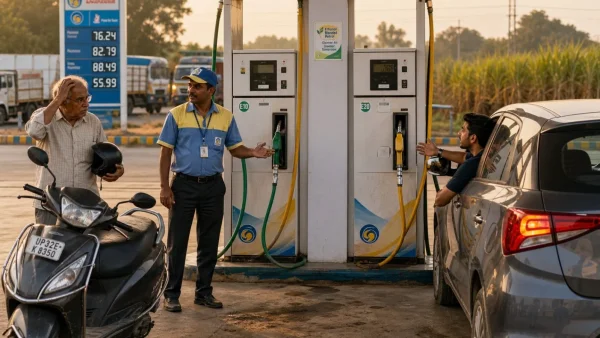
The biggest attraction of offering E10 alongside E20 would be choice.
Consumers with older vehicles or those who remain concerned about higher ethanol blends could potentially opt for E10, while vehicles designed or certified for E20 could continue using it.
This could reduce some of the anxiety surrounding the transition.
Instead of asking citizens to accept a single fuel standard immediately, the government could potentially provide a period of coexistence while the vehicle fleet gradually becomes more compatible with higher ethanol blends.
But There Is a Bigger Question: What Would It Cost?
Choice Sounds Simple—Implementation Isn’t
Offering two fuel blends nationwide would require careful consideration of supply chains, storage, transportation, dispensing infrastructure and pricing.
There is also the question of whether E10 would remain widely available at petrol pumps or become difficult to find.
If E10 is offered only theoretically while most outlets primarily stock E20, the “choice” could become meaningless.
The policy would therefore need clear rules regarding availability, pricing and consumer information.
Ethanol Policy Has Economic Goals Too
The Debate Isn’t Only About Cars
India’s ethanol programme is closely connected to energy security.
Higher ethanol blending can help reduce the amount of petrol—and therefore crude oil—that India needs to import.
It also creates demand for ethanol produced from feedstocks such as sugarcane and grains, supporting parts of the agricultural and biofuel economy.
For policymakers, therefore, the transition toward higher blending isn’t simply a fuel-quality question.
It is also about imports, farmers, energy security and the country’s broader fuel strategy.
The Mileage Debate
Why Some Vehicle Owners Are Concerned
Ethanol contains less energy per litre than petrol. As the proportion of ethanol increases, vehicles may experience some reduction in fuel economy, depending on the engine, calibration and driving conditions.
That is one reason consumers have been debating whether higher ethanol blends actually save them money at the pump.
The calculation is ultimately simple for a driver:
If a litre costs less but the vehicle travels significantly fewer kilometres on that litre, is the consumer actually saving money?
That’s where transparent pricing and reliable mileage information become important.
Could E10 + E20 Be the Political Middle Ground?
One Policy, Two Choices
The suggestion could offer policymakers a way to respond to concerns without abandoning the broader ethanol-blending strategy.
E20 could continue as the higher-blend option, while E10 provides an alternative for consumers whose vehicles or preferences make them more comfortable with the lower blend.
It would also give the market more time to transition toward vehicles specifically designed for higher ethanol concentrations.
The Bigger Question: Should Consumers Get a Choice?
The ethanol debate has often been framed as:
“E20 is the future.”
But the latest suggestion raises another possibility:
“Why not let consumers choose during the transition?”
For a country with a huge and diverse vehicle fleet—including millions of older cars and two-wheelers—a gradual transition may be easier for consumers than a sudden shift. The Strong Closing Angle
India’s Ethanol Story May Not Need to Be E10 vs E20
The more practical question could be whether India can offer both without compromising its energy goals.
If E20 is the destination, E10 could potentially serve as a bridge for consumers and vehicles that aren’t ready—or don’t want—to make the jump immediately.
And that could change the tone of the entire debate.
The question isn’t whether India should pursue ethanol. It’s whether the transition should be designed around policy targets alone—or around the people who actually have to fill their tanks.
Because a fuel transition works best when consumers aren’t simply told what to use—but are given a practical choice while the country moves toward its long-term goal.