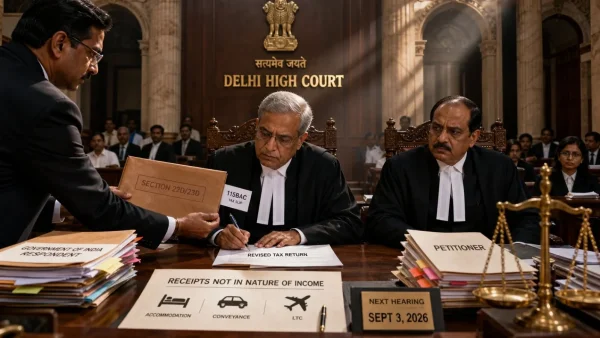
A significant tax dispute involving allowances received by Supreme Court and High Court judges has reached the Delhi High Court, putting the spotlight on the intersection of judicial service conditions, income-tax law and the new tax regime.
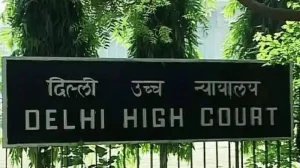
In Delhi Tax Bar Association through its Secretary K.G. Bansal v. Union of India & Anr., W.P.(C) 9365/2026, a Division Bench of the Delhi High Court examined whether certain statutory allowances and perquisites available to judges can continue to remain outside taxable salary when a judge opts for the new tax regime under Section 115BAC of the Income-tax Act, 1961. (Casemine)
The dispute is important because it is not simply about judges receiving a tax benefit. At its core, the case asks whether Parliament’s statutory protections for judicial allowances can be overridden by the architecture of the new tax regime.
What Triggered the Dispute?
The controversy stems from a CBDT Office Memorandum dated September 12, 2025, concerning the taxation of certain allowances available to High Court judges.
The Income Tax Department’s position, as recorded in the proceedings, was that judges opting for the new tax regime cannot claim exemptions or deductions that are unavailable under Section 115BAC. (Casemine)
The disputed benefits include certain allowances and facilities provided under the High Court Judges (Salaries and Conditions of Service) Act, 1954 and corresponding legislation governing Supreme Court judges.
These include:
Rent-free official accommodation or the relevant allowance
Conveyance facilities
Sumptuary allowance
Leave Travel Concession
The legal battle centres on whether these amounts are actually “exemptions” or “deductions” that disappear under the new regime—or whether they are legally excluded from taxable salary altogether.
What Does Section 22D Actually Say?
Section 22D of the High Court Judges Act contains a special provision dealing with income tax.
It states, notwithstanding the Income-tax Act, that specified facilities and allowances shall not be included in the computation of income chargeable under the head “Salaries.” (Casemine)
A corresponding provision exists for Supreme Court judges under Section 23D of the Supreme Court Judges (Salaries and Conditions of Service) Act, 1958.
This wording became central to the case.
The petitioner’s argument was essentially:
If Parliament never included the allowance in taxable salary in the first place, it isn’t an “exemption” or “deduction” being claimed under the Income-tax Act. That distinction could determine whether Section 115BAC affects these benefits.
What Does the New Tax Regime Say?
The new tax regime under Section 115BAC offers taxpayers concessional tax rates in exchange for giving up many exemptions and deductions available under the old regime.
The CBDT’s position was that the new regime does not permit the disputed allowances to be excluded in the manner claimed by judges.
According to the government’s position recorded in the proceedings, the new regime provides lower tax rates but generally removes the availability of various exemptions and deductions. (Casemine)
That creates the central legal clash:
CBDT: New regime means the relevant exemptions cannot be claimed.
Petitioner: These aren’t ordinary exemptions or deductions; the governing legislation removes them from taxable salary altogether.
What Did the Delhi High Court Say?
The Court has not finally decided the case.
But it gave a significant prima facie finding.
The Bench of Justice Dinesh Mehta and Justice Rajneesh Kumar Gupta observed that the non-obstante clauses in Sections 22D and 23D appear, at this stage, to give those provisions overriding effect over the Income-tax Act, including Section 115BAC. (Casemine)
The Court’s reasoning was particularly significant:
An amount that isn’t included in taxable income cannot simply be described as a deduction or exemption.
In other words, the Court distinguished between:
“I earned taxable income and am claiming an exemption”
and
“This amount was never included in taxable salary under the governing statute.”
That distinction is now at the heart of the litigation.
An Important Interim Direction
The Court permitted Supreme Court and High Court judges to file or revise their returns by showing the specified allowances under the category “receipts not in the nature of income.”
More importantly, the Court directed that such returns should not be processed or proceeded with until further orders.
The matter has been listed for September 3, 2026. (Casemine)
This means the interim order should not be presented as a final ruling that judges are permanently exempt from tax on these allowances.
The Court Also Disclosed Its Own Position
An unusual and important aspect of the order is that the Bench addressed potential concerns about conflicts or the appearance of a personal interest.
Justice Rajneesh Kumar Gupta disclosed that he had already filed his return under the new regime without claiming exemption on the disputed allowances.
Justice Dinesh Mehta stated that he had not yet filed his return and intended to file under the old regime so that the dispute would not personally affect or influence his decision. (Casemine)
That disclosure is significant because the litigation directly concerns the tax treatment of judges themselves.
Is This a “Special Tax Break for Judges”?
That is perhaps the easiest—and most politically charged—way to frame the controversy.
But legally, the issue is more complicated.
The allowances in question arise from specific statutes governing the salaries and service conditions of constitutional court judges.
The petitioners also argued that Articles 125 and 221 of the Constitution protect the salaries and allowances of Supreme Court and High Court judges from being varied to their disadvantage after appointment. (Casemine)
The constitutional dimension therefore adds another layer to the dispute.
The Court will ultimately have to consider whether the statutory provisions governing judicial allowances continue to operate despite the new tax regime.
Why Does This Matter Beyond Judges?
The case could have implications for how courts interpret the relationship between:
Special statutory provisions
and
the new income-tax regime.
It also highlights an important principle of tax law:
What is taxable income, and what is merely a receipt that the law excludes before taxation is calculated? That distinction can matter enormously.
If the Court ultimately accepts the petitioner’s interpretation, the ruling could reinforce the principle that a specific statutory exclusion cannot automatically be treated as an exemption or deduction merely because the taxpayer opts for the new tax regime.
If the government’s interpretation ultimately prevails, judges choosing the new regime could face taxation on allowances previously kept outside taxable salary.
The Taxpayer Equality Question
There is also a broader public debate here.
Ordinary taxpayers opting for the new regime have to understand which exemptions and deductions remain available and which disappear.
The government has repeatedly promoted the new tax regime as a simpler system with concessional rates and fewer deductions.
So citizens are naturally likely to ask:
If the new regime removes exemptions, why should judges receive different treatment? The answer, if any, must come from the specific statutory and constitutional framework governing judges, not merely from the fact that they hold judicial office.
That distinction is precisely why the legal interpretation matters.
This Is Not Yet a Final Victory for Either Side
The Court’s order is interim and records a prima facie view.
The government has been given time to file its response, and the matter remains pending. (Casemine)
Therefore, headlines such as “Delhi High Court declares judges’ allowances tax-free under the new regime” would be misleading.
The more accurate description is:
Delhi High Court has, at the interim stage, allowed judges to report specified statutory allowances as receipts not in the nature of income and directed that the relevant returns not be processed until further orders.
The Bigger Question: Can Tax Law Override Judicial Service Laws?
That is ultimately the question behind this case.
Parliament has created a special statutory framework for judges’ salaries and allowances.
Later, the income-tax regime was changed to provide taxpayers with a new concessional structure.
Now the courts have to determine how those two legislative frameworks interact.
This isn’t merely a dispute over a tax bill.
It concerns statutory interpretation, judicial independence, tax administration and the scope of Parliament’s own legislative protections.
What Happens Next?
The Delhi High Court is scheduled to consider the matter again on September 3, 2026. (Casemine)
Until then, the important points are:
The dispute concerns specified allowances and perquisites available to constitutional court judges.
CBDT had taken the position that the new regime does not permit the claimed tax treatment.
The Delhi High Court has expressed a prima facie view that Sections 22D and 23D may operate notwithstanding Section 115BAC.
Judges have been permitted, on an interim basis, to reflect the specified amounts as “receipts not in the nature of income.”
The relevant returns are not to be processed until further orders.
No final decision has yet been reached.
Final Word
The case puts an unusual question before the tax system:
Can something that Parliament has specifically kept outside taxable salary suddenly become taxable simply because a taxpayer chooses the new tax regime? The Income Tax Department says the new regime’s restrictions matter.
The petitioners argue that the allowances aren’t exemptions at all—they are statutory exclusions.
For now, the Delhi High Court has found the latter argument strong enough to grant interim protection.
The final answer, however, is still pending.
And when the Court eventually decides it, the ruling could become an important reference point for understanding where the new tax regime ends—and where special statutory protections begin.