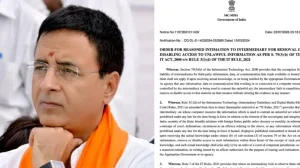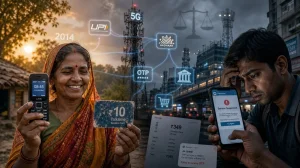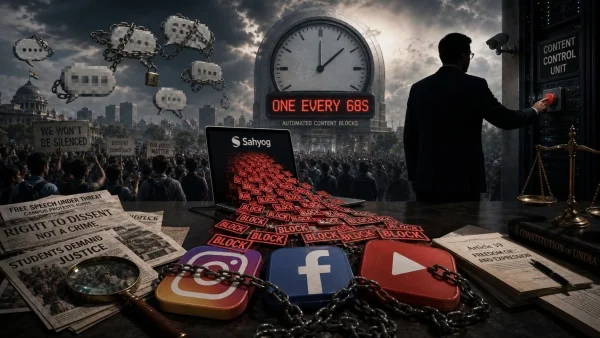
Between March and July, the Indian government sent social-media platforms an average of one blocking instruction every 68 seconds, according to data from the government’s Sahyog system cited in a report by The Indian Express.
That works out to roughly 1,275 instructions every day—and nearly 1.95 lakh instructions in just five months.
The numbers have triggered a larger debate over how India regulates online content, particularly at a time when social media has become one of the primary platforms for political debate, public criticism and student mobilisation.
The figures reportedly show a sharp increase in government instructions sent to platforms including Instagram, Facebook and YouTube during the March–July period.
Instagram Emerges as the Biggest Target
More Than Half of the Blocking Instructions Were Reportedly Sent to Instagram
Among the major platforms, Instagram appears to have received the largest share of the government’s blocking directions, according to the data cited by The Indian Express.
That is significant because Instagram has increasingly become a major platform for political communication, viral videos, citizen journalism and protest mobilisation.
Short videos can reach millions within hours, making the platform particularly influential during public movements.
The rise in blocking instructions therefore raises a basic question:
When does content moderation become excessive control over public conversation?
The Timing Raises Eyebrows
The Spike Coincided With Student Protests
The increase between March and July is particularly noteworthy because it overlapped with a period of heightened student activism over examination-related issues and alleged paper leaks.
The student protest movement at Delhi’s Jantar Mantar began in early June and, according to the information provided, continued until July 25.
During such movements, social media often becomes an alternative information network—allowing protesters to share videos, updates, demands and evidence directly with the public.
That makes the reported surge in blocking instructions especially important to examine.
Was the increase driven primarily by legitimate concerns such as misinformation, harmful content and security threats—or did it also affect political criticism and protest-related material?
The numbers alone cannot answer that question.
But they certainly make the question worth asking.
From Six Orders a Day to More Than 1,000?
The Scale of the Change Is What Makes the Data Stand Out
According to the comparison cited from Sahyog data, between October 2024 and September 2025, the average number of daily orders to remove content was around six.
Against that benchmark, the reported 1,275 instructions a day during March–July represents an enormous increase.
However, the two figures should be interpreted carefully because the categories, legal provisions, reporting periods and definitions of “blocking” and “content removal” may differ.
Still, the contrast illustrates how dramatically government-platform content restrictions can vary over time.
What Is Sahyog?
The Government’s Centralised Mechanism for Content-Removal Requests
Sahyog is a government platform designed to facilitate communication between government authorities and online intermediaries regarding content that authorities seek to have restricted or removed.
The system has become part of India’s broader framework for regulating online content.
Supporters argue that such mechanisms help authorities respond quickly to illegal content, threats and other material that may create public harm.
Critics, meanwhile, have raised concerns about transparency, due process and the possibility of excessive or politically motivated content restrictions.
The Free-Speech Question
The Internet Has Become India’s Public Square
Social media is no longer simply a place for entertainment.
For millions of Indians, it is where they:
Follow breaking news
Document alleged wrongdoing
Organise protests
Question government decisions
Share political opinions
Communicate during demonstrations
Publish material that traditional media may not immediately cover
That makes government blocking decisions particularly consequential.
A post disappearing from a platform is not merely a technical event—it can potentially remove information from a conversation involving millions of people.
At the same time, governments have a legitimate responsibility to act against content that violates the law or poses genuine risks to public safety.
The difficult question is therefore not whether governments should regulate online content.
It is how much power they should have, under what legal safeguards, and how transparently that power should be exercised.
The Student Protest Connection Deserves Scrutiny
If Protest Content Was Blocked, What Exactly Was Restricted?
The reported timing has inevitably prompted questions among those following the student movement.
If government orders targeted illegal, dangerous or demonstrably false content, the reasons should be clearly identifiable.
But if legitimate protest documentation, criticism or political speech was restricted, that would raise a very different set of concerns.
The distinction matters enormously.
A government blocking a fraudulent scam advertisement is one thing. A government blocking criticism of itself is another.
Without access to the individual orders and their legal grounds, however, it would be premature to conclude that the reported increase was specifically intended to suppress student protests.
The Bigger Question: Who Watches the Watchers?
When Content Disappears, Transparency Becomes Essential
The reported numbers bring the focus back to a fundamental democratic principle:
If the government asks a platform to remove something, citizens should have meaningful ways to understand why.
Greater transparency around blocking instructions could help answer questions such as:
Which law was invoked?
Which authority issued the order?
What category of content was targeted?
How many orders were successfully challenged?
How many were later withdrawn?
Were journalists, political speech or protest-related content affected?
What independent oversight exists?
Without such information, the public sees only the final result:
Content disappears.
The Irony of the Digital Age**
The Government Doesn’t Need to Shut Down the Entire Internet to Control the Conversation. Sometimes, controlling what gets seen can be enough.
One post removed may seem insignificant.
One account restricted may seem insignificant.
One video blocked may seem insignificant.
But when the numbers reach hundreds of thousands of government instructions in a few months, the scale itself demands scrutiny.
A democracy should not be judged only by how freely people can speak—but also by how transparently the state explains when, why and under whose authority that speech is restricted.
If the reported one blocking instruction every 68 seconds is accurate, the story is bigger than Instagram, Facebook or YouTube.
It is about the future of India’s digital public square.
Because when almost 1.95 lakh doors to online information can be asked to close in five months, citizens deserve to know who is closing them—and why.