What was once presented as a major infrastructure investment is now attracting attention for a very different reason.
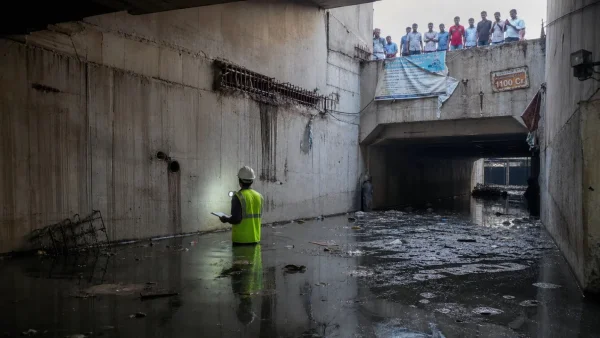
A tunnel project reportedly built at a cost of around ₹1,100 crore has allegedly deteriorated into a waterlogged, stagnant stretch, raising uncomfortable questions about planning, engineering, drainage and the use of public money.
A project costing thousands of crores is expected to deliver long-term public value. When such infrastructure instead becomes unusable or requires repeated repairs, the issue goes beyond inconvenience.
It becomes a question of governance.
From Mega Infrastructure to ‘₹1,100-Crore Water Body’?
The Question Nobody Wants to Answer
The purpose of a tunnel is fairly straightforward: improve connectivity, reduce travel time and provide reliable infrastructure.
But if water accumulation, drainage failures or structural problems leave the facility struggling to perform its basic function, taxpayers are entitled to ask:
Where did the planning go wrong?
Was the drainage system properly designed?
Were geological and rainfall conditions adequately studied?
Was the project independently inspected before being opened?
And perhaps most importantly:
Who is accountable when a ₹1,100-crore project fails to deliver what it was built for?
A Costly Project Cannot Have a Short-Term Lifespan
Public Infrastructure Is Supposed to Outlive Headlines
Large infrastructure projects are often announced with impressive numbers—kilometres of tunnels, thousands of crores in investment and ambitious completion targets.
But the real test begins after the inauguration ceremony.
A tunnel costing ₹1,100 crore cannot be judged merely by whether it was completed on schedule. It should be judged by whether it remains safe, functional and economically useful for years.
If significant deterioration occurs soon after construction, authorities need to explain whether the problem resulted from:
Design shortcomings
Poor construction quality
Inadequate drainage
Faulty maintenance
Unexpected environmental conditions
Contractual failures
Or a combination of these factors
Where Did the Planning Fail?
Waterlogging Is Not an Unexpected Guest in Infrastructure Planning
One of the most important questions surrounding any tunnel in a high-rainfall or groundwater-sensitive area is water management.
Engineers must account for surface runoff, groundwater seepage, drainage capacity, pumping systems and emergency water evacuation.
If a completed tunnel repeatedly accumulates stagnant water, an obvious question follows:
Was the drainage system designed for the conditions the tunnel actually faces?
If yes, why is it failing?
If no, why wasn’t the risk identified during planning?
Either answer deserves public scrutiny.
₹1,100 Crore and the Accountability Gap
Taxpayer Money Doesn’t Come With an ‘Oops’ Button
Infrastructure spending involves public money.
That means citizens should be able to expect transparency regarding the project’s original cost, tender conditions, construction standards, maintenance responsibilities and expenditure on subsequent repairs.
If additional public funds are now required to restore the tunnel, the public deserves to know why the original investment wasn’t enough.
And if a contractor or agency is found responsible for defective work, accountability should not end with a press statement.
There should be consequences under the applicable contractual and legal framework.
The Bigger Problem With ‘Build First, Fix Later’
Inauguration Is Not the Finish Line
India’s infrastructure ambitions are growing rapidly. New tunnels, bridges, expressways and urban projects are essential for economic development.
But speed cannot replace quality.
A project should not be considered successful simply because:
Tender awarded → Construction completed → Inauguration held → Cameras switched off.
The real sequence should be:
Plan → Build → Independently inspect → Operate → Maintain → Monitor → Fix responsibly.
Online Reactions: Sarcasm Writes Itself
If the reported condition is accurately represented, social media users are likely to ask the obvious sarcastic question:
“₹1,100 crore for a tunnel—or the country’s most expensive swimming pool?”
Another reaction practically writes itself:
“At least the water body didn’t need a separate construction budget.”
Humour may make the story viral, but behind the jokes is a serious issue: public infrastructure cannot become a monument to poor planning. A ₹1,100-Crore Project Should Not Become a ₹1,100-Crore Question Mark
The real scandal, if an independent inquiry establishes serious planning or construction failures, would not simply be the stagnant water.
It would be the possibility that warnings were ignored, risks were underestimated and public money was spent without adequate safeguards.
Citizens don’t expect every infrastructure project to be perfect.
They do expect something much simpler:
If ₹1,100 crore of public money is spent, the public should receive ₹1,100 crore worth of functioning infrastructure—not a bill, a repair estimate and a puddle.
*Because a tunnel becoming waterlogged is an engineering problem.
A ₹1,100-crore tunnel becoming a failed asset without anyone being held accountable is a governance problem.***