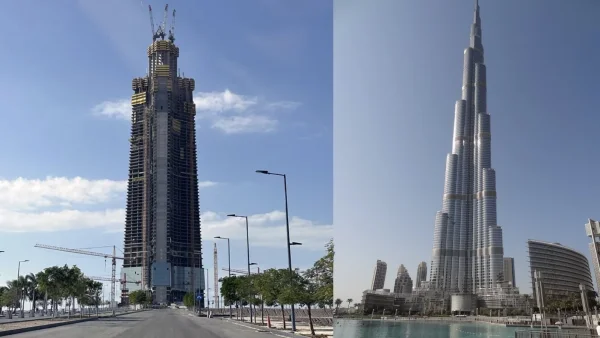
Saudi Arabia’s Jeddah Tower has reached a big point in its development, going past eighty floors and ready to be taller than the Burj Khalifa in Dubai, as the world’s tallest building. The very tall building is seen as a ‘vertical city’ and will probably change what people think of height, engineering, and city life, all over the world.
It is planned to be over 1,000 meters high – more than the Burj Khalifa by almost 200 meters. If it’s built as planned, it will be the first thing people have made that reaches a whole kilometer into the air. Being the center of Jeddah Economic City, the project is very important to the Kingdom’s Vision 2030 plan. The aim is to turn Jeddah into a world center for tourism, business, and a top-class lifestyle, and to move the economy away from depending on oil.
The tower was designed by Adrian Smith + Gordon Gill Architecture – the company that did the 828-meter Burj Khalifa. The team is using the newest engineering to deal with wind, heat and the pressure on the structure at very high levels.
Thornton Tomasetti, the structural engineers, said the building went past the 80-floor mark in December 2025. The company thinks the finished building will be over 1,000 meters, giving a new standard for very tall building work.
Being stable at this size depends on a shape that’s good for the air, which cuts down wind force. A strong concrete and steel center gives strength, while deep bases spread the huge weight over the land.
To deal with the heat and desert winds of the area, the outside of the tower will use energy-saving walls and advanced air systems. Smart controls will make the best of cooling, lights, and safety, making it work better and cutting costs.
Moving people up and down is central to what people using it will feel. The very fast lifts are likely to be among the fastest in the world, making the time it takes to get between hotels, offices, shops and the viewing platform less. Sending people to lifts based on where they want to go and having separate lift shafts will help deal with the biggest numbers of people.
Building began in 2009 but stopped in 2018 because of changes in who the building company was and in politics. Starting it up again shows that the project, and Saudi Arabia’s wider plans for its skyline, have new energy.
‘Building work has got going again, and the feeling on the site is strong,’ said Robert Forest, a partner at AS+GG. ‘The whole team is set on, and working to, making this famous building for the Kingdom of Saudi Arabia.’
The tower’s mix of uses fits what the market wants in developments that have everything people need and good things in them. People who live there, companies who rent space, and visitors will all share a ‘vertical world’ with places to stay, shops, and first-class views from the viewing platform.
More than just being famous, Jeddah Tower is a statement of what Saudi Arabia wants to do. It shows the Kingdom’s wish to get money in, skilled people and tourists, through bold city projects that are linked to Vision 2030.
There is more and more competition for height. With Jeddah Tower, the Kingdom has put forward ideas like a tower with the Trump name on it in Jeddah, and the $5 billion Rise Tower in Riyadh, which people say might reach 2 kilometers high.
Important points
What matters now is getting it done. Look out for when it reaches its highest point, how the outside walls are put on, and when the lift systems are tested. How quickly hotels, homes and offices are rented will also show what the market wants at the very highest level.
If the time plan is kept to, 2028 could see the world’s highest building move from Dubai to Jeddah. For building design, engineering and city development, the project is a very important test of how far ‘vertical cities’ can go in size, being good for the environment, and how people can use them in their everyday lives.