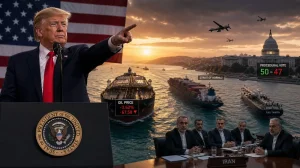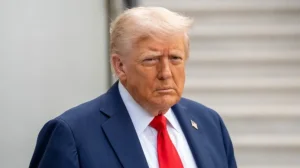
Donald Trump made it plain: if Tehran doesn’t toe the line on a pending accord, he will be back with the bombs. His words in France have sown some doubt over a plan that was being sold as an exit from a war of attrition, and they come just before a signing is due in Switzerland.
A deal in sight, but with a threat attached
According to Trump, the arrangement to put an end to hostilities is no done deal. He called it a memorandum of understanding for what it is – something that can be put in reverse. In his view, a hard line has been the only thing to keep off a global depression, one he said was being pushed by “stupid people.”
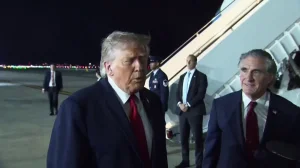
He was most direct when he was with Egypt’s President Abdel Fattah al-Sisi. “If they do not behave, we will go right back to dropping bombs right smack in the middle of their head,” he said. He also made a point of noting 47 years of misbehaviour on Iran’s part.
Energy chokepoint at the centre of the stakes
There is more to it than the talk. The Strait of Hormuz is already partly open and will be in full swing in a day or two, Trump said. You can’t put a price on getting those energy lines back up and running.
You could say the MoU is the means to an end – to stop the shooting and get business moving. But for all that, Trump won’t let you think the deal is set in stone, which is a reminder of how easily things can turn to force again.
What is in the framework under discussion
The US and Iran put out a framework the day before the summit got underway. Word on the street is that it calls for a 60-day lull in the fighting, the opening of Hormuz and an end to the American blockade on Iran.
Then there is a copy that has seen the light of day. That one says Iran can move its oil as it pleases and that the US would put up some $300 billion to help rebuild and develop the Iranian economy.
Trump has no time for that. “We are not putting up 10 cents. We are not investing, and we do not have a fund,” he said, making short work of the $300 billion figure even as he hypes the accord as a victory.
Why Trump’s remarks shift the calculus
It changes the equation for anyone who was banking on a ceasefire and some normalcy in trade. Now energy traders, shippers and governments in the region are left with an either/or: do as you’re told or we’ll be back with the strikes.
He has been making a case for his Iran deal since he hit France, but he has made its future contingent on some undefined good behaviour. It leaves the people at the table having to de-escalate and put up a front at the same time.
Here is what you are working with, from the documents and the people involved:
– 60-day halt in fighting
– Lifting of the US blockade
– Strait of Hormuz reopening
– Iran oil sales without restrictions
– US reconstruction funds denied by Trump
– MoU status not final
– Threat of renewed bombing
Impact on the war and the region
On paper, this is a way out of a conflict that has run amok across the Middle East and put a crimp in the supply of energy. Get the Strait open and the blockade down and the pressure on world shipping is off in a hurry.
But there is a chasm between what has been leaked and where Trump draws the line. Should there be a row over the money or how to make it stick, the 60 days on the clock may be less of a path to peace and more of a test of wills.
What happens next
All eyes are on a Friday in Switzerland for the signature, with the nitty-gritty of a final settlement to follow. The negotiators have 60 days to make the broad strokes of the deal into something with teeth.
With Trump’s warning in the air, there is a new value on being able to verify and build trust fast. One side makes an accusation of bad faith and you are back to military options in no time, and with it, any hope of those energy arteries being open again.