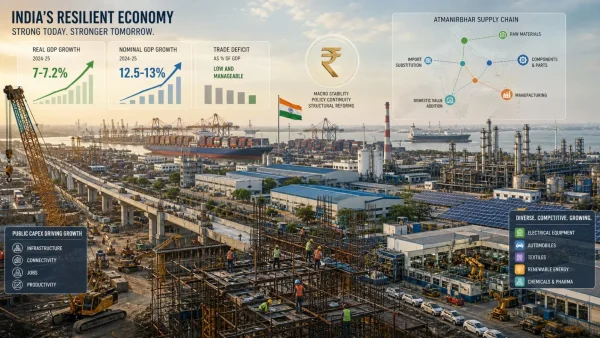
The growth narrative in India does not falter when faced with softer global commerce or steeper energy costs. An EY India review from August 2026 has the real GDP for FY27 on track for that 7-7.2% rise, anchored by frontloaded public capex and consistent domestic appetite while external forces bear down.
Growth outlook holds firm despite external strain
EY is forecasting a resilient band of 7.0-7.2% for real growth in FY27, no small feat given the circumstances. A decisive fiscal push early in the year is what underpins this; central capital expenditure put up 23.7% in 1QFY27, putting an end to the previous quarter’s lull and creating room for private investment and the supply chains that depend on them for jobs.
As for nominal GDP, EY has it at 12.5-13%. The firm sees wholesale price pressures as enough to put nominal growth ahead of the government’s 10.04% budget figure, which in turn bolsters revenue and ensures the financing of growth is non-inflationary.
External pressures are forcing a sharper policy pivot
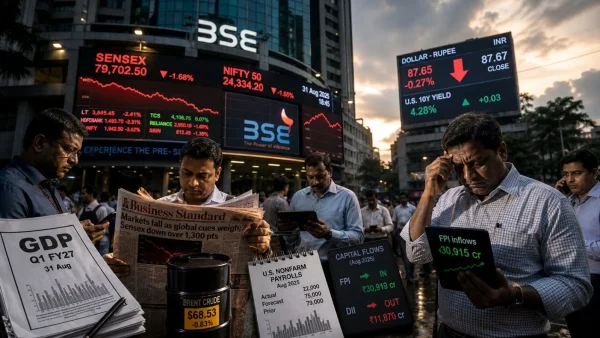
Take the merchandise trade deficit: it hit a six-month high of $32.0 billion in July 2026 with the rupee averaging INR 95.8/US$. The OECD has the current account deficit at 1.9% of GDP for FY27, a clear indication of the terms-of-trade penalty exacted by global energy prices.
There are concentration risks that amplify such shocks, says EY. D.K. Srivastava observes that petroleum crude and its products make up 22.4% of all imports. The rest, 77.6%, are largely drawn from China-centric hubs. It is a case for more diversified sourcing and substituting imports.
A focused import substitution plan takes shape
One can see policy moving away from blanket protectionism toward incentives at the product level. EY reports a Centre-state approach to replace some $189 billion in imports across 1,272 items – from chemicals and electronics to machinery and specialty steel – in order to put forex to better use and put down roots in the domestic value chain.
It is a redesign with a medium-term objective in mind: to lessen reliance on certain commodities and partners and to cultivate export strength through scale manufacturing instead of mere import curbs.
Industry and credit signal momentum, with caveats
The industrial recovery is plain to see. June 2026 saw the Index of Industrial Production up 7.3%, a 23-month best. Manufacturing output was up 7.8% with electrical equipment, motor vehicles and food products among the standouts, contributing to an average industrial growth of 5.7% in 1QFY27, the strongest in eight quarters.
Financially, the conditions are conducive. Gross bank credit growth hit an 18.6% in June 2026, a 25-month high, indicative of healthier balance sheets and an appetite for lending. But there are signs of moderation in the high-frequency numbers: the services PMI has cooled to 53.3 from 57.4 and manufacturing to 53.5 from 54.2 in July, though both remain in expansion mode.
Inflation, rates and the fiscal path
Headline CPI held at 4.4% in July, a touch over target but nothing to alarm. Wholesale price inflation was 9.8%, with mineral oils, metals and fuels being the drivers. The RBI’s MPC in August 2026 left the repo rate where it was at 5.25%, maintaining a neutral position for the sake of stability.
Fiscally, the 23.7% capex rebound in 1QFY27 comes after a 23.3% drop in 4QFY26. The quarter’s deficit was 18.2% of the annual target. With nominal growth possibly as high as 13%, the full-year deficit is expected to be contained at 4.3% of GDP.
Some of the markers to watch in the coming quarter include:
– How global energy prices pass through
– Any shifts in PMI for manufacturing and services
– What progress is made on the 1,272-product import initiative
– The CAD trajectory in relation to the 1.9% forecast