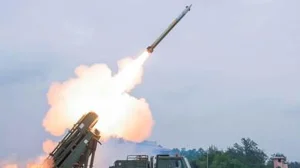
India’s defence sector is undergoing a major structural shift.
For decades, the development and production of sophisticated weapons remained heavily concentrated within government institutions and defence public-sector undertakings. That model is changing rapidly, with private companies increasingly being brought into the development, integration and manufacturing of advanced military systems.
But the claim that this is simply the “first time ever” that private companies are being allowed to build advanced missiles and nuclear-related systems needs qualification.
Private industry has already been involved in India’s defence ecosystem, including through technology transfers and partnerships. DRDO’s own records show that Category-A military technologies can be transferred to industry under licensing arrangements, and its current technology-transfer listings include systems such as the Astra Mk-I weapon system, HELINA missile system and 120-mm laser-guided anti-tank missile technology. (DRDO)
The genuinely significant development is the expansion of private-sector participation into increasingly sophisticated and strategic areas.
Why Is the Government Doing This?
The argument from the government side is straightforward:
India needs more capacity, more competition and faster production. Modern warfare requires enormous quantities of missiles, ammunition, drones, sensors and electronic systems.
A government-only manufacturing ecosystem can struggle to scale quickly enough.
The Defence Ministry has therefore been pushing greater private participation as part of Atmanirbhar Bharat.
DRDO itself has an established industry-partner ecosystem, while the government has progressively expanded opportunities for private companies to design, develop and manufacture defence systems. (DRDO)
Recent DRDO-linked reporting has also described the opening of missile and ammunition manufacturing to private companies, with the stated objective of increasing India’s defence-industrial capacity. (DRDO)
The Potential Upside
There are genuine arguments in favour of the move.
1. Faster production
Private companies can potentially build manufacturing capacity faster than traditional government establishments.
2. Competition
More suppliers could reduce dependence on a small number of state-owned manufacturers.
3. Innovation
Private firms may bring new approaches in electronics, artificial intelligence, propulsion, materials and manufacturing.
4. Export potential
A larger defence industry could eventually make India a more significant exporter of military equipment.
5. Surge capacity during conflict
Perhaps most importantly, multiple production lines could allow India to rapidly increase output during a prolonged conflict.
DRDO leadership has itself emphasised the importance of creating greater industrial “surge capacity” for situations requiring rapid replenishment. (DRDO)
But Here Comes the Difficult Question
Should every strategic technology be opened to private industry? This is where legitimate concerns begin.
A missile isn’t simply another manufactured product.
Some defence technologies involve:
Highly sensitive designs
Guidance systems
Propulsion technology
Military communications
Electronic warfare capabilities
Classified operational requirements
Strategic information
And when technologies have nuclear or strategic implications, the sensitivity becomes even greater.
That means ordinary corporate safeguards may not be enough.
Risk No. 1: Leakage of Sensitive Technology
The biggest concern is information security.
Even if a private company is trustworthy, it may employ thousands of people, work with subcontractors and maintain complex supply chains.
Every additional organisation involved in a sensitive project potentially creates another security interface.
The question therefore becomes:
How deeply can private companies be involved without increasing the possibility of classified information leaking? That requires extremely strict compartmentalisation, background checks, cybersecurity and continuous monitoring.
Risk No. 2: Corporate Concentration
Ironically, introducing private competition could eventually create another problem:
What if only a handful of large conglomerates end up controlling critical defence production? Instead of government monopoly, India could theoretically move toward private-sector concentration.
That would create its own strategic vulnerability.
If one company becomes responsible for a critical component and its production is disrupted because of financial problems, cyberattacks, industrial disputes or supply-chain failures, the armed forces could face serious consequences.
Risk No. 3: Profit vs National Security
A private company ultimately operates as a business.
Its shareholders expect efficiency and returns.
National security, however, sometimes requires maintaining expensive capabilities even when they aren’t commercially attractive.
For example:
A military may need a particular component even when producing it isn’t profitable.
The government therefore needs mechanisms ensuring that commercial considerations never override strategic requirements.
Risk No. 4: Accountability
This may be the most uncomfortable question.
If a government facility produces a defective defence component, there are established institutional chains of responsibility.
But when multiple private contractors, subcontractors and technology partners are involved, accountability can become complicated.
Who is responsible if:
A component fails?
Quality control is compromised?
A classified file leaks?
A contractor misses a deadline?
A subcontractor is compromised?
A cyberattack exposes sensitive information?
The contract cannot become a shield against accountability.
And What About “Nuclear-Related Systems”?
This part requires particular caution.
It would be misleading to suggest that private companies are simply being given unrestricted access to India’s nuclear weapons programme.
India’s nuclear sector operates under a much more tightly controlled strategic framework.
There is a major difference between:
manufacturing a defence component with potential strategic applications
and
being authorised to independently develop or control nuclear weapons.
Those should not be conflated.
So headlines suggesting that private companies are suddenly being handed India’s nuclear arsenal would require substantial evidence.
This Is Not an Overnight Revolution
Private participation in Indian defence is not entirely new.
DRDO has already been transferring technologies to private companies.
For example, DRDO records show technology transfers involving private-sector firms for systems including armoured vehicles, mounted gun systems and other defence equipment. (DRDO)
DRDO has also partnered with private industry on missile development. In 2026, the UAV-Launched Precision Guided Missile (ULPGM)-V3 development involved Bharat Dynamics Limited and Adani Defence Systems & Technologies as production agencies.
So the real story is not:
“Private companies have suddenly entered Indian defence.”
It is:
“Private companies are being pushed deeper into increasingly sophisticated defence technologies.” And that distinction matters.
The Question India Must Not Ignore
The government wants a defence ecosystem capable of producing weapons at scale.
That’s understandable.
But speed cannot replace safeguards.
Before expanding private participation in the most sensitive technologies, India needs iron-clad answers on:
Who gets access?
Who monitors them?
Who audits them?
Who protects classified information?
Who owns the intellectual property?
Who is liable when something goes wrong?
What happens if a private company becomes financially distressed?
Can the government take over critical production during a national emergency?
These aren’t anti-private-sector questions.
They are national-security questions.
The Bigger Debate: Self-Reliance or Privatisation of Security?
Supporters will argue that India cannot become militarily self-reliant while keeping its defence industry artificially restricted.
Critics will counter that national security cannot be treated like an ordinary commercial market.
Both arguments contain some truth.
India needs private innovation.
But it also needs state control over the most sensitive strategic capabilities.
The challenge is finding the line between the two.
India needs more missiles, faster innovation and greater defence manufacturing capacity. But opening the door to private industry should never mean opening the vault.
Private companies can bring:
capital, technology, competition and manufacturing scale.
But strategic weapons require:
security, oversight, accountability and national control.
The success of this policy will therefore not be measured simply by how many private companies receive defence contracts.
It will be measured by whether India can build a powerful private defence industry without compromising the security of the technologies that industry is being trusted to handle. More manufacturers may strengthen India’s defence.
Weak safeguards could weaken it.
That is the line policymakers now have to get exactly right.