A politically charged claim circulating on social media has alleged that “after ISRO, now DRDO has also been sold off”, accusing the Narendra Modi government of transferring the country’s strategic defence research responsibilities to private companies.
The claim has sparked debate over India’s defence policy and, more broadly, over the changing role of private industry in the country’s strategic and military sectors.
However, the phrase “DRDO has been sold off” does not accurately describe the institutional position of the organisation. The Defence Research and Development Organisation remains a government organisation under the Ministry of Defence and continues to conduct research and development for India’s armed forces.
Why DRDO matters
DRDO is one of India’s principal defence research organisations. Its laboratories and programmes have been involved in the development of a wide range of technologies, including missiles, radars, electronic warfare systems, combat vehicles, aircraft-related technologies, armaments and other defence systems.
For decades, DRDO has played a central role in India’s effort to reduce dependence on imported military technology and develop indigenous capabilities for the Army, Navy and Air Force.
Because many of these technologies directly concern India’s strategic capabilities, any major change in the way defence research is conducted naturally attracts public attention.
Where does the private sector come in?
The government’s defence-industry reforms have increasingly encouraged private companies, start-ups and other non-government organisations to participate in defence research, development and manufacturing.
Supporters of this approach argue that greater participation by private industry can bring additional investment, specialised expertise, faster innovation and stronger competition into India’s defence ecosystem.
The objective, they argue, is not necessarily to replace DRDO but to create a broader network in which government laboratories, universities, start-ups and established defence companies work together.
Critics, however, have raised a different concern: How much of India’s strategically sensitive defence research should be opened to private companies?
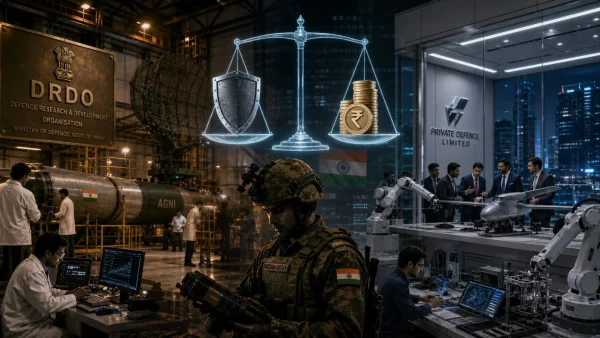
Can profit and national security coexist?
The criticism circulating online is based on a fundamental concern.
Private companies operate commercially and ultimately have to consider costs, efficiency and profitability. Critics therefore question whether commercial incentives could ever conflict with the demanding requirements of national security.
Defence equipment is not an ordinary commercial product. A failure in a missile, radar, aircraft component or battlefield communication system can have consequences far beyond financial losses.
That makes quality control, testing, reliability, cybersecurity and accountability particularly important.
At the same time, supporters of private-sector involvement point out that commercial participation does not automatically mean lower quality. Private companies already operate in highly regulated industries, and defence contracts can be subject to technical specifications, trials, certification, inspections and government oversight.
The ISRO comparison
The claim also invokes ISRO, India’s space agency, as part of a broader political argument about the increasing participation of private industry in strategic sectors.
But the comparison requires caution.
India has been encouraging private participation in the space sector while ISRO itself remains a government organisation. Similarly, increased private-sector participation in defence does not mean that DRDO has ceased to be a government institution.
The more meaningful question is therefore not whether the government has literally “sold” DRDO, but how responsibilities are being divided between DRDO and private industry—and whether adequate safeguards are in place.
The national-security question
The debate becomes especially important when the technology involved is strategically sensitive.
India faces a complex security environment, and maintaining domestic capabilities in missiles, surveillance, electronic warfare, aerospace and other advanced technologies is considered strategically important.
A successful partnership between government laboratories and private industry could potentially accelerate the development and production of such systems.
But greater private participation also requires strong safeguards against conflicts of interest, cost overruns, quality failures, data leaks, cybersecurity threats and excessive dependence on individual companies.
What should the public be asking?
Instead of relying solely on the political phrase “DRDO has been sold off,” the debate should focus on specific questions:
Which defence R&D programmes are being opened to private companies?
What responsibilities remain exclusively with DRDO?
How are strategically sensitive technologies protected?
Who conducts testing and quality assurance?
What penalties apply if defence equipment fails to meet specifications?
How is intellectual property created through public funding protected?
Does private participation improve India’s technological self-reliance—or create new dependencies?
These are questions that deserve transparent answers.
Beyond the political slogans
The transformation of India’s defence ecosystem is a significant policy development, but describing it simply as the “sale of DRDO” risks obscuring the more complicated reality.
DRDO continues to be a government defence R&D organisation, while private companies are increasingly being encouraged to participate in India’s defence innovation and manufacturing ecosystem.
The real test will be whether this model strengthens India’s technological independence without compromising quality, accountability or national security.
For a country whose defence preparedness depends increasingly on indigenous technology, the debate should ultimately be judged not by political slogans, but by one measurable outcome:
Are India’s soldiers, sailors and air force personnel receiving safer, more reliable and more advanced systems—and is India becoming genuinely more self-reliant in defence technology?