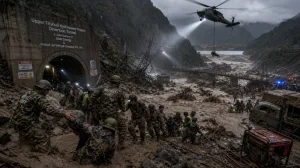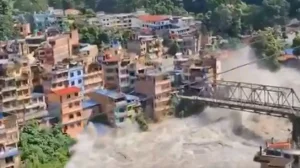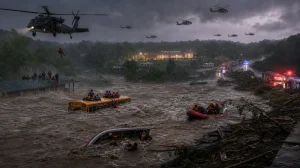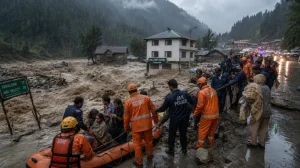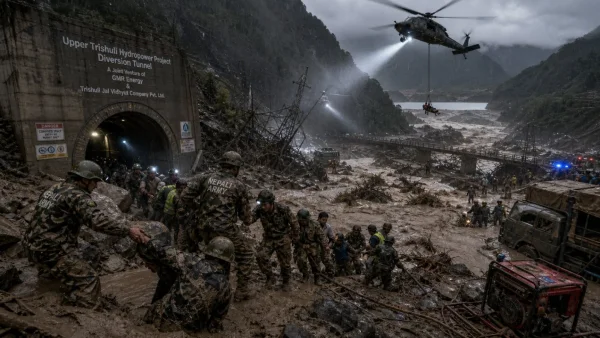
A devastating Himalayan disaster has entered an even more dangerous phase after a newly formed lake near the Nepal–Tibet border began overflowing, raising fears of another flash flood in an area already struggling to recover from a catastrophic deluge. Rescue operations were temporarily suspended as authorities assessed the risk posed by the unstable water body and surrounding terrain. Residents in vulnerable areas were urged to move towards higher ground as emergency teams warned of the possibility of further flooding, landslides and avalanches.
The developing crisis follows a massive glacier collapse and ice-rock avalanche on August 26, which sent an enormous surge of mud, rock, ice and water through river valleys on both sides of the Nepal–China border.
A disaster born in the high Himalayas
According to reporting based on satellite imagery and expert analysis, a section of glacier and surrounding rock near Langtang Lirung in Nepal collapsed, sending debris into the Lhende Khola river.
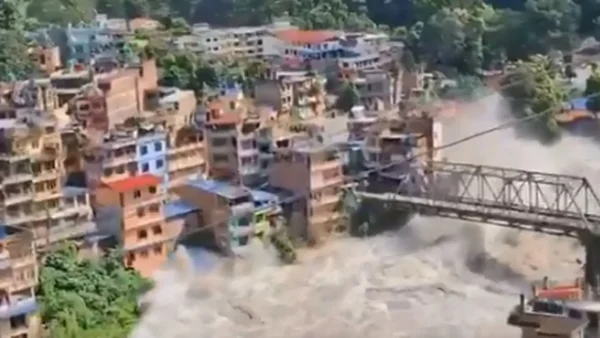
The resulting debris flow travelled for more than 20 kilometres and struck the Gyirong border area in Tibet, before devastating communities downstream in Nepal. Roads, bridges, homes, power infrastructure and other facilities were swept away.
The scale of the destruction has been enormous.
Reports indicate that hundreds of people have died and well over a thousand remain missing, although casualty figures continue to change as rescue teams reach previously inaccessible areas. More than 90,000 people have reportedly been affected by the wider disaster.
Now comes the threat of a second disaster
The first flood was already devastating. But the formation of a natural barrier lake has created a new danger.
The landslide and debris blocked the normal flow of water, creating a lake upstream. As water continued to accumulate, authorities feared that the barrier could fail or overflow suddenly, releasing another powerful surge downstream.
At one point, rescue teams were forced to suspend operations because conditions became too dangerous. Villagers and emergency personnel were moved away from potentially vulnerable areas as authorities monitored the rapidly changing situation.
China subsequently resumed rescue work after aerial surveys and modelling suggested that the immediate risk had become more manageable, although officials continued monitoring the lake closely. Reuters reported that the lake had grown to more than 2.5 million cubic metres, with additional inflow expected amid continuing rainfall.
Gyirong border area devastated
The Gyirong border port, an important crossing between China and Nepal, has been severely affected.
The disaster damaged roads and other infrastructure around the border, while rescue operations have been complicated by unstable slopes, destroyed access routes and the continuing threat of additional landslides.
The Chinese authorities have also been dealing with a large number of missing people in the affected Tibetan area.
For Nepal, the consequences have been equally severe.
Entire communities along affected river valleys have been hit by floodwaters and debris. Homes have disappeared, bridges have been destroyed and essential transport links have been severed.
Was this caused by a Chinese dam?
This is where claims circulating online require an important correction.
There is currently no reliable evidence that the initial disaster was caused by the collapse of a Chinese-built dam.
The available reporting points instead to a glacier collapse and massive landslide as the trigger for the original flash flood. The later lake is a naturally formed barrier lake created by debris, rather than evidence of a conventional concrete or hydroelectric dam failure.
That distinction matters, particularly when assigning responsibility.
However, the disaster does raise broader questions about infrastructure, environmental risk and development in the extremely fragile Himalayan region.
The Himalayan warning
Scientists say the event demonstrates the growing danger posed by an increasingly unstable high-mountain environment.
Experts have pointed to warming temperatures, glacier retreat and changes in precipitation as factors that can destabilise ice, rock and mountain slopes. Nepal has lost a significant amount of glacier ice over recent decades, increasing concern about glacial hazards and sudden flooding.
The Himalayas are also experiencing increasing infrastructure development, including roads, hydropower projects and cross-border trade facilities.
That makes risk assessment and early-warning systems increasingly important.
The human cost cannot be ignored
Behind the casualty figures are families still waiting for news of loved ones.
Among those missing are foreign nationals who were travelling through the region, including pilgrims and tourists. Governments from several countries have been attempting to locate their citizens and provide consular assistance.
For survivors, the immediate concerns are much more basic:
Where will they live?
How will they reach hospitals?
How will food and medicines arrive?
How will destroyed roads and bridges be rebuilt?
And what happens if another flood comes?
These questions cannot wait for the disaster to disappear from international headlines.
Development versus safety
The tragedy also raises a larger question about development in the Himalayan region.
Infrastructure is essential. Roads, bridges, hydropower facilities and border infrastructure can bring connectivity and economic opportunities to remote communities.
But development in a high-risk mountain environment must be accompanied by rigorous geological studies, environmental safeguards, early-warning systems and emergency evacuation plans.
Economic development cannot be measured only by kilometres of roads built or megawatts of electricity generated. It must also be measured by how well communities are protected when nature turns against them.
Accountability must follow evidence
The devastation has understandably generated anger and demands for accountability.
But responsibility must be established through scientific investigation, satellite evidence, engineering assessments and independent inquiries, rather than assumptions circulating on social media.
If investigators find that infrastructure projects, inadequate environmental assessment, poor planning or failures in early-warning systems contributed to the scale of the disaster, those responsible should be held accountable.
If the disaster was primarily a natural catastrophe intensified by a changing climate, governments must still examine whether communities had adequate warning and evacuation systems.
The immediate priority: save lives
For now, the priority is not political blame.
It is rescue.
The danger remains dynamic, with unstable terrain, rising water levels and the possibility of further flooding. Authorities on both sides of the border are monitoring the situation while emergency teams attempt to reach isolated communities.
The tragedy is a reminder that in the Himalayas, one geological event can trigger a chain of disasters across an international border.
The world must pay attention—not only to the scale of the destruction, but also to the lessons it carries.
A warning for the future
The Nepal–Tibet catastrophe is not simply a story about one flood.
It is a warning about what happens when climate change, unstable mountains, extreme weather and expanding infrastructure intersect.
Development is necessary. Connectivity is necessary. Energy and trade are necessary.
But none of them can justify putting communities at unacceptable risk.
No infrastructure project, economic target or political achievement is worth more than a human life.
The responsibility now is twofold: save those who can still be saved, and learn exactly why this disaster became so deadly—before the next warning arrives.