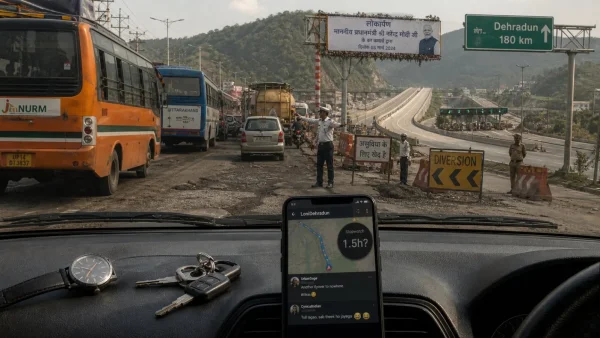
Can motorists really travel from Loni to Dehradun in around 1.5 hours or from Delhi to Dehradun in roughly two hours? And if such travel times are being projected, what happens when the reality on the road tells a different story?
These questions have become the subject of political commentary and social-media debate, with critics using sarcasm to question the government’s claims about India’s rapidly expanding highway infrastructure.
The criticism centres on the gap that some commuters perceive between headline travel-time targets and actual driving conditions.
“On such roads?”
India has invested heavily in expressways and highway infrastructure over the past decade, with the government frequently highlighting reduced travel times between major cities as evidence of improved connectivity.
The Delhi–Dehradun corridor is among the projects that have attracted considerable attention because of its strategic and economic importance.
But travel time is determined by more than the theoretical speed of a highway.
Traffic congestion, construction zones, diversions, road bottlenecks, entry and exit points, weather conditions, local traffic and the condition of connecting roads can all significantly affect an actual journey.
This is where critics have focused their attack.
Their argument is simple: If a government promises dramatically shorter travel times, citizens should be able to experience those improvements consistently on the ground.
From “two hours” to the reality of the journey
The political criticism has also taken a sarcastic turn, with references to “space technology” being used to mock what critics see as exaggerated infrastructure claims.
The underlying issue, however, is more serious.
A road can be technically capable of supporting high speeds while the door-to-door journey remains substantially longer because travellers must first reach the highway, negotiate congested urban stretches and then exit into local roads.
Therefore, a claim such as “Delhi to Dehradun in two hours” needs to be understood in its proper context: whether it refers to a particular stretch, an ideal travel scenario, or the complete journey under normal traffic conditions.
Gadkari and the politics of infrastructure
Union Road Transport and Highways Minister Nitin Gadkari has become one of the government’s most prominent faces when it comes to India’s road-building programme.
His ministry has repeatedly highlighted new highways, expressways, tunnels and infrastructure projects as evidence of India’s changing transport network.
Consequently, whenever road projects fail to meet expectations—or commuters encounter congestion, potholes, bottlenecks or incomplete work—the criticism frequently lands directly on the minister.
The latest political jabs have even linked the issue to Gadkari’s comments over the years about his future in politics and public life, with critics sarcastically suggesting that the minister may be “talking about retirement” because of the gap between promises and reality.
However, that interpretation is political commentary rather than evidence of any direct connection between road conditions and Gadkari’s career plans.
The bigger infrastructure question
The controversy highlights an important distinction in evaluating India’s highway expansion.
Building kilometres of roads is one metric. Reducing actual travel time safely and consistently is another.
For commuters, the real measure of a highway is not the inauguration ceremony, the number of kilometres constructed or the speed claimed in a presentation.
It is the experience of making the journey.
If a route genuinely cuts travel time, improves safety and reduces congestion, the benefits are immediately visible to citizens. But if bottlenecks remain on approach roads or promised travel times are achievable only under ideal conditions, public scepticism is inevitable.
Promises versus performance
The debate over the Delhi–Dehradun route therefore goes beyond one journey or one political statement.
It raises a broader question about how India’s infrastructure projects should be evaluated.
Should success be measured by announcements and projected travel times, or by actual journey times recorded by ordinary commuters?
The answer is straightforward.
Let the roads—and the stopwatch—decide.
Because when the government says a journey that once took several hours can now be completed in a fraction of that time, citizens are entitled to test the claim for themselves.
And if the promised two-hour journey still takes substantially longer, the government should be prepared to explain why.