A prolonged strike by sanitation workers in Haryana has taken a confrontational turn in Hisar, where protesting workers and police personnel clashed during an attempt by civic authorities to clear accumulated garbage from the city.
The dispute centres on long-standing demands from sanitation workers, including permanent government employment, an end to the contractual and outsourcing system and a minimum monthly wage of ₹30,000.
Garbage piles up as strike continues
Sanitation workers across Haryana have been on strike since August 6, with the agitation disrupting garbage collection in several cities.
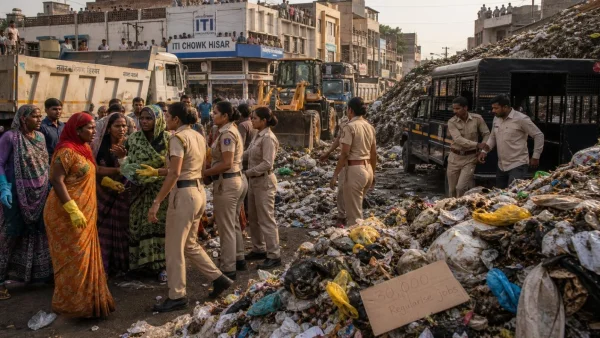
In Hisar, the situation became particularly serious as waste accumulated across residential areas and major roads. Reports said that more than 3,600 tonnes of garbage had accumulated in the city during the strike.
With the sanitation system under increasing pressure, municipal authorities began deploying machinery and teams to remove the accumulated waste.
But when civic officials, accompanied by police personnel, reached ITI Chowk to begin a garbage-clearance operation, protesting workers attempted to stop the move.
Confrontation at ITI Chowk
The situation escalated as striking workers opposed the administration’s attempt to remove the garbage.
Police detained several protesters, while a separate confrontation reportedly took place between women sanitation workers and women police personnel.
According to police and administrative accounts reported by news organisations, some protesting women allegedly threw garbage at police personnel, following which the women police officers intervened and detained them.
A separate case had also been registered against 16 named sanitation workers and around 100 unidentified individuals following an earlier confrontation connected with garbage-clearance efforts.
The workers’ side has disputed aspects of the administration’s handling of the situation, while the authorities have maintained that garbage removal became necessary because of the growing public-health risk.
Why are the workers protesting?
At the heart of the dispute is the workers’ demand for job security and better wages.
Sanitation workers and their unions are seeking:
Regularisation of contractual and outsourced workers
An end to the contractual/outsourcing system
Direct departmental employment for workers currently engaged through contractors
A minimum monthly wage of ₹30,000 for door-to-door sanitation workers
Better working conditions and timely payment of wages
The demand for permanent employment has emerged as the most difficult issue in negotiations.
Government says most demands accepted
The confrontation comes amid stalled negotiations between the Haryana government and employee unions.
According to reports, the government has said that it has accepted 13 of the workers’ 14 demands, but the issues of regularisation of contractual workers and ending the contractual system remain unresolved.
Talks held between government representatives and employee unions failed to break the deadlock, with workers deciding to continue the strike.
A sanitation crisis for residents
While the dispute is fundamentally about workers’ employment conditions, the prolonged strike has created a second crisis for ordinary residents.
With garbage collection disrupted for weeks, waste has accumulated at multiple locations across Hisar.
Residents face the consequences through:
foul-smelling garbage heaps, blocked roads, unhygienic surroundings and concerns about the spread of disease.
This creates a difficult situation for both sides.
The sanitation workers argue that their demands concern dignity, job security and fair wages. Meanwhile, residents need essential sanitation services to continue regardless of the labour dispute.
The outsourcing question
One of the central issues is the workers’ opposition to outsourcing.
Employees argue that workers performing essential sanitation duties should not remain trapped in insecure contractual employment indefinitely.
The debate reflects a broader question facing municipal bodies across India:
If sanitation is an essential public service, should the people performing that work have permanent employment and stronger social security—or should municipalities continue relying heavily on contractual labour?
The answer has significant implications for both workers and local governments.
When a labour dispute becomes a public-health issue
The Hisar confrontation illustrates how quickly a labour dispute involving essential services can escalate.
For workers, prolonged industrial action is a way to pressure authorities into addressing demands they say have remained unresolved.
For the administration, allowing garbage to accumulate indefinitely creates a public-health and civic-management problem.
And for residents, the result is an increasingly unpleasant and potentially hazardous urban environment.
The longer the dispute continues, the greater the pressure on both sides to find a solution.
The real issue is bigger than one clash
The scenes from Hisar may attract attention because of the confrontation between sanitation workers and police, but the underlying dispute is much larger.
These are workers who perform one of the city’s most basic and essential functions.
Their demands for permanent employment and a ₹30,000 minimum wage have now collided with the administration’s responsibility to keep cities clean.
The immediate priority should therefore be to prevent further confrontation and return to meaningful negotiations.
Workers need dignity and security. Residents need clean streets. Authorities need a workable sanitation system.
The solution cannot be found in an endless cycle of strike, garbage accumulation, police deployment and confrontation.
A test for the government
The Haryana government now faces a difficult balancing act.
It must ensure that essential sanitation services continue while also addressing legitimate employment concerns raised by workers.
The most sustainable solution will require more than temporary garbage-clearance drives.
It will require a transparent settlement on regularisation, wages, outsourcing and working conditions.
Until then, Hisar’s mounting garbage is more than a sanitation problem.
It is a visible sign of a labour dispute that has been allowed to reach a critical point.