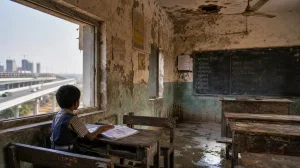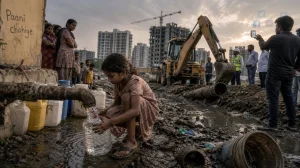
For students in Mahoba, getting to school appears to have become an obstacle course of potholes, broken stretches and unsafe roads.
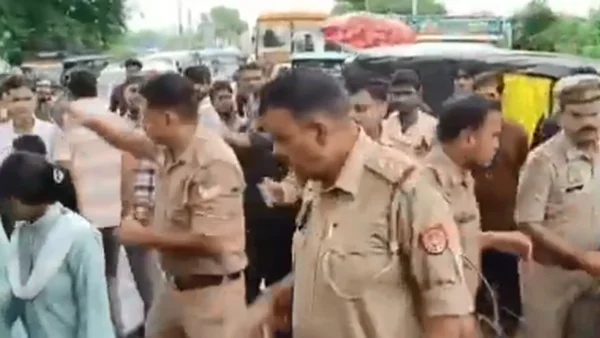
Instead of quietly accepting the situation, the students reportedly came out in protest, demanding that the road leading to their school be repaired.
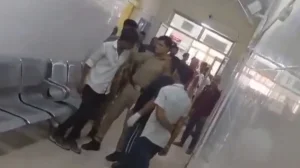
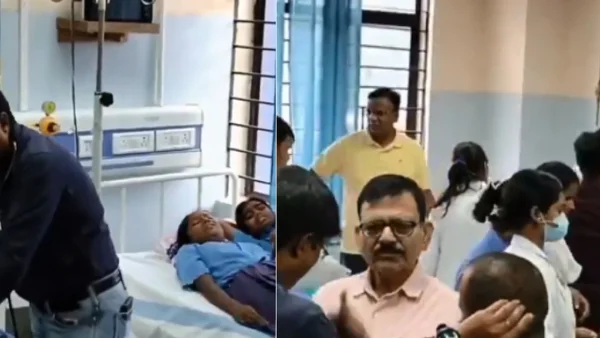
What followed was captured on video and has now triggered criticism on social media.
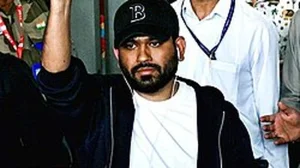
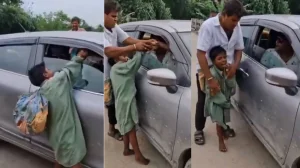
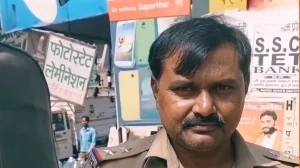
The footage appears to show an official confronting the protesting students in an aggressive manner. The contrast has become the story itself:
Children are asking for a road to their school. The response they appear to be receiving is anger instead of answers.
The Road Is the Real Issue
For a student, the road to school isn’t merely a piece of infrastructure.
It determines whether they can reach class safely.
A badly damaged road can mean:
Students arriving late or missing classes
Greater risk of falls and accidents
Problems for bicycles and two-wheelers
Difficulties during the monsoon
Additional hardship for younger children
Parents becoming reluctant to send children to school
And unlike a luxury demand, a safe road to an educational institution is a basic public-service expectation.
Students Asked for Repairs—Not a Favour
The reported protest raises a simple question:
Why did children have to protest before anyone listened? If the road is genuinely in poor condition, the administration should inspect it, assess the damage, identify the responsible department and provide a repair timeline.
If the students’ allegations are incorrect, authorities can demonstrate that with evidence.
But shouting at students does not repair potholes.
Neither does intimidation.
A road cannot be fixed with an angry speech. It requires a budget, engineering work and accountability.
The Viral Video Has Changed the Conversation
The confrontation has attracted attention because of the apparent difference in the official’s behaviour depending on whom he is facing.
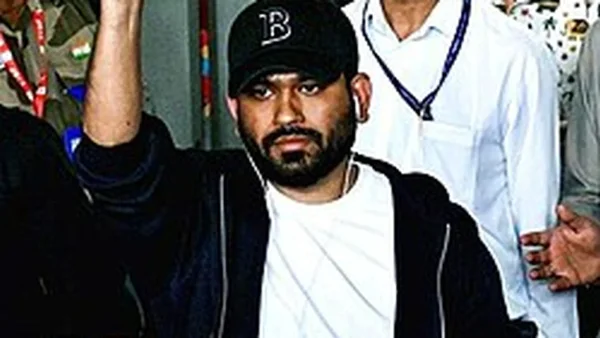
The social-media commentary surrounding the footage has been particularly sarcastic, portraying the official as much more intimidating in front of children than before political leaders.
That comparison is difficult to independently verify from the video alone and should not be treated as an established fact.
But the broader criticism is clear:
Authority should not become louder when the people demanding answers are schoolchildren. If anything, children raising concerns about their school deserve greater patience and explanation.
What Should the Administration Do Now?
Rather than allowing the controversy to remain a social-media spectacle, the administration can settle the matter quickly.
Officials should publicly clarify:
Who is responsible for the road?
When was it last repaired?
How much money was sanctioned for it?
Why has it deteriorated?
Has a technical inspection been conducted?
When will repair work begin?
What is the completion deadline?
These are questions that can be answered through documents and official records—not political arguments.
The Bigger Problem: Children Shouldn’t Have to Become Protesters
There is something uncomfortable about the image of schoolchildren standing on the road demanding something as basic as safe access to their school.
Education campaigns routinely tell children:
“Go to school.”
But that message has an obvious second half:
“Make sure the route to school is safe.” A functioning education system requires more than classrooms and teachers.
It requires roads, transport, electricity, sanitation, drinking water and basic safety. The irony of the Mahoba episode is hard to miss.
The students aren’t asking for a new stadium. They’re asking for the road to their school to be repaired. If the road is broken, fix the road.
If the budget is missing, explain the budget.
If another department is responsible, name it.
If work is already sanctioned, publish the deadline.
But if children have to stand in the street before the administration notices the condition of the road they use every day, the problem is bigger than potholes.
And perhaps the most important lesson for officials is this:
Being powerful in front of children isn’t an achievement. The real test of authority is whether you can listen to them without making them afraid to speak.