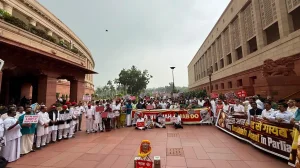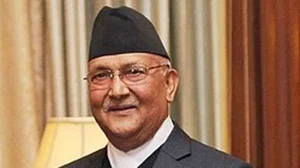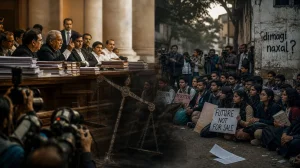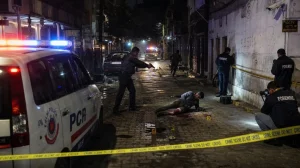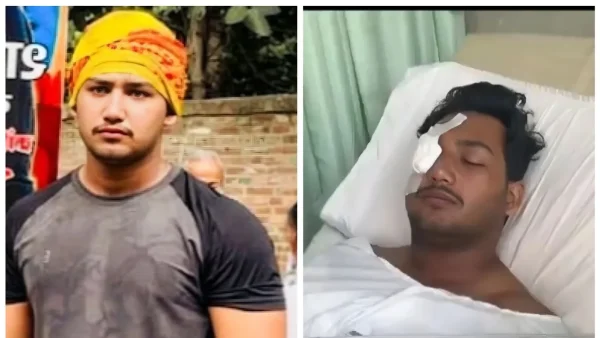
A statement attributed to Union Parliamentary Affairs Minister Kiren Rijiju that no one was hurt or hospitalised during the July 20 Parliament march has come under renewed scrutiny after multiple protesters were treated in hospitals following the police crackdown.
The most striking case is that of Sahil Lochab, a 19-year-old Delhi University student who was preparing for a career in the police force.
Instead of moving closer to that dream, he is now fighting to save the sight in his right eye.
According to reporting by The Indian Express, AIIMS confirmed that Lochab had pellet injuries on the right side of his body. He underwent surgery after a pellet/shrapnel injury to his right eye, and at the time doctors were still assessing the extent of his vision loss. Lochab said doctors had given him only about a 1% chance of recovering eyesight in the injured eye.
That makes the question surrounding the government’s account particularly serious.
One Statement. One Hospital Bed. A Very Different Reality.
The July 20 protest was organised by supporters of the Cockroach Janta Party (CJP) as part of a campaign over alleged examination irregularities and paper leaks.
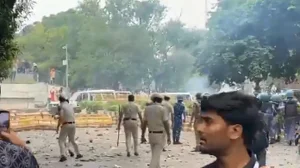
Delhi Police had denied permission for the proposed Parliament march and imposed prohibitory orders in the New Delhi district. When protesters attempted to march, clashes broke out and police used tear gas and baton charges. Delhi Police said its personnel were also injured and that protesters had violated restrictions.
But the aftermath produced a very different picture.
NDTV reported that around 90 students were injured during the July 20 protests, with many discharged by the following day. A 20-year-old woman was admitted to the ICU after being injured and was later reported stable.
An RML Hospital official also told The Indian Express that approximately 65 protesters and 10 police personnel were brought to the emergency department, with injuries ranging from head trauma to fractures.
So the issue isn’t simply whether one particular sentence was technically accurate.
It is whether the government’s public description of the crackdown reflected what happened to people on the ground.
Sahil Lochab: From Police Aspirant to Hospital Bed
He Joined the Protest Because He Had Already Been Failed by the Examination System
Lochab’s story carries an especially bitter irony.
He was preparing for recruitment to the Delhi Police and had appeared for a recruitment examination in 2024. He told The Indian Express that he joined the protest because he was frustrated after the examination was cancelled following a paper leak.
He went to protest over the very system he hoped would determine his future.
During the July 20 march, he was injured in the face and right side of his body.
AIIMS subsequently confirmed pellet injuries. His family said doctors told them that the damage to his eye was severe and that the possibility of restoring vision was extremely low.
His own words captured the stakes: without his eyesight, he feared he would no longer have a realistic chance at the government examinations he had been preparing for.
But Who Fired the Pellets?
This Is Where the Story Gets Even More Complicated
Delhi Police initially denied using pellet guns during the protest.
The Rapid Action Force, a specialised wing of the CRPF, was also deployed during the crackdown. The CRPF initially said it was examining the sequence of events and did not immediately confirm the use of pellet guns.
Then came a major development.
A Hindustan Times report published on July 29 said police records showed two rounds of pellets were used during the July 20 march on the orders of a DCP, based on a statement by a Rapid Action Force deputy commander recorded in a general diary at Parliament Street police station.
The report said the record contradicted the earlier denial that pellet guns had been used.
That changes the nature of the controversy.
The question is no longer simply:
“Were protesters exaggerating their injuries?”
It becomes:
Who authorised the use of pellets, under what circumstances, and was the force proportionate?
It Wasn’t Only Sahil
Lochab was not the only person reporting pellet injuries.
Reports identified other people treated following the crackdown, including 25-year-old Sheikh Irshad Mansuri and a 28-year-old journalist. The Indian Express reported that at least three people had been treated in hospitals for pellet injuries and that the CRPF had initiated an inquiry into the events and the role of the RAF.
Mansuri underwent surgery after pellets were reportedly found in his face and neck.
Later reporting also identified additional people alleging pellet-like injuries.
The accumulating accounts make an independent examination of the July 20 operation increasingly important.
The Government’s Side Must Also Be Heard
It is important not to turn the incident into a one-sided narrative.
The Parliament march had not been authorised, and Delhi Police had imposed prohibitory orders in the area. Police said protesters ignored directions to disperse and described their behaviour as “unruly, aggressive, violent.” Police also reported injuries among their own personnel and detentions of protesters.
Those facts matter.
The right to protest does not mean immunity from lawful restrictions or violence committed during a demonstration.
But the existence of a prohibited march also does not answer the separate question of whether the force used against protesters was lawful and proportionate.
Those are two different questions.
The Real Accountability Question
A Protester Can Be Wrong. The State Still Has to Be Right.
This is perhaps the most important distinction in the entire controversy.
If protesters broke the law, they can be detained.
If someone assaulted a police officer, they can be prosecuted.
If property was damaged, the perpetrators can be held accountable.
But when the State uses force, the State’s conduct must also be examined.
And when a teenager ends up undergoing eye surgery after a protest crackdown, the public deserves answers.
Not slogans.
Not political blame games.
Not competing press conferences.
Answers.
And Then There Is the Word “Expendable”
The criticism that young protesters are being treated as “expendables” is politically charged, but the underlying concern is serious.
These are young people who are:
preparing for competitive examinations;
dealing with paper leaks and cancellations;
worried about their careers;
demanding accountability;
and, in some cases, now dealing with serious injuries.
Sahil’s case makes that human cost impossible to ignore.
He went to the protest carrying aspirations for a government job.
He left it facing the possibility of permanent damage to one of his eyes.
The Most Important Question Is Still Unanswered
If the later police record reported by Hindustan Times is accurate and pellet rounds were indeed used on July 20, then the public deserves to know:
Who ordered them?
Why were they used?
What threat justified their deployment?
What type of ammunition was used?
Were standard crowd-control protocols followed?
Who was responsible for the injuries?
And finally:
Why did the initial official account appear so different from what injured protesters, hospitals and later records were reporting?
Sahil wanted to become a policeman. He went to protest because he believed the examination system had failed his generation. Now he is fighting to preserve the eyesight that his future depended on. That is not a statistic.
That is a 19-year-old's life.
And that is why statements about “no one being hurt” cannot simply be treated as political soundbites when young people are lying in hospital beds.
If the government is right, an independent investigation should prove it. If the protesters are wrong, the evidence should expose that too.
But if pellets were fired, people were injured and the initial official account failed to acknowledge what happened, then accountability cannot stop at a press statement.
Because in a democracy, citizens are not expendable—and neither is the truth about how they were treated.