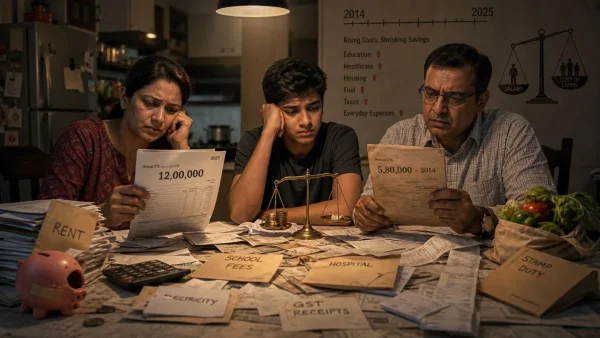
Earning ₹12 lakh a year today may sound substantially better than earning a few lakh rupees a decade ago. But once inflation and the rising cost of living are taken into account, the headline income can tell a very different story.
A recent claim circulating online says that ₹12 lakh today is equivalent to only around ₹5.8 lakh in 2014 in real terms, while describing the overall tax burden as having risen by about 24% in real terms.
The numbers need to be interpreted carefully because “real income,” “tax burden” and “purchasing power” are different calculations. Nevertheless, the underlying issue is important: Indians cannot judge their economic position simply by looking at the number printed on their salary slip.
₹12 Lakh Sounds Bigger. But What Can It Buy?
Imagine two employees.
One earns ₹5.8 lakh in 2014.
Another earns ₹12 lakh today.
At first glance, the second employee appears substantially better off.
But between those two points, the prices of housing, education, healthcare, transport, food and everyday services have changed considerably.
Economists therefore distinguish between nominal income and real income.
Nominal income is the amount you receive.
Real income reflects what that amount can actually buy after accounting for inflation.
That distinction is crucial when comparing incomes across a decade.
The Tax Story Has Also Changed
India’s personal income-tax structure has undergone several changes since 2014.
The government introduced the new tax regime in 2020, and Budget 2025 substantially altered its slabs and increased the rebate threshold.
Under the 2025-26 new regime, the government raised the income level eligible for a rebate to ₹12 lakh, while salaried taxpayers can effectively have income up to ₹12.75 lakh without tax because of the ₹75,000 standard deduction, subject to the applicable conditions. (mint)
That means today’s tax system cannot simply be compared with the 2014 system by looking at one headline rate.
Deductions, exemptions, rebates and the choice between the old and new regimes all matter.
So Is the Taxpayer Actually Paying More?
This is where the “24% increase” claim needs context.
A tax burden can be measured in several ways:
Total tax paid
Tax as a percentage of income
Tax after adjusting for inflation
Income-tax plus indirect taxes
Tax paid compared with real purchasing power
These measurements can produce very different results.
Therefore, saying simply that “tax burden has risen 24%” without identifying the methodology can be misleading.
What can be said with confidence is that the Indian government’s tax system has changed significantly over the period, while taxpayers have also experienced substantial changes in their incomes and expenses.
But There’s Another Tax Most Families Can’t Escape
Income tax is only one part of the story.
Consumers also pay taxes through everyday spending.
GST is embedded in the prices of numerous goods and services.
Fuel taxation affects transportation costs.
Property transactions can involve stamp duty and other charges.
Electricity, telecom, insurance, restaurants and many other expenses can carry indirect taxes.
So the amount deducted from a salary is not necessarily the full measure of a household’s tax contribution.
The real question is not merely “How much income tax did I pay?” It is:
“After all taxes and inflation, how much purchasing power is left?”
The Middle-Class Squeeze
This is where the debate becomes especially relevant for salaried households.
A person’s salary may rise from:
₹6 lakh → ₹8 lakh → ₹12 lakh
But that does not automatically mean their standard of living has doubled.
If housing costs rise sharply, school fees increase, healthcare becomes more expensive and commuting costs climb, a large part of the additional income can disappear before the family feels materially richer.
This is why salary growth and living-standard growth are not the same thing.
The ₹12 Lakh Tax-Free Debate
There is also an important irony.
The government’s 2025 tax changes were widely welcomed because income up to ₹12 lakh became effectively tax-free under the new regime through the rebate mechanism. (mint)
But a tax break does not automatically solve the purchasing-power problem.
A person can pay zero income tax and still feel financially squeezed if rent, education, healthcare, food and transportation consume an increasing share of their income.
Tax-free does not mean cost-free.
Why the 2014 Comparison Is Politically Powerful
Comparing today’s income with 2014 is politically potent because it asks a simple question:
Has the average taxpayer actually become richer in real terms? Not:
“Is the salary number bigger?”
But:
“After inflation and taxes, what can that salary buy?”
That is a much harder question for any government to answer.
But There Is Also a Positive Side
A balanced assessment should acknowledge that India’s tax structure has also evolved.
The government has expanded digital tax administration, simplified some compliance processes and introduced a new tax regime with lower rates in several income bands.
The 2025 changes substantially reduced tax liability for many taxpayers compared with the earlier structure. For example, government budget calculations showed significant savings at incomes such as ₹18 lakh and ₹24 lakh under the revised regime.
So it would be inaccurate to portray the entire period simply as a story of continuously increasing income-tax rates.
The more complicated reality is:
Tax rules changed.
Income increased.
Prices increased.
And household purchasing power changed differently for different income groups.
The Number That Ultimately Matters
For most families, the real financial equation is not:
Salary − Income Tax = Wealth
It is closer to:
Income − Taxes − Inflation − Housing − Education − Healthcare − Transport − Food = Actual Financial Security
That final number is what determines whether a household feels prosperous or permanently stretched. ₹12 lakh on a salary slip may look like a middle-class success story. But if the cost of living has risen faster than the family’s ability to save, the bigger number can hide a smaller life. The debate over tax burden should therefore move beyond political slogans and headline figures.
Governments should publish clear comparisons showing:
income growth,
inflation-adjusted income,
tax paid,
indirect taxes,
Because the real question isn’t whether the taxpayer’s salary has grown from ₹5.8 lakh to ₹12 lakh.
The real question is: after the government takes its share and the market takes its share, how much of that ₹12 lakh is actually left for the citizen? And that is the number the middle class feels every month.