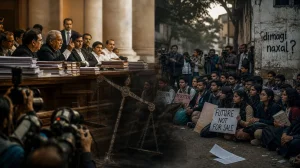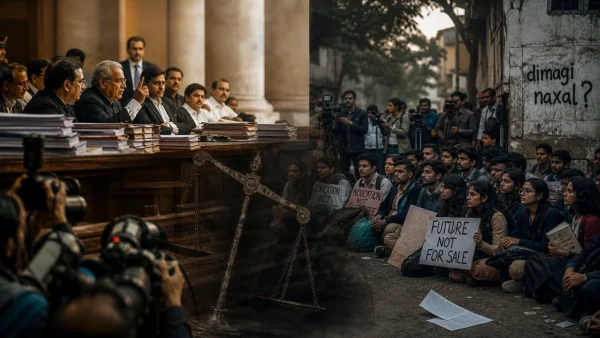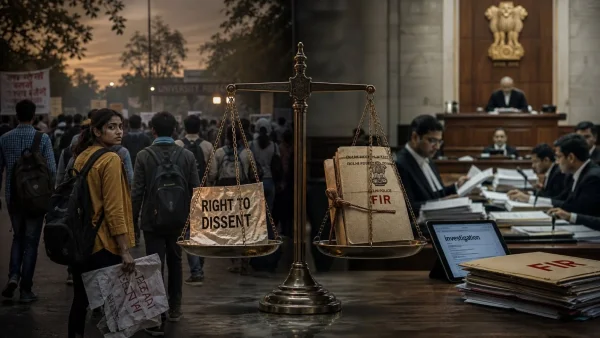
The controversy over FIRs registered against students during the nationwide protests over examination irregularities has now moved from the streets to the courtroom.
The protesters say they were given a clear assurance on July 25: FIRs registered against protesters would be withdrawn and there would be no further punitive action against those who participated in the agitation.
The government, however, has since taken the position in court that existing FIRs and investigations can continue in certain circumstances.
That apparent contradiction has created a question bigger than any individual FIR:
When the government gives an assurance to end a protest, how binding is its word?
What Happened on July 25?
The nationwide agitation ended on July 25 after the resignation of then Union Education Minister Dharmendra Pradhan.
At a joint briefing, protest representatives said the government had agreed to withdraw all FIRs filed against protesters and assured that no action would be taken against those involved in the protests in the future. The protesters subsequently called off their agitation. (Indian Express)
That assurance became central to the protesters’ decision to return from the streets.
In other words, the understanding was not merely about the minister’s resignation.
It was also about what would happen to the young people who had participated in the movement.
Then the Supreme Court Entered the Picture
On July 28, the Supreme Court passed interim directions in petitions concerning the protests and allegations of police excesses.
The Court directed that no coercive action be taken against protesters in the relevant FIRs and ordered the release of detained minors who did not have criminal antecedents. At the same time, the Court’s order was understood as permitting investigation in existing FIRs in certain circumstances. (Bar and Bench – Indian Legal news)
That created confusion.
The protesters argued that allowing investigations to continue appeared inconsistent with the government’s July 25 assurance.
Their concern was straightforward:
If the government promised withdrawal of the cases, why should those cases continue to hang over students?
The Supreme Court Later Clarified the Position
This part is important because the claim that the Supreme Court simply refused to quash all FIRs is not an accurate description of the latest position.
On August 3, the Supreme Court clarified that Delhi and other state governments were at liberty to close or withdraw FIRs against protesters in accordance with law.
The Court also clarified that the phrase “criminal antecedents” in its earlier order referred to grave or heinous offences, rather than minor or petty cases.
The Centre’s Solicitor General, Tushar Mehta, also reiterated in court that the government remained committed to withdrawing cases against eligible protesters, while excluding those involved in serious criminal offences.
That clarification significantly changes the picture.
The latest position is not that the Supreme Court has blocked the withdrawal of FIRs. Rather, the Court has said governments can withdraw or close eligible cases, while serious criminal matters can be treated differently.
So Why Are Protesters Still Angry?
Because They Want the July 25 Promise Implemented—Not Merely Interpreted
The protesters’ concern is that a distinction between “withdrawal” and “investigation continuing” could leave young people facing police inquiries, legal expenses and uncertainty for months or years.
The CJP has specifically argued that it wants withdrawal of FIRs, rather than simply stopping further action or treating cases as closed.
That distinction matters.
For a student, an FIR can become a continuing source of anxiety even if no eventual conviction follows.
There can be:
police inquiries;
repeated appearances;
legal expenses;
employment and examination concerns;
reputational consequences;
and the psychological burden of having a criminal case hanging over one’s head.
But There Is Another Side
Not Every FIR Can Simply Disappear Because a Protest Ended
The government has a legitimate legal argument as well.
If an individual committed a grave or heinous offence, participation in a protest cannot automatically provide immunity.
That is why the Supreme Court’s clarification is significant.
The Court has effectively drawn a line between ordinary protest-related cases and serious criminal conduct.
That means the debate should not be framed as:
“Withdraw everything, regardless of what happened.”
It should be:
“Withdraw cases against peaceful protesters and distinguish them from genuinely serious criminal offences on the basis of evidence.” That is a much more defensible standard.
The Court Is Also Looking at Police Conduct
The controversy is not limited to the protesters.
The Supreme Court has said that allegations of police excesses during the protests prima facie warranted an independent investigation and has moved towards a mechanism for examining those allegations.
The Court has also indicated that it intends to frame a comprehensive protocol concerning the use of pellet guns during crowd-control operations.
That is significant.
If protesters are expected to answer for unlawful conduct, then authorities should also be accountable for excessive or unlawful use of force.
Accountability cannot be a one-way street.
What Should the Government Do Now?
The easiest way to end the controversy is transparency.
The Centre and states should publish a clear category-wise position:
1. FIRs against peaceful protesters
Withdraw or close them as promised, in accordance with law.
2. Cases involving minor offences
Explain why any such case remains pending and whether it qualifies for withdrawal.
3. Serious criminal cases
Publish the legal basis for retaining them and distinguish them clearly from protest participation.
4. Police-excess allegations
Allow the independent investigation to proceed without interference.
5. July 25 assurance
Put the exact terms of the government’s commitment before the Supreme Court so there is no ambiguity about what was promised.
The protesters themselves have asked that the government’s July 25 commitment be placed before the Court.
The Real Issue Is Trust
A government can disagree with a protest.
It can restrict a march where legally justified.
It can prosecute genuine criminal offences.
But when negotiations end a major protest movement, the credibility of the agreement matters enormously.
If young people leave the streets because they believe the government has given its word, that commitment should not subsequently become a matter of conflicting interpretations.
The question isn’t whether every FIR should disappear regardless of the facts.
It is whether a government that gave its word on July 25 will honour that word for the people who trusted it. The Supreme Court has now clarified that eligible protest-related FIRs can be closed or withdrawn and that its earlier order does not prevent governments from doing so.
So the government has an opportunity to remove the ambiguity.
Identify the serious cases. Explain them. Withdraw the rest.
Don’t leave thousands of young people wondering whether the promise that brought them off the streets was merely a temporary political arrangement.
Because governments can win arguments in court. But democratic governments ultimately survive on something more fragile: trust.
And once young citizens stop believing that a government’s word means what it says, no press conference can easily rebuild that trust.