Roads are supposed to carry vehicles. Drains are supposed to carry water.
But in Bakhtiyarpur, Bihar, an unusual piece of civic engineering appears to have given both jobs a new challenge.
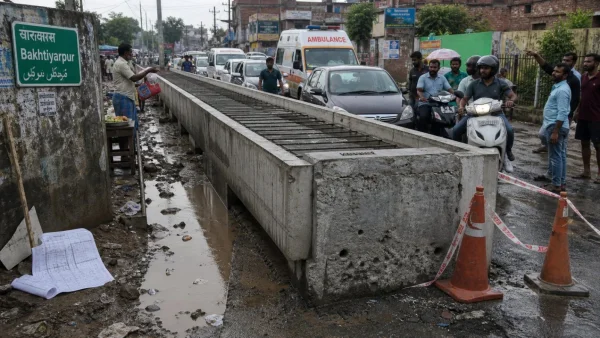
A drain has reportedly been constructed right in the middle of a road and around three feet above the road level. The result is almost perfectly ironic:
Vehicles cannot move normally. Water cannot drain normally.
In other words, the infrastructure designed to solve one problem appears to have created two more.
A Drain That Became a Roadblock
Imagine driving down a road and suddenly finding a concrete drain standing across your path.
Not beside the road.
Not underneath it.
Not even at road level.
Three feet above it.
That is reportedly what residents in the Bakhtiyarpur area are facing.
Instead of quietly carrying wastewater away, the elevated structure has effectively become an obstacle for vehicles.
And if the purpose was drainage, the obvious question is:
How is water supposed to reach a drain that sits above the level of the road?
When Engineering Becomes a Puzzle
The bizarre construction has prompted the kind of reactions that usually accompany infrastructure projects gone spectacularly wrong.
A road with a drain in the middle sounds like a design problem.
A drain three feet above the road sounds like a physics problem.
And a project that allegedly leaves both vehicles and drainage disrupted sounds like an accountability problem.
The situation has naturally triggered sarcasm online, with people joking that perhaps Bihar has invented a new form of “flyover drainage”—where the water is expected to climb uphill before being drained away.
The Drain Has One Job
And Gravity Isn’t Taking Instructions
The basic principle of drainage is simple: water generally flows from a higher level to a lower level.
But if a drain is constructed significantly above the surrounding road surface without an appropriate connecting system, residents can reasonably ask how surface water is expected to enter it.
If the drain cannot collect the water, it stops functioning as a drain.
And if the structure blocks vehicles, the road stops functioning as a road.
That leaves one obvious question: What exactly was the project designed to achieve?
Residents Get the Worst of Both Worlds
For people living and travelling in the area, poorly planned infrastructure is not merely funny.
It can become a daily inconvenience.
A road obstruction can mean:
Traffic bottlenecks
Difficulty for two-wheelers and cars
Problems for ambulances and emergency vehicles
Waterlogging during rainfall
Increased accident risks
Damage to vehicles
Difficulty for pedestrians
If the construction is indeed as reported, residents are effectively being asked to live around an infrastructure project that appears to have compromised the very road it was supposed to serve.
The Bigger Question Isn’t Just “Who Built It?”
Who Approved It?
This is where the story moves beyond internet humour.
Public infrastructure normally passes through multiple stages:
Planning → Design → Technical approval → Tender → Construction → Inspection → Completion
If a drain has genuinely been constructed at a level that obstructs the road, the public deserves to know where the design and supervision process failed.
Was the original road level measured correctly?
Was the drainage design approved by engineers?
Was the construction inspected?
Did anyone conduct a site inspection before the project was completed?
And if the work is defective, who will pay for correcting it?
The ‘Development’ Question
India spends enormous amounts of public money on roads, drainage, bridges and urban infrastructure.
But infrastructure isn’t successful merely because something concrete has been constructed.
The real test is whether it performs its intended function.
A drain that doesn’t drain is not successful drainage infrastructure.
A road that cannot accommodate traffic is not successful road infrastructure.
Concrete is not development. Functionality is.*
What Should Happen Now?
The relevant local authorities should conduct an immediate technical inspection and publicly clarify:
Which agency constructed the drain?
What was the sanctioned design?
Why was it constructed above road level?
Was the work technically approved?
What was the project cost?
Who supervised the construction?
Has the contractor been paid in full?
What corrective work will now be carried out?
If the construction violates the approved design, responsibility should not disappear behind the usual cycle of “inquiry ordered” → “committee formed” → “report awaited.”
Bakhtiyarpur may have accidentally discovered the only infrastructure project where the drain blocks the road and the road blocks the drain.
The episode is funny enough to become a viral meme.
But for the people who have to use that road every day, bad engineering isn’t comedy—it is public money turned into public inconvenience.
A drain has one basic responsibility:
Take water away.
A road has one basic responsibility:
Let people move.
If a project manages to stop both, the biggest blockage may not be the drain.
It may be the accountability that was supposed to come before the construction.