A recent Bombay High Court order involving Maharashtra’s Food and Drug Administration (FDA) has triggered a debate that goes well beyond one Pune sweet shop.
The case concerns Gurunanak Dairy & Sweets, whose food licence was suspended by the FDA on June 12, 2026, following a complaint linked to food poisoning.
The establishment challenged the action.
The dispute eventually reached the Bombay High Court, which not only quashed the licence-suspension order but directed the Maharashtra FDA to pay ₹5 lakh in compensation to the shop. The court also permitted the business to resume operations.
But the controversy became sharper because Maharashtra FDA Commissioner Tukaram Mundhe subsequently defended the original action, saying the department had acted after a food-poisoning incident in which people were hospitalised and laboratory reports indicated that the food samples were unsafe.
That leaves two competing questions:
Did the FDA go too far? And:
Does a regulator protecting consumers risk being punished when its enforcement decision is later overturned?
What Exactly Happened?
According to the court record as reported by Live Law, the FDA suspended the sweet shop’s licence on June 12 over hygiene concerns.
The shop challenged the suspension before the FDA Commissioner and submitted a compliance report.
A subsequent inspection reportedly found the establishment to be 98% compliant, meeting 35 of 36 parameters assessed during the re-inspection.
Despite that result, the licence suspension was not immediately revoked because the appeal was still pending before the FDA Commissioner.
That became the central point of the litigation.
The High Court questioned why a business found to be 98% compliant should remain shut merely because its appeal had not yet been decided.
The Court’s Objection Was About the Continued Suspension
The division bench comprising Acting Chief Justice Ravindra Ghuge and Justice Gautam Ankhad criticised the FDA’s approach.
The court described the continued suspension as harassment and questioned the logic of keeping the establishment closed after the re-inspection had found 98% compliance.
The shop’s owners told the court that the closure had caused substantial business losses. According to the petitioner’s submissions, the establishment normally earned approximately ₹25,000 per day, and the 34-day closure had resulted in losses of more than ₹8 lakh.
The court consequently:
quashed the FDA's licence-suspension order;
allowed the shop to resume operations;
and directed the Maharashtra FDA to pay ₹5 lakh to the petitioner.
Then Came Tukaram Mundhe’s Response
Mundhe did not simply accept the criticism of the department’s original action.
According to ANI’s account cited by Inshorts, the FDA Commissioner said the matter was surprising because, according to the department’s version, it was a food-poisoning case, people had been hospitalised, and the food samples were unsafe.
Mundhe said the department believed its action was correct and that the FDA would decide its next steps after examining the court’s written order. (Inshorts – Stay Informed)
That creates an important distinction.
The court was examining whether the continued suspension of the licence was legally and administratively justified. The FDA was defending the reason it initially intervened. Those are not necessarily the same question.
Did the Court “Punish” the FDA for Protecting Consumers?
Not exactly.
That framing would go beyond what the judgment establishes.
The High Court did not rule that food-safety enforcement itself was wrong.
In fact, the court reportedly acknowledged that the FDA’s intention was laudable, but found that the department had gone “overboard” in continuing the suspension despite the subsequent 98% compliance finding. (Live Law)
The compensation was therefore linked to the court’s finding about the unjustified continuation of the licence suspension and resulting business loss, rather than a declaration that food-safety regulation is unnecessary.
That distinction is essential.
So Where Is the Real Controversy?
It lies in what happens between an initial food-safety emergency and a final legal determination.
Imagine the regulator receives a serious food-poisoning complaint.
People are allegedly hospitalised.
Food samples are collected.
Laboratory results reportedly indicate unsafe food.
The regulator acts quickly and suspends the licence.
That kind of rapid intervention can protect the public.
But then imagine a subsequent inspection finds the establishment 98% compliant.
Should the licence remain suspended?
For how long?
Who compensates the business for lost revenue if the initial action is later found excessive?
And what happens if the regulator chooses not to act because officials fear being sued or ordered to pay compensation?
That is the policy dilemma this case exposes.
The “Tukaram Mundhe Effect”
The case comes at a time when Mundhe’s Maharashtra FDA has been pursuing an aggressive food-safety campaign.
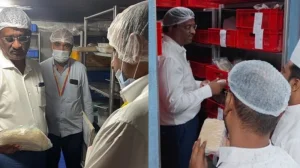
The department has conducted statewide inspections targeting adulterated food, unhygienic establishments and unlicensed businesses. Recent operations have resulted in seizures, licence suspensions and legal action.
The FDA has also publicly warned hotels, restaurants, caterers and food businesses that serious violations can result in fines, licence cancellation, closure and even imprisonment, depending on the offence.
That enforcement-first approach has won Mundhe considerable public attention.
But this case demonstrates the other side of aggressive regulation:
A regulator can be expected to act decisively—and simultaneously be expected to get every procedural step right.
Does This Mean Courts Are Protecting Food Adulterators?
There is no factual basis to make that claim from this judgment alone.
The High Court did not hold that the sweet shop had a right to sell unsafe food.
Nor did it rule that food adulteration should be tolerated.
Its concern was with the FDA’s continued suspension of the licence despite the 98% compliance finding and the consequences of that administrative decision.
Calling the judgment evidence of “corruption in the judiciary” would therefore be an allegation unsupported by the facts currently available.
But criticism of the judgment’s policy implications is entirely legitimate.
The public can reasonably ask:
Could such compensation orders make regulators more cautious about taking urgent action in future food-poisoning cases? That is a question worth discussing without accusing judges of corruption.
The Bigger Problem: Regulators Need Protection Too
There is an uncomfortable possibility here.
If a regulator acts too slowly when people are falling ill, the public asks:
“Why didn’t you act?”
If the regulator acts quickly and the establishment later proves substantially compliant, the business asks:
“Why did you shut us down?”
And if the court finds the regulatory action excessive, taxpayers may ultimately bear the financial consequences.
This creates a difficult balancing act.
Public health requires decisive enforcement.
Rule of law requires proportionate enforcement.
A good regulatory system has to deliver both.
What Should Happen Next?
Rather than turning this into a battle between “the court” and “the regulator”, the case should prompt several practical reforms.
1. Publish the scientific evidence
If food-poisoning and unsafe laboratory samples were the basis for the original suspension, the relevant test results and findings should be made available wherever legally permissible.
2. Establish clear emergency suspension timelines
If a licence is suspended immediately because of a public-health threat, there should be a defined process for reassessment.
3. Separate immediate safety action from prolonged closure
An emergency suspension may be justified initially, but continuing it should require fresh evidence.
4. Ensure rapid appeals
A small food business can suffer enormous losses from even a few weeks of closure.
5. Protect honest enforcement
Officials should not be afraid to intervene when there is a genuine threat to public health merely because enforcement carries legal risk.
6. Hold officials accountable for genuine procedural violations
Consumer protection cannot become an excuse for arbitrary administrative action.
The Real Question Isn’t “Court vs FDA”
The public needs both.
Courts protect citizens from arbitrary state action.
Regulators protect citizens from unsafe products.
One cannot function properly if the other is weakened.
The ideal outcome isn’t a regulator that is afraid to act.
Nor is it a regulator that can shut down businesses indefinitely without accountability.
The ideal system is one where officials can act quickly in an emergency—and courts can ensure that those powers are exercised proportionately.
If the FDA’s food-poisoning evidence was genuine, the government must make sure that regulators do not become afraid of acting when public health is at risk. If the FDA’s continued licence suspension was legally excessive, the court was right to demand accountability.
Both things can be true at the same time.
So the real lesson from the ₹5 lakh order isn’t that “courts are protecting food adulterators.”
It is that India needs a food-safety system where:
unsafe food is stopped quickly,
businesses are treated fairly,
laboratory evidence is transparent,
officials follow due process,
and consumers never become collateral damage in the fight between enforcement and litigation.
A regulator should never be punished simply for protecting the public.
But neither should a business be punished indefinitely simply because an official once suspected it.
The strongest system is one that protects both: the consumer’s plate and the citizen’s right to fair administration.