Ten years ago, India launched one of its most ambitious public campaigns with a simple promise: make India cleaner.
The Swachh Bharat Mission (SBM) was launched on October 2, 2014, with sanitation, toilet access and the elimination of open defecation at its core. The government says the rural mission helped enable the construction of more than 100 million household toilets, with over six lakh villages declared open-defecation free by 2019. (Swachh Bharat Mission)
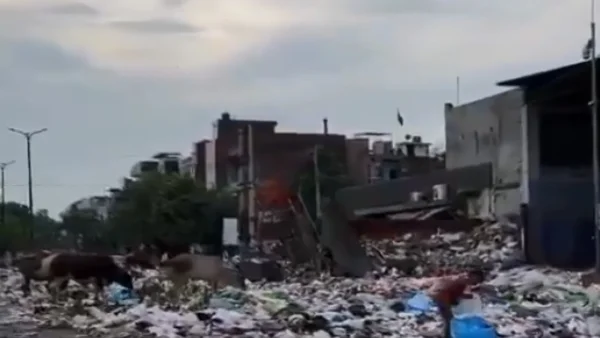
But a decade later, another picture is visible across many Indian cities: garbage piles, dusty roads, overflowing drains, broken footpaths and mountains of legacy waste.
That contrast has created a legitimate question:
If cleanliness was made a national mission, why does basic cleanliness still feel like a daily struggle for millions of citizens?
First, the Facts About the “Swachh Bharat Cess”
Yes, Citizens Were Charged a Dedicated 0.5% Cess
The government introduced the Swachh Bharat Cess (SBC) at 0.5% on taxable services from November 15, 2015. The stated purpose was to finance and promote Swachh Bharat initiatives.
It was subsequently abolished from July 1, 2017, with the introduction of GST.
The government collected approximately:
₹3,925.74 crore in 2015-16
₹12,474.87 crore in 2016-17
₹4,243.40 crore in 2017-18
The total was roughly ₹20,644 crore across those years.
Earlier government data showed that money from the cess was channelled through sanitation programmes, including household toilets, community sanitation facilities and solid and liquid waste management. (Press Information Bureau)
So the claim that a Swachh Bharat-specific cess was collected is factually correct.
But there is an important qualification:
The existence of the cess does not mean every rupee collected was spent directly on cleaning roads in your neighbourhood. Swachh Bharat is a broad programme covering sanitation, toilets, waste management, behaviour-change campaigns and related infrastructure.
So Where Did All the Money Go?
The Mission Has Actually Delivered Some Major Results
It would be inaccurate to describe Swachh Bharat simply as a “scam” without evidence of financial wrongdoing.
There have been measurable achievements.
The government’s current data says urban India has increased municipal solid-waste processing from around 16% in 2014 to 81.3% in 2026. It also reports that 97% of urban wards have door-to-door waste collection. (Press Information Bureau)
The rural programme similarly reports substantial expansion of sanitation coverage and a shift toward ODF Plus, which includes solid and liquid waste management and visual cleanliness. (Swachh Bharat Mission)
There are also documented cases where legacy dumpsites have actually been transformed. In Rajkot, for example, a dumpsite containing about 16 lakh tonnes of legacy waste was remediated and converted into a 20-acre urban forest. (Press Information Bureau)
So there is a genuine story of progress.
But progress on paper doesn’t automatically mean cleanliness on every street.
The Garbage Problem Has Changed—Not Disappeared
India Is Still Sitting on Mountains of Legacy Waste
The government’s own data shows the scale of the problem.
In January 2026, the Centre said 2,488 major dumpsites containing nearly 25 crore metric tonnes of legacy waste had been identified.
Of these, 1,138 dumpsites had been completely remediated, while another 1,020 were under remediation. About 15.51 crore tonnes of waste had been processed, according to the government. (Press Information Bureau)
That means the country has made progress—but enormous quantities of old waste remain.
And new garbage is generated every single day.
According to the government’s January 2026 figures, urban India generates approximately 1.62 lakh tonnes of municipal solid waste every day, of which about 1.32 lakh tonnes is processed. (Press Information Bureau)
That leaves roughly 31,000 tonnes a day that is not being processed according to the reported figures.
That is not a small gap.
The Real Problem: A Cleanliness Campaign Can’t Replace Municipal Services
A Road Doesn’t Become Clean Because a Celebrity Sweeps It for a Camera
Swachh Bharat was deliberately designed as a behavioural-change movement.
That matters.
But long-term cleanliness requires something much less glamorous:
Daily garbage collection.
Waste segregation.
Functional drains.
Sewage treatment.
Reliable municipal workers.
Scientific waste processing.
Maintenance of public spaces.
Enforcement against illegal dumping.
A city can organise a massive cleanliness drive on October 2.
But if garbage collection fails on October 3, the pile returns.
And Then There Are the Drains
Cleanliness Isn’t Just About Picking Up Garbage
When monsoon rain arrives, blocked drains quickly expose weaknesses in urban planning.
Garbage thrown into open drains combines with silt, plastic and other waste.
The result?
Waterlogging.
Overflowing drains.
Filthy streets.
Mosquitoes.
Traffic disruption.
And eventually another emergency cleanliness drive.
The government’s own urban programmes recognise that sanitation is broader than garbage collection. SBM-U 2.0 includes scientific waste management, legacy-dumpsite remediation and used-water management. (Press Information Bureau)
The challenge is implementation at the local level.
The “Scam” Question Needs Evidence
Bad Roads and Garbage Do Not Automatically Prove Financial Fraud
Calling the entire Swachh Bharat Mission the “biggest scam of the decade” is a serious allegation.
To establish a scam, one would need evidence of things such as:
Money being diverted illegally
Fake beneficiaries
Inflated contracts
Ghost projects
Fraudulent expenditure
Procurement irregularities
Criminal collusion
The mere fact that garbage exists on a road cannot establish any of those things.
In fact, government data demonstrates that substantial sanitation infrastructure has been created.
The stronger criticism is therefore not necessarily “Where did all the money disappear?” It is:
“After spending and implementing a programme of this scale, why are basic municipal cleanliness standards still so inconsistent?” That’s a question that can be asked without overstating the evidence.
Where the Government Deserves Scrutiny
The Next Phase Must Be About Outcomes, Not Announcements
The government’s own targets are becoming more ambitious.
SBM-U 2.0 was launched with the goal of creating Garbage Free Cities, including 100% door-to-door collection, source segregation, scientific waste processing and remediation of legacy dumpsites. (Press Information Bureau)
But targets are not outcomes.
The public should be able to see city-level data showing:
How much waste was generated?
How much was collected?
How much was actually processed?
How much was dumped?
How many drains were cleaned?
How many complaints were resolved?
How much money was spent—and on what?
That is the accountability citizens actually need.
The Irony Is Hard to Miss
The mission began with enormous publicity around the broom.
But the country’s cleanliness problem cannot be solved with a broom alone.
A broom can clean a street.
It cannot fix a broken garbage collection contract.
It cannot build a sewage treatment plant.
It cannot prevent illegal dumping.
It cannot maintain a drainage network.
And it certainly cannot replace accountable municipal governance.
The Bigger Question**
Did Swachh Bharat Fail? Not Exactly. Did It Finish the Job? Definitely Not.
The evidence shows both progress and persistent problems.
Millions gained access to toilets.
Waste collection expanded.
Waste processing capacity increased.
Legacy dumpsites are being remediated.
But citizens still encounter filthy public spaces, overflowing drains, litter and poorly maintained infrastructure.
Both realities can exist simultaneously.
And that is precisely why the debate should move beyond political slogans.
Ten years ago, India was told to pick up the broom. Today, citizens are asking who is responsible for keeping the street clean after the cameras leave.
The Swachh Bharat Mission has produced measurable achievements, so calling the entire programme a “scam” without evidence would be misleading.
But neither can the government point to toilets constructed, certificates issued or waste-processing percentages and declare the cleanliness problem solved.
A clean India is not a statistic on a government dashboard.
It is the street outside your house.
It is the drain that doesn’t overflow.
It is the footpath you can actually walk on.
It is the garbage truck that arrives when it is supposed to.
The real report card of Swachh Bharat isn’t hanging on a government website.
It’s lying on the roadside—in the form of the garbage that still hasn’t been picked up.