A disturbing video circulating on social media has sparked an uncomfortable conversation about empathy, compassion and the way society treats vulnerable children.
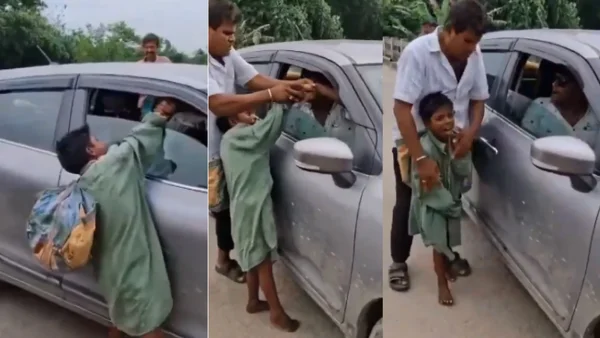
The footage reportedly shows a young child approaching a person sitting inside a car and extending his hand, apparently asking for help. Instead of simply refusing or moving away, the person inside the vehicle is seen rolling up the car window while the child’s hand is still near it.
The child’s hand reportedly becomes trapped, leaving him visibly distressed and crying.
What makes the episode particularly disturbing is the allegation that the window was not immediately released, until other people nearby intervened.
You Can Say No—But Why Cause Pain?
Helping Someone Is Optional. Basic Humanity Isn’t. Nobody is legally or morally obligated to give money to every person who asks for it.
A person can refuse.
They can drive away.
They can choose not to engage.
They can simply say “No.”
But deliberately causing physical pain to someone—particularly a vulnerable child—is an entirely different matter.
The incident has therefore raised a simple question:
When did saying “no” become an excuse to forget basic humanity?
The Child’s Hand Was Reaching for Help, Not Trouble
And the Response Became a Lesson in Cruelty
For a child living in difficult circumstances, approaching strangers may be one of the few ways available to ask for assistance.
That does not mean every passerby must give money.
But the child’s circumstances should at least invite a degree of caution and compassion.
Instead, if the viral footage accurately captures what happened, the child’s attempt to seek help ended with him crying in pain.
Fortunately, other people reportedly stepped in and helped him.
Sometimes humanity arrives not from the person with the most money—but from the stranger who simply decides:
“This isn’t right. I have to help.”
The Sarcasm Writes Itself
Apparently, the Window Was More Valuable Than the Child’s Hand
The internet has a thousand ways to say no.
A simple hand gesture.
A shake of the head.
A closed door.
A sentence:
“Sorry, I can’t help.”
But apparently, in this episode, even the car window had to become part of the negotiation.
And the irony is painful:
The child was asking for a little help. The people around him ended up having to help him escape the person who was supposedly being asked for help.
Where Is Our Empathy Going?
Have We Become So Desensitised That Someone Else’s Pain Doesn’t Even Make Us Pause?
Modern life is fast.
People are busy.
Everyone has their own problems.
But none of that should make us indifferent to another person’s suffering.
The incident has sparked wider conversations about how vulnerable children are treated in public spaces.
A child asking for money can be inconvenient.
A child asking repeatedly can be frustrating.
But a child’s vulnerability should never become an invitation for cruelty.
The Bigger Issue Isn’t the Money
It’s About How We Treat People Who Have Less Power Than Us
The most disturbing aspect of such incidents is often the power imbalance.
An adult sitting safely inside a car has considerably more control over the situation than a small child standing outside it.
That difference in power makes compassion even more important.
If someone chooses not to help, that’s their right.
But when someone is visibly in pain, the minimum human response should be to stop and make sure they are safe.
A Society Is Judged by How It Treats Its Most Vulnerable
The child in the video may eventually forget the incident.
But the larger question remains for everyone who watches it:
What would we have done if we had been standing there?
Would we have looked away?
Would we have taken out our phones?
Or would we have stepped forward?
You don’t have to give a child money. You don’t have to solve his life. You don’t even have to open your wallet.
But you can choose not to hurt him.
A society doesn’t lose its humanity because people stop giving alms.
It loses its humanity when someone sees a vulnerable child in pain—and chooses to make that pain worse. And perhaps the saddest irony is this:
The child reached out his hand asking for help. It was the strangers who finally gave him humanity.