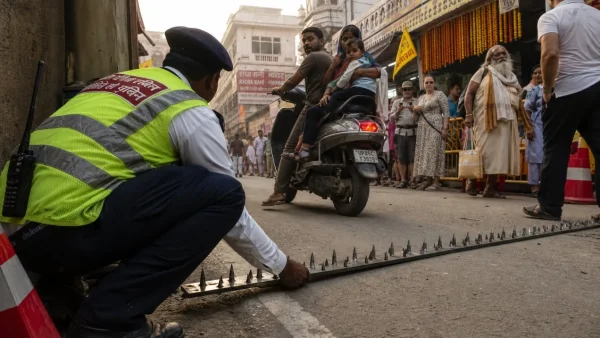
Traffic enforcement may soon take a rather sharp turn in Uttar Pradesh.
Police in Vrindavan, Mathura, are reportedly testing a new device designed to stop motorcycles and scooters whose riders attempt to evade traffic checks.
The device looks relatively simple: a thick, sharp-edged strip fitted with pointed spikes that can be used against a motorcycle’s tyre.
The intended result is equally simple:
The rider keeps going. The tyre doesn’t.
From Challan to Puncture
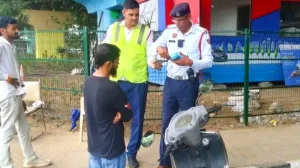
Traffic police frequently face a familiar problem.
A rider sees a checkpoint.
The rider doesn’t stop.
The police signal them to pull over.
The rider accelerates.
Chasing a fleeing two-wheeler can create another danger—not only for the police officer but also for pedestrians and other motorists.
The new device is reportedly being tested as an alternative way of bringing such vehicles to a halt.
Rather than chasing the rider, police can deploy the device so that the motorcycle’s tyre comes into contact with the spikes.
The idea is to make escape mechanically difficult rather than physically dangerous through a high-speed chase.
Why Vrindavan?
Vrindavan is one of Uttar Pradesh’s busiest religious destinations, attracting large numbers of pilgrims and tourists.
That means traffic management can become particularly challenging during festivals, weekends and peak pilgrimage periods.
Two-wheelers weaving through crowded streets, wrong-side driving, signal violations and riders attempting to avoid police checks can create significant risks.
A device capable of stopping a fleeing motorcycle could therefore have an obvious attraction for traffic enforcement.
But there’s a catch.
A Puncture at 50 kmph Is Not the Same as a Puncture Outside a Parking Lot
This is where safety becomes critical.
A motorcycle tyre suddenly losing pressure at speed can destabilise the vehicle.
The rider could fall.
A passenger could be thrown off.
Other motorists could crash while trying to avoid the falling motorcycle.
Pedestrians could also be endangered.
So the critical question isn’t simply:
“Does the device work?”
It’s:
“Under exactly what circumstances can police safely use it?”
Technology Can Stop a Vehicle. It Can’t Judge the Situation.
A mechanical device doesn’t know whether the person approaching it is:
a reckless traffic violator;
a confused tourist;
a rider who didn’t see the police signal;
carrying a child;
transporting an injured person;
or simply trying to avoid an unexpected obstacle.
That judgment has to come from the police officer.
And that’s why clear operating protocols will be essential if the device moves beyond testing.
What Rules Should Accompany the Device?
Before widespread deployment, authorities should ideally establish clear guidelines covering:
When can the spikes be deployed?
At what speed should a vehicle be approaching?
How far should officers stand from the vehicle?
Can the device be used in crowded pedestrian areas?
What happens if a passenger is riding pillion?
Can it be used for ordinary traffic violations, or only dangerous attempts to flee?
Who is authorised to deploy it?
What happens if the device causes an accident?
These questions matter because traffic enforcement should reduce accidents—not create new ones.
The Biggest Advantage: No High-Speed Chase
There is nevertheless a potentially important benefit.
If properly deployed, a tyre-stopping system could reduce the need for police officers to chase motorcycles through crowded streets.
High-speed police pursuits can themselves become dangerous.
A controlled method of stopping a vehicle may therefore be safer if it is used selectively, with proper training and adequate safeguards.
The technology isn’t inherently good or bad.
Its safety will depend largely on how, when and against whom it is used.
From E-Challans to Spike Strips
Traffic enforcement has steadily moved from manual policing towards technology.
Cameras record violations.
Automatic number-plate recognition identifies vehicles.
E-challans issue penalties.
And now, in Vrindavan, police are reportedly testing a device that can physically prevent a fleeing two-wheeler from continuing.
It’s a sign of how traffic policing is changing.
But every new enforcement tool brings a new responsibility:
The more powerful the tool, the clearer the rules governing its use must be.
A traffic violator may think he can outrun a police officer.
The new message from Vrindavan appears to be: you may outrun the officer, but you won’t outrun the spikes. That may sound effective.
But a traffic rule violation should end with a challan, not a potentially life-changing crash.
If UP Police’s new device is to become a regular enforcement tool, the objective must remain crystal clear:
Stop the vehicle—not punish the rider.
Because the best traffic technology isn’t the one that punctures the fastest. It’s the one that makes the roads safer without turning enforcement itself into another road hazard.