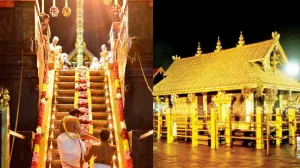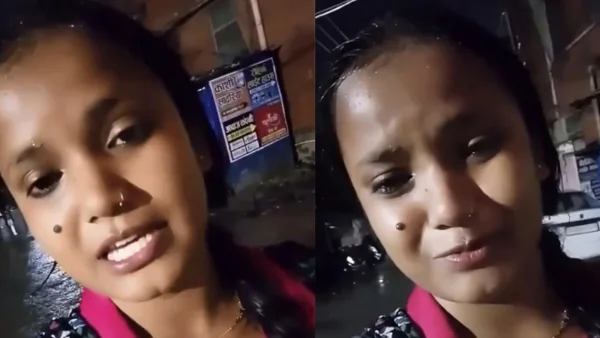
She travelled from Ghazipur to Varanasi with one simple purpose—to have darshan at the Kashi Vishwanath Temple.
She waited in the queue for hours.
By the time she reached the temple’s entry point, it was reportedly around 3 a.m.
Then, according to her account captured in a viral video, she was stopped by police personnel and asked to produce identification.
She showed her Aadhaar card.
But there was a problem.
“Ghazipur ka ID nahi chalega. Varanasi ka ID lao.”
The young woman reportedly broke down.
Her response was painfully simple:
“Main Ghazipur ki hoon. Varanasi ka ID kahan se laaun?”
Aadhaar Proves Who She Is—But Apparently Not Where She Can Pray?
The episode has triggered outrage online because of the alleged distinction being made between a devotee from a neighbouring district and those receiving what the woman described as VIP darshan.
Her frustration became even more intense when she saw other people being allowed to enter through the nearby route.
She reportedly asked, in tears:
“Kya main criminal hoon? Andar jaake Mahadev ko maar dungi?”
The sentence may have been made in anger and desperation, but it captures the larger question behind the incident.
If security is the reason for checking identity, shouldn’t the same transparent rule apply to everyone?
And if a particular ID requirement genuinely exists, where was that requirement communicated to ordinary devotees before they spent hours standing in line? The Bigger Issue Isn’t One Girl This is not simply about whether one devotee was allowed into a temple.
It is about the experience of ordinary citizens at one of India’s most revered religious sites.
A person travels from another district.
They spend hours waiting.
They reach the final checkpoint.
And only then discover that their identification may not satisfy an entry condition.
That raises an obvious administrative question:
Why wasn’t the rule clearly communicated at the beginning of the queue?
If a devotee is going to be denied entry because of residency or identification requirements, that information should ideally be available before they spend hours waiting. What About VIP Darshan? This is where the controversy becomes particularly sensitive.
The woman allegedly saw people being allowed inside through a VIP route while she remained outside despite waiting in the general queue.
There may be legitimate arrangements for different categories of visitors, including authorised VIP or special-access protocols.
But the optics are difficult to ignore.
One person waits until 3 a.m.
Another walks through a separate entrance.
And the first person is told that her ID is from the “wrong” district.
For an ordinary devotee, that can understandably feel less like darshan management and more like a hierarchy of access. Fact Check: Does a Varanasi ID Actually Determine Temple Entry? This is the part that needs official clarification.
A viral video alone cannot establish that the Kashi Vishwanath Temple has a blanket rule saying people from Ghazipur cannot enter with a valid government ID.
The temple authorities and district administration should therefore clarify:
Is there currently a district-specific ID requirement for entry?
If yes, under what order?
Does it apply to all devotees or only during particular periods?
Was the rule displayed at entry points and queue areas?
Why was the devotee allegedly stopped after reaching the final stage?
What categories of devotees are eligible for VIP or special darshan?
Are there separate verification rules for those categories?
Until authorities provide those answers, the viral claim should be treated as an allegation about what happened to this particular devotee, rather than proof of a general temple policy. Security Is Necessary. Humiliation Isn’t. Temples attracting huge crowds understandably need security arrangements.
Identity checks can be legitimate.
Crowd-control restrictions can also be necessary during peak periods.
But there is a difference between security protocol and arbitrary treatment.
A devotee who has travelled hours to visit a temple should not have to discover the rules at the final barrier.
And if an entry restriction exists, it should be:
Clear.
Public.
Consistent.
Applied equally. The VIP Question Cannot Be Ignored The incident also revives a broader debate about VIP culture at India’s major religious sites.
Should religious access increasingly depend on who you are, whom you know or which category you fall into?
Or should ordinary devotees at least be guaranteed a transparent and dignified system?
The issue isn’t necessarily whether VIP arrangements should exist at all.
The issue is whether ordinary devotees are made to feel like second-class citizens in places they have travelled to visit with faith and expectation. A Simple Solution The temple administration could end much of the confusion by publicly displaying its entry rules.
A large notice at the beginning of every queue could clearly state:
Who can enter?
What ID is accepted?
Are there district restrictions?
When do restrictions apply?
Who qualifies for special darshan?
What should an out-of-district devotee do?
That would prevent a person from standing in a queue for hours only to discover an unexpected rule at the final checkpoint. Strong Closing Angle
She didn’t ask for a red carpet. She didn’t ask for VIP treatment. She asked for darshan after standing in line until 3 a.m.
If the Ghazipur ID allegation is accurate, the administration owes her—and thousands of other devotees—a straightforward explanation.
If there is a rule, publish it.
If the rule was wrongly applied, correct it.
If VIP access exists, explain its criteria.
Because faith may be deeply personal, but public administration cannot be based on who gets through the gate faster.
Mahadev doesn’t need a Varanasi address to be worshipped.
And a devotee shouldn’t need VIP status to be treated with dignity.