Things are getting difficult for India as it sells products to the United States. The United States Trade Representative has begun a large Section 301 investigation, as Washington, D.C. is looking more carefully at what other countries do in industry and thinking about new ways to deal with trade problems. The investigation is happening at the same time as increasing problems with India buying oil from Russia, and this makes the connection between trade and energy even more important in the relationship between the two countries.
The new Section 301 probe and its scope
The USTR is investigating what it claims are unfair practices in 16 major economies, and India is one of them. This comes after the U.S. Supreme Court cancelled a previous set of tariffs and a new announcement from the President that puts a 10% tax on all countries for 150 days.
Section 301 gives the U.S. the power to find out if something another country does, a policy it uses, or a normal way it operates is unfair or treats the U.S. badly, and if it makes it harder for the U.S. to do business. If the USTR finds something wrong, the U.S. government can put on more tariffs, limit amounts, or create other problems.
This particular investigation is very broad. It includes steel, aluminum, cars, batteries, electronics, chemicals, machines, semiconductors, and solar panels. These are all central to modern manufacturing and how things are made and delivered around the world, so anything that happens with them could have a big effect on trading partners.
Just recently, New Delhi and Washington announced a new plan to increase trade between them, but U.S. officials have said that current discussions won’t stop the U.S. from taking action if the investigation does show harmful practices. This means there is a very real chance of trade problems in the near future.
Risks for India’s $100 billion export pipeline
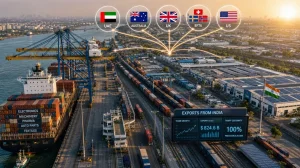
India sells over 100 billion dollars of goods to the U.S. each year, including electronics, manufactured items, metals, and materials for solar energy. These sales have increased a lot in the last few years, and this makes India more likely to be affected by any new trade restrictions from the U.S.
Tariffs or quotas from Section remedies would make products more expensive to get to the U.S., reduce how much profit companies make, and could cause orders to be sent elsewhere. Even if no action is taken immediately, the possibility of penalties can disrupt how businesses make contracts and plan what stock to have for the next six to nine months.
Exporters who sell most of their products to the U.S. are in the biggest trouble. This includes companies that only make a few types of products that are on the list, or those who rely on a small number of large customers in the U.S. Companies can protect themselves with financial strategies and by getting orders from lots of different places, but not all manufacturers have these options.
What the USTR will test: overcapacity and industrial policy
The investigation is focused on whether government help to industry, increases in what is being produced with government support, problems getting into the market, how a country manages its money, or low demand inside a country have led to too much being made in the world, and this harms U.S. businesses. The investigation will be based on proof and specific practices.
Experts say several parts of India’s economy could be looked at closely. The U.S. has mentioned solar panels, and the amount of solar panel manufacturing in India is nearly three times what people in India actually need. This raises the chance of having too many to export.
Similar concerns exist for petrochemicals and steel, where production is increasing faster than it is being used within the country. Trade researchers have also mentioned textiles, health products, building materials, and cars.
Indian businesses that export say their growth is mostly because of demand and that they sell to many places. However, investigators will closely examine how much can be made, and papers showing prices, how much things cost to make, and who ultimately buys the products will be important.
Energy geopolitics: Russian oil complicates the trade picture
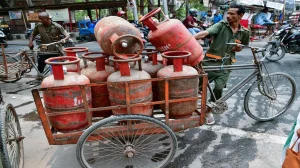
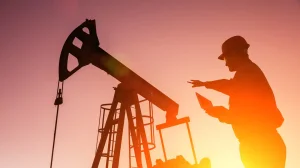
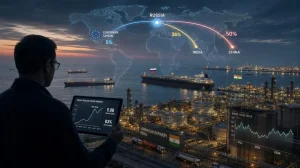
Since the war in Ukraine, how India gets its energy has changed. India now buys a significant amount of cheaper Russian oil, and at times this is around 30 to 40 percent of all the oil India imports. This plan has helped to control costs and make sure people in the country continue to have gas. The United States is continuing to put pressure on Russia’s oil and gas business, but Washington did recently allow a temporary 30-day exception to deal with Russian crude oil that was already on ships at sea. India’s oil processors were quick to get this oil, and the biggest privately-owned oil processor in India apparently bought around six million barrels in March.
Problems in the Middle East are making the situation even more important. Tension in the Strait of Hormuz, a vital route for a large amount of India’s oil, is a threat. Because of the increasing danger to ships, oil processors are using different sea routes and Russian oil to get their supplies from a variety of places.
The U.S. has a tricky job. It wants to make sure trade rules are followed and keep the pressure on Russia, but it also wants to avoid big jumps in prices and interruptions to the oil supply. Because of this double goal, India’s decisions about energy are unavoidable in the wider world of economic discussion between countries.
Process, timeline, and potential outcomes
The Section 301 process has specific steps. The official place to submit written statements opened on March 17th. Companies, groups of companies, and governments can send in their comments and ask to present their views at a public meeting. These statements and requests to speak at the meetings must be sent in by April 15th.
Public meetings are planned for May 5th through 8th at the U.S. International Trade Commission in Washington. Responses to what is said at the meetings are due within seven days of the meetings ending. After talking with the governments of other countries, the USTR (United States Trade Representative) will decide if it should suggest punishments for another country.
These punishments could be anything from new taxes on certain products, to limits on the amount of those products allowed in, to more general restrictions. The USTR could also vary the punishments by industry, focusing on areas where it has the strongest proof of damage to American businesses.
Because Section riters are limited in what they can do compared to simply imposing taxes on everything, a very detailed and data-filled set of records will determine the result. Companies involved in the official process can help decide exactly what the facts are and argue for certain things to be left out of the punishments, or for the punishments to be less severe.
How Indian businesses can prepare
Companies that export goods should figure out how much of what they sell to the U.S. falls into the types of products being investigated. They should find their most popular items, where most of their customers are, and which contracts will be up for renewal in the next six to twelve months, as these might have new prices or be sent to different countries.
Put together a file of information. Keep proof of your costs and prices, how much of your production you are using, and proof of how much the product is wanted in your country. Document sales to people who aren’t connected to you and track where things come from in your supply chain, to answer questions about government financial support or advantages because of the government.
Get involved early. Work with your industry organizations to send in information about how the market is working, how quickly production is increasing, and how much demand there is. Think about giving testimony at the meetings. A clear, specific look at the industry can help the USTR understand what is or is not hurting American businesses.
Plan for problems with getting goods around. Look at other markets, making things closer to home, and different shipping routes. Protecting yourself against changes in shipping costs and using a variety of ports for sending and receiving goods can lessen the impact if changes at the border make things take longer or cost more to follow the rules.
Implications for the strategic partnership
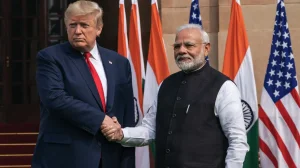
How the U.S. enforces trade rules will be a test for both the U.S. and India, even as their leaders try to achieve a broader economic plan. Washington and New Delhi recently outlined a plan to expand their relationship and resolve disagreements, but the U.S. has said that these negotiations will not stop the Section 301 actions.
For India, getting energy that is both affordable and dependable is still the main goal. Russian oil has helped with this during a difficult time for the world. For the U.S., correctly enforcing Section 301 and having stable oil prices are both very important to its strategy.
The next few months will be key. As the investigation gathers information and how energy is being moved changes to reflect world political dangers, the two countries will need to deal with disagreements without stopping their cooperation. A lot is at risk: over $100 billion in trade, and a vital relationship in a world economy that is easily disrupted.