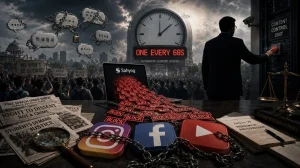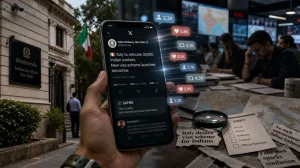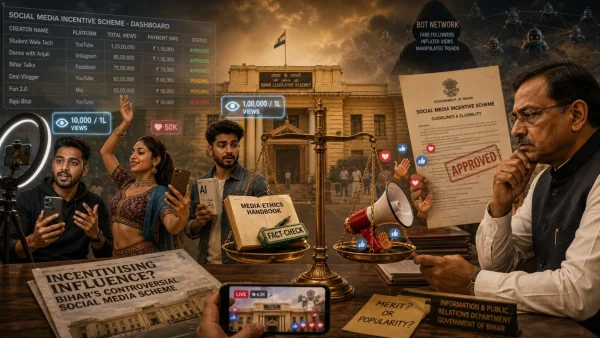
A new Bihar government initiative offering financial incentives to social-media content creators has triggered a political and public debate over the use of taxpayer money for digital publicity.
According to reports, creators can receive ₹10,000 for every 1 lakh views, with payments potentially reaching ₹1 lakh for 10 lakh views, subject to the applicable rules and eligibility conditions. The stated purpose is to use social-media platforms to communicate government schemes, programmes and achievements to a wider audience.
But the controversy begins with a basic question:
When does government communication become government promotion?
What Does the Official Policy Say?
Bihar already has a formal Social Media and Online Media Policy, 2024.
The state’s official portal says the policy aims to use the growing influence of social media and online platforms to inform citizens about government policies, welfare programmes and achievements.
The policy also provides for empanelment of social-media accounts with substantial audiences. An individual or organisation with at least 1 lakh followers on platforms such as Facebook, Instagram, X or YouTube can apply, subject to the prescribed conditions.
So this isn’t simply an informal decision to hand money to random influencers.
There is an established government framework for digital outreach.
Why Is the ₹10,000-for-1-Lakh-Views Formula Controversial?
The concern isn’t necessarily that governments should not communicate online.
Governments around the world use social media to explain schemes and reach citizens.
The controversy lies in how that communication is paid for and what kind of content is being incentivised.
If creators are rewarded primarily for producing positive content about government programmes, critics can reasonably ask:
Is the government buying publicity—or providing public information? That distinction matters.
A factual video explaining how to apply for a government scholarship is clearly public information.
A video portraying the government as exceptionally successful while ignoring relevant shortcomings is closer to political promotion.
The “Gunaagaan” Claim Needs a Fact Check
The viral framing that creators are simply being paid to “sing praises of the Bihar government” is stronger than what the official policy itself establishes.
The government’s stated objective is to disseminate information about its policies, programmes and achievements.
The reported incentive scheme also refers to factors such as content quality, relevance and positive social impact, rather than explicitly saying that creators must praise a political party or individual leader.
Therefore, describing the scheme as literally requiring “BJP/NDA praise” would need additional evidence.
The real controversy is subtler—and arguably more important. Even government-funded promotional content can influence public opinion without explicitly mentioning a political party.
Could This Become Government-Funded Propaganda?
This is the central criticism.
Suppose two creators make videos about the same government scheme.
Creator A says:
“This scheme provides X benefit and here is how citizens can apply.”
Creator B says:
“This is an extraordinary achievement of the government and proves that the government has transformed Bihar.”
If both receive the same financial incentive based on views, the system could potentially reward persuasion rather than information.
That is where editorial independence becomes an issue.
The Biggest Problem: Who Decides What Is “Positive”?
The official policy places emphasis on content that is relevant and has a positive impact.
That raises an uncomfortable question:
Can a genuinely critical but factually accurate video qualify? For example, what if a creator says:
“The government launched this scheme, but implementation has been poor in my district.”
Would that be considered useful public communication?
Or would it be considered negative content?
The answer needs to be transparent.
Otherwise creators could naturally begin self-censoring.
The Incentive Problem
Paying according to views creates another potential weakness.
Views are not the same as public value. A sensational video can attract millions of views.
A detailed explanation of a complicated welfare programme may attract only a fraction of that audience.
If money is strongly tied to reach, creators have an incentive to produce content that maximises engagement.
That can encourage:
sensational headlines
exaggerated claims
oversimplification
emotional content
political cheerleading
clickbait
The government therefore needs safeguards ensuring that virality does not become the primary measure of public-information quality.
What About Fake Views?
This is another major issue.
Social-media views can be manipulated through:
bots
paid traffic
engagement farms
artificial amplification
coordinated sharing
If public money is linked directly to view counts, the government needs robust verification mechanisms.
The obvious questions are:
Are views independently audited?
Are bot-generated views excluded?
Are duplicate views counted?
Which period determines the payment?
Is engagement quality considered?
Can creators appeal rejected claims?
Without transparent answers, a view-based payment system could become vulnerable to manipulation.
There Is Already a Larger Government Digital-Outreach Ecosystem
Bihar’s Information and Public Relations Department explicitly describes one of its responsibilities as publicising government policies, programmes and achievements and facilitating advertising work.
The state has also run influencer-oriented campaigns through its Tourism Department.
For example, the Bihar Tourism Department’s current influencer programmes use metrics such as reach, likes and shares, while offering substantial prizes for selected content.
That demonstrates that influencer-based government communication is not an entirely new concept.
What is new—and politically sensitive—is the scale and structure of linking payments to social-media reach for government-related content. The
Opposition Will Naturally See a Political Angle
Critics can argue that public money should primarily fund:
schools, hospitals, roads, sanitation, jobs and basic services, rather than digital image-building.
But that argument also needs nuance.
Governments routinely spend money on public communication.
Citizens need to know about welfare schemes, health programmes, scholarships, disaster warnings and government services.
Communication itself isn’t wasteful. The question is whether the communication serves citizens or the government’s political image.
What Would Make the Scheme More Credible?
If the government wants to eliminate accusations of propaganda, several safeguards could be introduced.
1. Mandatory disclosure
Every paid creator should clearly state:
“This content has been produced with financial support from the Government of Bihar.”
2. No party-political campaigning
Government funds should not be used to promote a political party, candidate or electoral campaign.
3. Permit criticism
Creators should be allowed to discuss shortcomings and implementation problems without losing eligibility merely because the content is critical.
4. Independent auditing
View counts and payments should be subject to independent verification.
5. Public expenditure dashboard
The government could publish:
Creator’s name
Platform
Video
Views
Amount paid
Subject of content
That would make the system auditable.
6. Fact-checking
Creators receiving public money should be required to follow basic accuracy standards.
The Transparency Test
There is a simple way to settle much of the controversy.
Publish the complete list of payments. If the government is confident that this is a legitimate public-information programme, transparency should not be a problem.
Citizens should be able to see:
How much was spent?
Who received it?
For which videos?
How many views did they generate?
What exactly did the videos say?
Were critical videos eligible?
Those answers would allow the public to judge the programme on evidence rather than political claims.
The Bigger Question
Social media has transformed political communication.
A government no longer needs to rely entirely on newspapers and television to reach citizens.
A single Instagram Reel or YouTube Short can reach hundreds of thousands of people within hours.
That makes influencers powerful communication partners.
But it also creates a new responsibility.
When a private creator speaks, it is their opinion. When the government pays that creator, citizens deserve to know exactly what they are watching.
Conclusion: Information or Image Management?
The Bihar government’s social-media incentive programme may have a legitimate objective: bringing information about government schemes to people where they increasingly consume news and information.
But the scheme deserves scrutiny because public communication and political promotion can occupy a very thin line.
The claim that the government is simply paying creators to “praise” itself should not be treated as established fact without examining the actual rules and implementation.
At the same time, the government should not dismiss the criticism.
If public money is being used to influence the public conversation, transparency must be higher—not lower. The strongest safeguard is simple:
Tell citizens who is being paid, how much is being paid, what content is being funded and whether creators are free to criticise the government while participating.
Because ₹10,000 for a lakh views may sound like an influencer opportunity—but once the money comes from taxpayers, the question becomes much bigger than social media.
It becomes a question of who controls the public narrative—and who pays for it.